
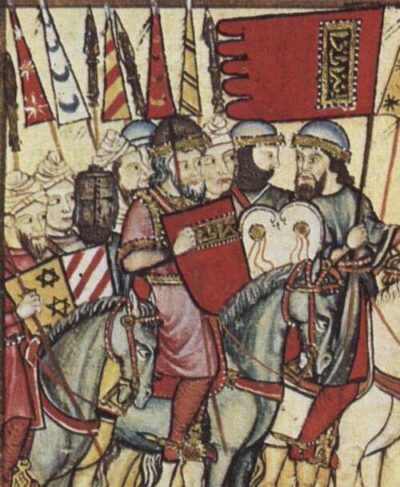
Muhammad I of Granada
Muhammad I of Granada was a First ruler of the Emirate of Granada from c. 1232 to 1273. Born 1199, in Arjona. Died January 22, 1273, in Granada. Positions held include emir of Granada (1238–1273) and Amir (1232–1238).
Facts
16 facts · 1 confirmed by two sources · 3 cited · 11 from one source · 1 where the sources disagree
What’s different
- Born: we show 1199 (Sources disagree). Wikidata also lists 1194
Where this comes from
Papalocal keeps its own record. It started from these sources; what each one said is kept here as it was copied, so a change on their side never changes this page by itself. Tap one to read its version.
What Wikidata says · copied November 16, 2026 · revision 2567608216
- Described as
- First ruler of the Emirate of Granada from c. 1232 to 1273
- Other names
- Ibn al-Ahmar, Al-Galib bi-llah, Abu Abdullah Muhammad ibn Yusuf ibn Nasr
- Born
- 1194; 1199 · 1 reference
- Died
- January 22, 1273
- Born in
- Arjona
- Died in
- Granada · 1 reference
- Cause of death
- horse fall
- Name at birth
- Muhammad ibn Yusuf ibn Nasr
- Citizen of
- Emirate of Granada (1238–); Taifa of Arjona (1195–1244)
- Occupation
- ruler; Amir · 1 reference; politician · 1 reference
- Positions held
- emir of Granada (1238–1273); Amir (1232–1238)
- Children
- Muhammad II of Granada
- Father
- Yusuf
- Religion
- Islam
- Wikipedias with a page
- 30
Wikidata item Q510879 (wikidata.org/wiki/Q510879), public domain (CC0). Copied November 16, 2026.
What Wikipedia says · copied November 16, 2026 · revision 1379276940
Abu Abdullah Muhammad ibn Yusuf ibn Nasr (Arabic: أبو عبد الله محمد بن يوسف بن نصر, romanized: Muḥammad ibn Yūsuf ibn Naṣr; c. 1195 – 22 January 1273), also known as Ibn al-Ahmar (ابن الأحمر, lit. 'Son of the Red') and by his honorific al-Ghalib billah (الغالب بالله, lit. 'The Victor by the Grace of God'), was the first ruler of the Emirate of Granada, the last independent Muslim state on the Iberian Peninsula, and the founder of its ruling Nasrid dynasty. He lived during a time when Iberia's Christian kingdoms—especially Portugal, Castile and Aragon—were expanding at the expense of the Islamic territory in Iberia, called Al-Andalus. Muhammad ibn Yusuf took power in his native Arjona in 1232 when he rebelled against the de facto leader of Al-Andalus, Ibn Hud. During this rebellion, he was able to take control of Córdoba and Seville briefly, before he lost both cities to Ibn Hud. Forced to acknowledge Ibn Hud's suzerainty, Muhammad was able to retain Arjona and Jaén. In 1236, he betrayed Ibn Hud by helping Ferdinand III of Castile take Córdoba. In the years that followed, Muhammad was able to gain control over southern cities, including Granada (1237), Almería (1238), and Málaga (1239). In 1244, he lost Arjona to Castile. Two years later, in 1246, he agreed to surrender Jaén and accept Ferdinand's overlordship in exchange for a 20-year truce.
In the 18 years that followed, Muhammad consolidated his domain by maintaining relatively peaceful relations with the Crown of Castile; in 1248; he even helped the Christian kingdom take Seville from the Muslims. But in 1264, he turned against Castile and assisted in the unsuccessful rebellion of Castile's newly conquered Muslim subjects. In 1266 his allies in Málaga, the Banu Ashqilula, rebelled against the emirate. When these former allies sought assistance from Alfonso X of Castile, Muhammad was able to convince the leader of the Castilian troops, Nuño González de Lara, to turn against Alfonso. By 1272 Nuño González was actively fighting Castile. The emirate's conflict with Castile and the Banu Ashqilula was still unresolved in 1273 when Muhammad died after falling off his horse. He was succeeded by his son, Muhammad II.
The Emirate of Granada, which Muhammad founded, and the Nasrid royal house, lasted for two more centuries until it was annexed by Castile in 1492. His other legacy was the construction of the Alhambra, his residence in Granada. His successors would continue to build the palace and fortress complex and reside there, and it has lasted to the present day as the architectural legacy of the emirate.
- Born, in its opening lines
- c. 1195
- Died, in its opening lines
- January 22, 1273
From the Wikipedia article “Muhammad I of Granada” (en.wikipedia.org/wiki/Muhammad_I_of_Granada), by its contributors, under CC BY-SA 4.0 (creativecommons.org/licenses/by-sa/4.0/). Copied November 16, 2026; not changed.
Confirmed Two sources agree. Cited One source, and it names where it got it. One source One source, without a reference of its own. Sources disagree The sources disagree. We show the best-supported value and keep theirs below.
