
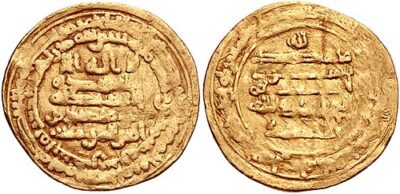
Muhammad ibn Tughj al-Ikhshid
Muhammad ibn Tughj al-Ikhshid was an Autonomous ruler of Egypt and Syria. Born February 8, 882, in Baghdad. Died June 24, 946, in Damascus. Positions held include Governor of Egypt for the Abbasid Caliphate (933) and Amir (935–946).
Facts
11 facts · 1 confirmed by two sources · 0 cited · 9 from one source · 1 where the sources disagree
What’s different
- Died: we show June 24, 946 (Sources disagree). Wikipedia says July 24, 946
Where this comes from
Papalocal keeps its own record. It started from these sources; what each one said is kept here as it was copied, so a change on their side never changes this page by itself. Tap one to read its version.
What Wikidata says · copied November 16, 2026 · revision 2553833173
- Described as
- Autonomous ruler of Egypt and Syria (882-946)
- Other names
- Battle of Alexandria
- Born
- February 8, 882
- Died
- June 24, 946
- Born in
- Baghdad
- Died in
- Damascus
- Buried in
- Bab al-Asbat Cemetery
- Occupation
- politician
- Positions held
- Governor of Egypt for the Abbasid Caliphate (933); Amir (935–946)
- Children
- Abu'l-Hasan Ali ibn al-Ikhshid; Abu'l-Qasim Unujur ibn al-Ikhshid
- Father
- Tughj ibn Juff
- Wikipedias with a page
- 28
Wikidata item Q963733 (wikidata.org/wiki/Q963733), public domain (CC0). Copied November 16, 2026.
What Wikipedia says · copied November 16, 2026 · revision 1379062856
Abū Bakr Muḥammad ibn Ṭughj ibn Juff ibn Yiltakīn ibn Fūrān ibn Fūrī ibn Khāqān (8 February 882 – 24 July 946), better known by the title al-Ikhshīd (Arabic: الإخشيد) after 939, was a Abbasid commander and governor who became the autonomous ruler of Egypt and parts of Syria (Levant) from 935 until his death in 946. He was the founder of the Ikhshidid dynasty, which ruled the region until the Fatimid conquest of 969.
The son of Tughj ibn Juff, a general of Turkic origin who served both the Abbasids and the autonomous Tulunid rulers of Egypt and Syria, Muhammad ibn Tughj was born in Baghdad but grew up in Syria and acquired his first military and administrative experiences at his father's side. He had a turbulent early career: he was imprisoned along with his father by the Abbasids in 905, was released in 906, participated in the murder of the vizier al-Abbas ibn al-Hasan al-Jarjara'i in 908, and fled Iraq to enter the service of the governor of Egypt, Takin al-Khazari. Eventually he acquired the patronage of several influential Abbasid magnates, chiefly the powerful commander-in-chief Mu'nis al-Muzaffar. These ties led him to being named governor first of Palestine and then of Damascus. In 933, he was briefly named governor of Egypt, but this order was revoked after the death of Mu'nis, and Ibn Tughj had to fight to preserve even his governorship of Damascus. In 935, he was re-appointed to Egypt, where he quickly defeated a Fatimid invasion and stabilized the turbulent country. His reign marks a rare period of domestic peace, stability and good government in the annals of early Islamic Egypt. In 938 Caliph al-Radi granted his request for the title of al-Ikhshid, which had been borne by the rulers of his ancestral Farghana Valley. It is by this title that he was known thereafter.
Throughout his governorship, al-Ikhshid was engaged in conflicts with other regional strongmen for control over Syria, without which Egypt was vulnerable to invasion from the east, but unlike many other Egyptian leaders, notably the Tulunids themselves, he was prepared to bide his time and compromise with his rivals. Although he was initially in control of the entirety of Syria, he was forced to cede the northern half to Ibn Ra'iq between 939 and 942. Following Ibn Ra'iq's murder, al-Ikhshid reimposed his control over northern Syria, only to have it challenged by the Hamdanids. In 944 al-Ikhshid met Caliph al-Muttaqi at Raqqa; the caliph had fled there from the various strongmen vying to kidnap him and control the caliphal government in Baghdad. Although unsuccessful in persuading the caliph to come to Egypt, he received recognition of hereditary rule over Egypt, Syria and the Hejaz for thirty years. Following his departure, the ambitious Hamdanid prince Sayf al-Dawla seized Aleppo and northern Syria in the autumn of 944, and although defeated and driven out of Syria by Ibn Tughj himself in the next year, a treaty dividing the region along the lines of the agreement with Ibn Ra'iq was concluded in October. Ibn Tughj died nine months later, and was buried in Jerusalem. He left his son Unujur as ruler of his domains, under the tutelage of the powerful black eunuch Abu al-Misk Kafur.
- Born, in its opening lines
- February 8, 882
- Died, in its opening lines
- July 24, 946
From the Wikipedia article “Muhammad ibn Tughj al-Ikhshid” (en.wikipedia.org/wiki/Muhammad_ibn_Tughj_al-Ikhshid), by its contributors, under CC BY-SA 4.0 (creativecommons.org/licenses/by-sa/4.0/). Copied November 16, 2026; not changed.
Confirmed Two sources agree. Cited One source, and it names where it got it. One source One source, without a reference of its own. Sources disagree The sources disagree. We show the best-supported value and keep theirs below.
