
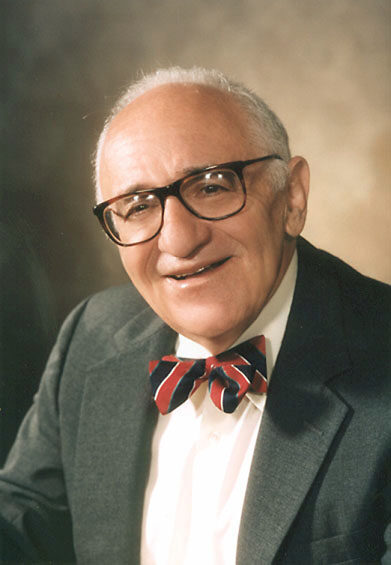
Murray Rothbard
Murray Rothbard was an American economist. Born March 2, 1926, in New York City. Died January 7, 1995, in New York City. Educated at Columbia University (2 times) and Birch Wathen Lenox School.
Facts
25 facts · 2 confirmed by two sources · 7 cited · 16 from one source
Where this comes from
Papalocal keeps its own record. It started from these sources; what each one said is kept here as it was copied, so a change on their side never changes this page by itself. Tap one to read its version.
What Wikidata says · copied November 13, 2026 · revision 2558057341
- Described as
- American economist (1926–1995)
- Other names
- Murray Newton Rothbard, Murray N. Rothbard
- Born
- March 2, 1926 · 2 references
- Died
- January 7, 1995 · 2 references
- Born in
- New York City
- Died in
- New York City · 3 references
- Buried in
- Oakwood Cemetery · 1 reference
- Cause of death
- myocardial infarction
- Name at birth
- Murray Newton Rothbard
- Citizen of
- United States
- Occupation
- economist · 1 reference; philosopher · 1 reference; activist; historian · 2 references; professor · 2 references; university teacher; essayist; writer · 3 references
- Political party
- Peace and Freedom Party (1968–1974); Libertarian Party (1974–1995)
- Worked for
- University of Nevada, Las Vegas (1986–1995); Stern School of Business (1954–1958) · 1 reference; New York University Tandon School of Engineering (1966–1986)
- Education
- Columbia University (2 times) (1942–1956); Birch Wathen Lenox School · 1 reference
- Field
- libertarianism; general economics
- Wikipedias with a page
- 60
Wikidata item Q297079 (wikidata.org/wiki/Q297079), public domain (CC0). Copied November 13, 2026.
What Wikipedia says · copied November 13, 2026 · revision 1384329991
Murray Newton Rothbard (US: ; March 2, 1926 – January 7, 1995) was an American economist of the Austrian School, economic historian, political theorist, and activist. Rothbard was a central figure in the 20th-century American libertarian movement, particularly its right-wing strands, and was a founder and leading theoretician of anarcho-capitalism. He wrote over twenty books on political theory, history, economics, and other subjects.
Rothbard argued that all services provided by the "monopoly system of the corporate state" could be provided more efficiently by the private sector and wrote that the state is "the organization of robbery systematized and writ large". He called fractional-reserve banking a form of fraud and opposed central banking. He categorically opposed all military, political, and economic interventionism in the affairs of other nations.
Rothbard rejected mainstream economic methodologies and instead embraced the praxeology of Ludwig von Mises. Along with his writing and libertarian activism, he taught economics part-time at the Brooklyn Polytechnic Institute starting in 1966, and after 1986 in an endowed position at the University of Nevada, Las Vegas. Partnering with the oil billionaire Charles Koch, Rothbard was a founder of the Cato Institute and the Center for Libertarian Studies in the 1970s. He broke with Cato and Koch, and in 1982 joined Lew Rockwell and Burton Blumert to establish the Mises Institute in Alabama.
While he was a right-libertarian, Rothbard was a critic of Milton Friedman, Ayn Rand, and Adam Smith. Rothbard opposed egalitarianism and the civil rights movement, and blamed women's voting and activism for the growth of the welfare state. He promoted historical revisionism and befriended the Holocaust denier Harry Elmer Barnes. Later in his career, Rothbard advocated a libertarian alliance with paleoconservatism (which he called paleolibertarianism), favoring right-wing populism and describing David Duke and Joseph McCarthy as models for political strategy. In the 2010s, he received renewed attention as an influence on the alt-right.
- Born, in its opening lines
- March 2, 1926
- Died, in its opening lines
- January 7, 1995
From the Wikipedia article “Murray Rothbard” (en.wikipedia.org/wiki/Murray_Rothbard), by its contributors, under CC BY-SA 4.0 (creativecommons.org/licenses/by-sa/4.0/). Copied November 13, 2026; not changed.
Confirmed Two sources agree. Cited One source, and it names where it got it. One source One source, without a reference of its own. Sources disagree The sources disagree. We show the best-supported value and keep theirs below.
