
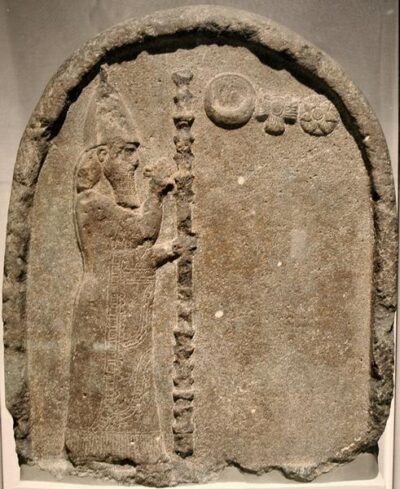
Nabonidus
Nabonidus was a king of Babylon. Born 615 BC, in Harran. Died 538 BC, in Carmania (Satrapy). Positions held include King of Babylon (-556–-539).
Facts
12 facts · 0 confirmed by two sources · 1 cited · 11 from one source
Where this comes from
Papalocal keeps its own record. It started from these sources; what each one said is kept here as it was copied, so a change on their side never changes this page by itself. Tap one to read its version.
What Wikidata says · copied November 16, 2026 · revision 2568756643
- Described as
- king of Babylon
- Born
- 615 BC
- Died
- 538 BC · 1 reference
- Born in
- Harran · 1 reference
- Died in
- Carmania (Satrapy) · 1 reference
- Citizen of
- Assyrian Empire; Babylon
- Occupation
- king
- Positions held
- King of Babylon (-556–-539)
- Children
- Belshazzar; Ennigaldi-Nanna
- Father
- Nabû-balātsu-iqbi
- Mother
- Adad-guppi
- Wikipedias with a page
- 50
Wikidata item Q239414 (wikidata.org/wiki/Q239414), public domain (CC0). Copied November 16, 2026.
What Wikipedia says · copied November 16, 2026 · revision 1380952247
Nabonidus (Neo-Babylonian Akkadian: 𒀭𒀝𒈾𒀪𒀉, romanized: Nabû-naʾid, meaning "May Nabu be exalted" or "Nabu is praised") was the last king of the Neo-Babylonian Empire, ruling from 556 BC to the fall of Babylon to the Achaemenid Empire under Cyrus the Great in 539 BC. Nabonidus was the last native ruler of ancient Mesopotamia, the end of his reign marking the end of thousands of years of Sumero-Akkadian states, kingdoms and empires. He was also the last independent king of Babylon. Regarded as one of the most vibrant and individualistic rulers of his time, Nabonidus is characterised by some scholars as an unorthodox religious reformer and as the first archaeologist.
The origins of Nabonidus, his connection to previous royalty, and subsequently what claim he had to the throne remain unclear, given that Nabonidus made no genealogical claims of kinship to previous kings. This suggests that he was neither related nor connected to the Chaldean dynasty of Babylonian rulers. However, he is known to have had a prominent career of some kind before he became king. It is possible that he was connected to the Chaldean kings via marriage, possibly having married a daughter of Nebuchadnezzar II (r. 605–562 BC). Nabonidus's mother, Adad-guppi, was of Assyrian ancestry. His father, Nabu-balatsu-iqbi, of whom little is known, may also have been either Assyrian or Babylonian. Some historians have speculated that either Adad-guppi or Nabu-balatsu-iqbi were members of the Sargonid dynasty, rulers of the Neo-Assyrian Empire until its fall in 609 BC.
Nabonidus was, to his own apparent surprise, proclaimed king after the deposition and murder of Labashi-Marduk (r. 556 BC) in a plot likely led by Nabonidus's son Belshazzar. Throughout his reign, inscriptions and later sources suggest that Nabonidus worked to increase the status of the moon god Sîn and decrease the status of Babylon's traditional national deity Marduk. While some have suggested that Nabonidus wished to go as far as to completely replace Marduk with Sîn as the head of the Mesopotamian pantheon, the extent to which Nabonidus's devotion to Sîn led to religious reforms is debated. Nabonidus was in self-imposed exile in Tayma, Arabia from 552 to 543/542 BC. The reason for this is unknown, though it might have been due to disagreements with the Babylonian clergy and oligarchy. Belshazzar acted as regent in Babylonia during this period, while Nabonidus continued to be recognised as the king.
When Nabonidus returned to Babylonia in 543/542 BC, he escalated his religious efforts and rebuilt the Eḫulḫul, the temple dedicated to Sîn in the major northern city of Harran. Nabonidus's reign came to an abrupt end with the quick victory over his empire by Cyrus the Great in 539 BC. After the decisive battle of Opis, the Persians entered Babylon without a fight. Several sources state that Nabonidus was captured but spared, and possibly allowed leave to the region of Carmania. He may have been alive in exile as late as the reign of Darius the Great (r. 522–486 BC).
From the Wikipedia article “Nabonidus” (en.wikipedia.org/wiki/Nabonidus), by its contributors, under CC BY-SA 4.0 (creativecommons.org/licenses/by-sa/4.0/). Copied November 16, 2026; not changed.
Confirmed Two sources agree. Cited One source, and it names where it got it. One source One source, without a reference of its own. Sources disagree The sources disagree. We show the best-supported value and keep theirs below.
