
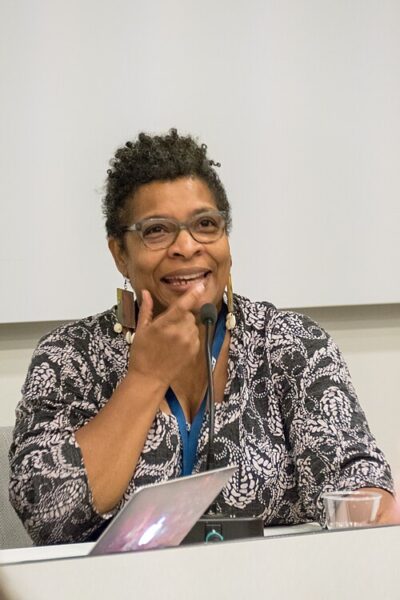
Nalo Hopkinson
Nalo Hopkinson is a Jamaican-born Canadian writer. Born December 20, 1960, in Kingston. Known for Brown Girl in the Ring, The Salt Roads and Skin Folk. Educated at Seton Hill University and Anglia Ruskin University. Awards include Locus Award for Best First Novel, Astounding Award for Best New Writer and World Fantasy Award for Best Collection.
Facts
26 facts · 1 confirmed by two sources · 8 cited · 17 from one source
Where this comes from
Papalocal keeps its own record. It started from these sources; what each one said is kept here as it was copied, so a change on their side never changes this page by itself. Tap one to read its version.
What Wikidata says · copied November 16, 2026 · revision 2565617401
- Described as
- Jamaican-born Canadian writer
- Born
- December 20, 1960 · 5 references
- Born in
- Kingston
- Citizen of
- Canada; Jamaica
- Occupation
- writer · 2 references; novelist; science fiction writer; editor; comics writer · 2 references
- Worked for
- University of British Columbia
- Education
- Seton Hill University; Anglia Ruskin University
- Genre
- science fiction literature; fantasy; fantasy literature
- Known for
- Brown Girl in the Ring; The Salt Roads; Skin Folk
- Awards
- Locus Award for Best First Novel (1999) · 1 reference; Astounding Award for Best New Writer (1999); World Fantasy Award for Best Collection (2002) · 1 reference; Inkpot Award (2018) · 1 reference; British Fantasy Award for Best Anthology (2017) · 1 reference; Damon Knight Memorial Grand Master Award (2021) · 1 reference; Theodore Sturgeon Award (2022) · 1 reference
- Website
- https://www.nalohopkinson.com/
- Wikipedias with a page
- 23
Wikidata item Q270204 (wikidata.org/wiki/Q270204), public domain (CC0). Copied November 16, 2026.
What Wikipedia says · copied November 16, 2026 · revision 1385033623
Nalo Hopkinson (born 20 December 1960) is a Jamaican-born Canadian speculative fiction writer and editor. Her novels – Brown Girl in the Ring (1998), Midnight Robber (2000), The Salt Roads (2003), The New Moon's Arms (2007) – and short stories such as those in her collection Skin Folk (2001) often draw on Caribbean history and language, and its traditions of oral and written storytelling.
Hopkinson has edited two fiction anthologies: Whispers from the Cotton Tree Root: Caribbean Fabulist Fiction and Mojo: Conjure Stories. She was the co-editor with Uppinder Mehan of the 2004 anthology So Long Been Dreaming: Postcolonial Visions of the Future, and with Geoff Ryman co-edited Tesseracts 9.
Hopkinson defended George Elliott Clarke's novel Whylah Falls on the CBC's Canada Reads 2002. She was the curator of Six Impossible Things, an audio series of Canadian fantastical fiction on CBC Radio One.
As of 2021, she lives and teaches in Vancouver, British Columbia. In 2020, Hopkinson was named the 37th Damon Knight Grand Master, in recognition of "lifetime achievement in science fiction and/or fantasy".
- Born, in its opening lines
- December 20, 1960
From the Wikipedia article “Nalo Hopkinson” (en.wikipedia.org/wiki/Nalo_Hopkinson), by its contributors, under CC BY-SA 4.0 (creativecommons.org/licenses/by-sa/4.0/). Copied November 16, 2026; not changed.
Confirmed Two sources agree. Cited One source, and it names where it got it. One source One source, without a reference of its own. Sources disagree The sources disagree. We show the best-supported value and keep theirs below.
