
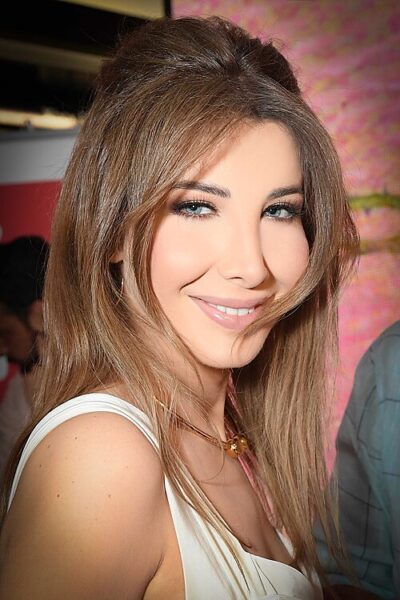
Nancy Ajram
Nancy Ajram is a Lebanese singer and actress. Born May 16, 1983, in Ashrafieh. Positions held include UNICEF Goodwill Ambassador (2009–). Educated at Collège Saint Joseph – Antoura. Awards include 2008 World Music Awards.
Facts
28 facts · 1 confirmed by two sources · 3 cited · 24 from one source
Where this comes from
Papalocal keeps its own record. It started from these sources; what each one said is kept here as it was copied, so a change on their side never changes this page by itself. Tap one to read its version.
What Wikidata says · copied November 16, 2026 · revision 2564672688
- Described as
- Lebanese singer and actress
- Other names
- Nancy Nabil Ajram, Nancy ajram
- Born
- May 16, 1983 · 1 reference
- Born in
- Ashrafieh
- Name at birth
- نانسي نبيل عجرم
- Citizen of
- Jordan
- Occupation
- actor; singer; philanthropist; model; musician · 1 reference
- Positions held
- UNICEF Goodwill Ambassador (2009–)
- Worked for
- UNICEF
- Education
- Collège Saint Joseph – Antoura
- Member of
- Syndicate of Professional Artists in Lebanon
- Genre
- pop music; folk-pop; Arabic pop; Arabic music; Khaliji
- Instrument
- voice
- Record label
- EMI; In2Musica
- Awards
- 2008 World Music Awards
- Spouse
- Fadi El Hachem (2008–)
- Siblings
- Nabil Ajram
- Religion
- Eastern Orthodoxy · 1 reference
- Lived in
- Keserwan District
- Height
- 1.57 m (5 ft 2 in) · 1 reference
- Website
- http://www.nancyajram.com/
- Wikipedias with a page
- 62
Wikidata item Q774155 (wikidata.org/wiki/Q774155), public domain (CC0). Copied November 16, 2026.
What Wikipedia says · copied November 16, 2026 · revision 1384900548
Nancy Nabil Ajram (Arabic: نانسي نبيل عجرم, Lebanese Arabic: [ˈnæːnsi ˈʕæʒræm]; born May 16, 1983) is a Lebanese singer and television personality, often dubbed as the "Queen of Arab Pop". With the support of her father, she began performing as a child and appeared on several television shows in her early years. By the age of 15, Ajram signed a recording contract with EMI and released her debut studio album Mihtagalak (1998). In spite of being under the legal age, Ajram was accepted to the Syndicate of Professional Artists in Lebanon. The following year, she released her second album Sheel Oyoonak Anni (2001).
Her breakthrough occurred with the start of her collaboration with well-known Lebanese producer Jiji Lamara, when she released her hit single "Akhasmak Ah"; created by Egyptian composer Mohamed Saad, and third studio album Ya Salam (2003) in which she adopted a more sensual public image while reinventing her music. Ajram's fourth album Ah W Noss (2004) was another commercial success, spawning the chart-topping singles "Ah W Noss", "Lawn Ouyounak", "Oul Tani Keda" and "Inta Eyh", at which point she had established pop icon status in the Middle East. In 2007, Ajram released her first children's album, Shakhbat Shakhabit, which was the most notable and successful work for children at the time. Betfakkar Fi Eih (2008), her sixth album, produced seven singles including the commercially successful Egyptian hits "Betfakkar Fi Eih", "Min Dally Nseek" and the Lebanese single "Mashi Haddi". It won Ajram her first World Music Award (WMA) for best-selling Middle-Eastern artist, and made her the youngest Arab WMA winner to date.
Having sold over 30 million records as of 2007, Ajram is one of the best-selling Middle Eastern music artists. By 2010 she was announced the best-selling Middle Eastern female singer of the decade (2000–2009). Throughout her career, Ajram has released twelve studio albums to date (including two dedicated for children) and numerous chart toppers such as "Yay", "Ya Tabtab", "Moegaba", "Ehsas Jdeed", "Ibn El Giran", "Fi Hagat", "Ya Kether", "Ma Tegi Hena", "Aam Betaala' Feek", "Badna Nwalee El Jaw", "Salamat", and "Aala Shanak". Ajram is the first and only female spokesperson of Coca-Cola in the Arab world, releasing several promotional Coke anthems that became instant smash-hits, such as "Oul Tani Keda", "El Dounya Helwa", "Noss El Kawn" and "Shaggaa Bi Alamak". Ajram has made the list of Most Powerful Arabs on Arabian Business several times, and was similarly listed by Newsweek as one of the most influential Arab singers.
She has appeared in patriotic songs for her country Lebanon, and has also dedicated seven patriotic songs to Egypt; a country she is widely popular in thanks to her Egyptian hits such as "Akhasmak Ah" and "Ah W Noss". Between 2013 and 2017, Ajram served as a judge on MBC's reality talent show Arab Idol. She also served as a coach on The Voice Kids Arabia for three seasons between 2016 and 2020. In 2020, Nancy was the most-streamed Arab female artist on Spotify, achieving more than 100 million plays of her songs, followed by Lebanese singer Fairuz with 67 million plays.
- Born, in its opening lines
- May 16, 1983
From the Wikipedia article “Nancy Ajram” (en.wikipedia.org/wiki/Nancy_Ajram), by its contributors, under CC BY-SA 4.0 (creativecommons.org/licenses/by-sa/4.0/). Copied November 16, 2026; not changed.
Confirmed Two sources agree. Cited One source, and it names where it got it. One source One source, without a reference of its own. Sources disagree The sources disagree. We show the best-supported value and keep theirs below.
