
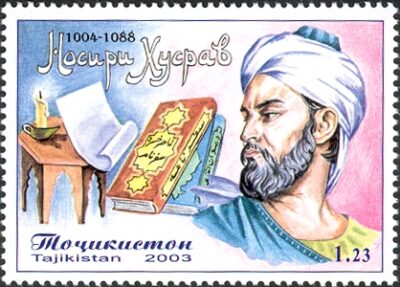
Nasir Khusraw
Nasir Khusraw was the 11th-century Persian Isma'ili poet, scholar, philosopher, and missionary. Born September 3, 1004, in Qabodiyon. Died 1088, in Yamgan. Known for Safarnama and Diwan.
Facts
29 facts · 1 confirmed by two sources · 9 cited · 18 from one source · 1 where the sources disagree
What’s different
- Born: we show September 3, 1004 (Sources disagree). Wikipedia says 1072
Where this comes from
Papalocal keeps its own record. It started from these sources; what each one said is kept here as it was copied, so a change on their side never changes this page by itself. Tap one to read its version.
What Wikidata says · copied November 16, 2026 · revision 2559102747
- Described as
- 11th-century Persian Isma'ili poet, scholar, philosopher, and missionary
- Other names
- Abu Muin Nasur ibn Khusraw ibn Harith Nasir-i Khusraw, Nasir-i Khusraw, Nasir Xosrov, Nasir Khusrau
- Born
- September 3, 1004
- Died
- 1088
- Born in
- Qabodiyon
- Died in
- Yamgan
- Buried in
- Balkh
- Name at birth
- نَاصِر بْنُ خُسْرُو بْنِ حَارِث القُبَادیَانِي البَلِْخي
- Citizen of
- Ghaznavid Empire; Seljuk Empire
- Occupation
- poet · 1 reference; writer; philosopher · 1 reference; mathematician; essayist; traveler; da'i; scholar
- Known for
- Safarnama; Diwan
- Field
- Persian literature · 1 reference; Persian poetry · 1 reference; travel book · 1 reference; Islam · 1 reference; Isma'ilism · 1 reference
- Religion
- Islam · 1 reference; Shia Islam · 1 reference
- Lived in
- Balkh; Mary; Cairo; Badakhshan
- Wikipedias with a page
- 51
Wikidata item Q328796 (wikidata.org/wiki/Q328796), public domain (CC0). Copied November 16, 2026.
What Wikipedia says · copied November 16, 2026 · revision 1381415027
Abu Mo'in Nasir ibn Khusraw ibn Harith Qubodiyani Balkhi, known as Nasir Khusraw (Persian: ناصرخسرو; 1004 – between 1072–1088), was an Persian-speaking Isma'ili poet, philosopher, traveler, and missionary (da'i and later Ḥujjah of Imam al-Mustansir Billah) for the Isma'ili Fatimid Caliphate. He was born in Qubodiyon, Khorasan and died in Yamgan, Badakhshan. His resting place is in Balkh, Afghanistan.
Despite being one of the most prominent Isma'ili philosophers and theologians of the Fatimids and the writer of many philosophical works intended for only the inner circle of the Isma'ili community, Nasir is best known to the general public as a poet and writer who ardently supported his native Persian tongue as an artistic and scientific language. All of Nasir's philosophical Isma'ili works are in Persian, a rarity in the Isma'ili literature of the Fatimids, which primarily used Arabic.
Nasir was a key figure in the spread of Isma'ilism in Central Asia. He is with great reverence called "Pir" or "Shah Sayyid Nasir" by the Isma'ili community of Badakhshan (split between Afghanistan and Tajikistan) and their branches in northern Pakistan, who all consider him to be their founder.
- Born, in its opening lines
- 1072
- Died, in its opening lines
- 1088
From the Wikipedia article “Nasir Khusraw” (en.wikipedia.org/wiki/Nasir_Khusraw), by its contributors, under CC BY-SA 4.0 (creativecommons.org/licenses/by-sa/4.0/). Copied November 16, 2026; not changed.
Confirmed Two sources agree. Cited One source, and it names where it got it. One source One source, without a reference of its own. Sources disagree The sources disagree. We show the best-supported value and keep theirs below.
