
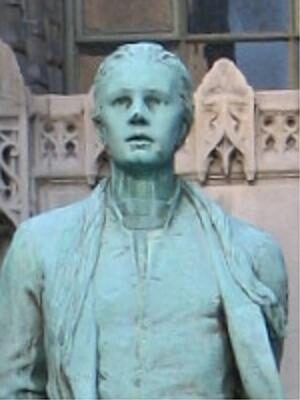
Nathan Hale
Nathan Hale was a soldier for the Continental Army during the American Revolutionary War. Born June 6, 1755, in Coventry. Died September 22, 1776, in New York City. Educated at Yale College.
Facts
14 facts · 2 confirmed by two sources · 4 cited · 8 from one source
Where this comes from
Papalocal keeps its own record. It started from these sources; what each one said is kept here as it was copied, so a change on their side never changes this page by itself. Tap one to read its version.
What Wikidata says · copied November 16, 2026 · revision 2568786768
- Described as
- soldier for the Continental Army during the American Revolutionary War
- Born
- June 6, 1755 · 5 references
- Died
- September 22, 1776 · 5 references
- Born in
- Coventry
- Died in
- New York City · 1 reference
- Buried in
- Nathan Hale Cemetery
- Cause of death
- hanging to death
- Citizen of
- Kingdom of Great Britain
- Occupation
- military officer · 1 reference; spy · 1 reference
- Education
- Yale College
- Father
- Richard Hale · 1 reference
- Mother
- Elizabeth Strong · 1 reference
- Siblings
- Enoch Hale
- Military branch
- Continental Army
- Wikipedias with a page
- 30
Wikidata item Q465574 (wikidata.org/wiki/Q465574), public domain (CC0). Copied November 16, 2026.
What Wikipedia says · copied November 16, 2026 · revision 1376223076
Nathan Hale (June 6, 1755 – September 22, 1776) was an American Patriot, soldier, and spy for the Continental Army during the American Revolutionary War. He volunteered for an intelligence-gathering mission in New York City but was captured by the British and executed. Hale is considered an American hero and in 1985 was officially designated the state hero of Connecticut.
- Born, in its opening lines
- June 6, 1755
- Died, in its opening lines
- September 22, 1776
From the Wikipedia article “Nathan Hale” (en.wikipedia.org/wiki/Nathan_Hale), by its contributors, under CC BY-SA 4.0 (creativecommons.org/licenses/by-sa/4.0/). Copied November 16, 2026; not changed.
Confirmed Two sources agree. Cited One source, and it names where it got it. One source One source, without a reference of its own. Sources disagree The sources disagree. We show the best-supported value and keep theirs below.
