
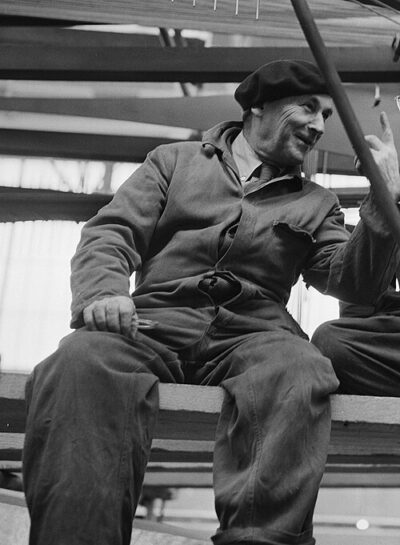
Naum Gabo
Naum Gabo was a Russian-American sculptor. Born August 5, 1890, in Bryansk. Died August 23, 1977, in Waterbury. Positions held include full professor. Known for Kinetic Construction. Educated at LMU Munich and Technical University of Munich. Awards include Guggenheim Fellowship and Knight Commander of the Order of the British Empire.
Facts
33 facts · 2 confirmed by two sources · 18 cited · 13 from one source
What’s different
- Died: we show August 23, 1977 (Confirmed). Wikidata also lists 1973
Where this comes from
Papalocal keeps its own record. It started from these sources; what each one said is kept here as it was copied, so a change on their side never changes this page by itself. Tap one to read its version.
What Wikidata says · copied November 15, 2026 · revision 2569365652
- Described as
- Russian-American sculptor (1890–1977)
- Other names
- Naum Neemia Pevsner, Naum Pevzner, Naum Borisovich Pevzner, Nathanael Neemia Pevsner, Naum Abramovic Pevzner, Neemija Berkovic Pevzner, Nehemiah Borisovich Pevzner, Nahum Gabo, Naum Abramowitsch Pevsner
- Born
- August 5, 1890 · 11 references
- Died
- August 23, 1977 · 10 references; 1973 · 1 reference
- Born in
- Bryansk · 1 reference
- Died in
- Waterbury · 1 reference
- Citizen of
- Russian Empire; Russian Soviet Federative Socialist Republic; United States · 1 reference
- Occupation
- sculptor · 4 references; architect · 2 references; painter · 3 references; university teacher; printmaker · 1 reference; photographer · 2 references; scenographer · 1 reference; teacher · 1 reference
- Positions held
- full professor · 1 reference
- Worked for
- Harvard University
- Education
- LMU Munich · 1 reference; Technical University of Munich · 1 reference
- Member of
- American Academy of Arts and Sciences; Abstraction-Création · 1 reference; American Academy of Arts and Letters
- Known for
- Kinetic Construction
- Awards
- Guggenheim Fellowship (1954) · 1 reference; Knight Commander of the Order of the British Empire
- Field
- art of sculpture · 1 reference; Constructivism · 1 reference; kinetic art · 1 reference; kinetic artist · 1 reference
- Spouse
- Miriam Gabo (1937–) · 1 reference
- Children
- Nina Williams
- Siblings
- Antoine Pevsner · 1 reference; Alexei Pevsner
- Wikipedias with a page
- 35
Wikidata item Q309482 (wikidata.org/wiki/Q309482), public domain (CC0). Copied November 15, 2026.
What Wikipedia says · copied November 15, 2026 · revision 1375161825
Naum Gabo (born Naum Neemia Pevsner; Russian: Наум Борисович Певзнер; Hebrew: נחום נחמיה פבזנר; 5 August [O.S. 24 July] 1890 – 23 August 1977) was a Russian and American constructivist sculptor and theorist. He was a key figure in the Russian avant-garde and the subsequent development of 20th-century sculpture.
His work combined geometric abstraction with a dynamic organization of form in small reliefs and constructions, monumental public sculpture and pioneering kinetic works that assimilated new materials such as nylon, wire, lucite and semi-transparent materials, glass and metal. Responding to the scientific and political revolutions of his age, Gabo led an eventful and peripatetic life, moving to Berlin, Paris, Oslo, Moscow, London, and finally the United States, and within the circles of the major avant-garde movements of the day, including Cubism, Futurism, Constructivism, the Bauhaus, de Stijl and the Abstraction-Création group. Two preoccupations, unique to Gabo, were his interest in representing negative space—"released from any closed volume" or mass—and time. He famously explored the former idea in his Linear Construction works (1942-1971)—used nylon filament to create voids or interior spaces as "concrete" as the elements of solid mass—and the latter in his pioneering work, Kinetic Sculpture (Standing Waves) (1920), often considered the first kinetic work of art.
Gabo elaborated many of his ideas in the Constructivist Realistic Manifesto, which he issued with his brother, sculptor Antoine Pevsner as a handbill accompanying their 1920 open-air exhibition in Moscow. In it, he sought to move past Cubism and Futurism, renouncing what he saw as the static, decorative use of color, line, volume and solid mass in favor of a new element he called "the kinetic rhythms (…) the basic forms of our perception of real time." Gabo held a utopian belief in the power of sculpture—specifically abstract, Constructivist sculpture—to express human experience and spirituality in tune with modernity, social progress, and advances in science and technology. After working on a smaller scale in England during the war years (1936-1946), Gabo moved to the United States, where he received several public sculpture commissions, only some of which he completed. These include Constructie, a 25-metre (82 ft) commemorative monument in front of the Bijenkorf Department Store (1954, unveiled in 1957) in Rotterdam, and Revolving Torsion, a large fountain outside St Thomas' Hospital in London. The Tate Gallery, in Millbank, London, held a major retrospective of Gabo's work in 1966 and holds many key works in its collection, as do the Museum of Modern Art and Guggenheim Museum in New York. Work by Gabo is also included at Rockefeller Center in New York City and The Governor Nelson A. Rockefeller Empire State Plaza Art Collection in Albany, New York, US.
- Born, in its opening lines
- August 5, 1890
- Died, in its opening lines
- August 23, 1977
From the Wikipedia article “Naum Gabo” (en.wikipedia.org/wiki/Naum_Gabo), by its contributors, under CC BY-SA 4.0 (creativecommons.org/licenses/by-sa/4.0/). Copied November 15, 2026; not changed.
Confirmed Two sources agree. Cited One source, and it names where it got it. One source One source, without a reference of its own. Sources disagree The sources disagree. We show the best-supported value and keep theirs below.
