
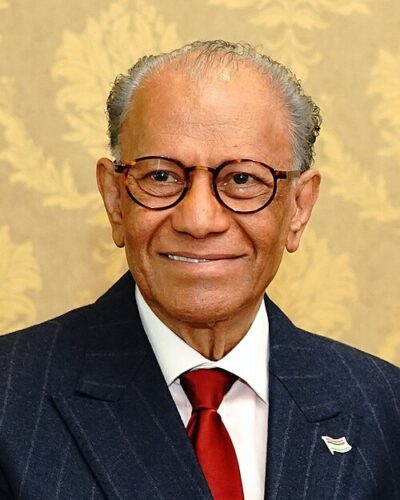
Navin Ramgoolam
Navin Ramgoolam is a Prime Minister of Mauritius (1995–2000, 2005–2014, 2024–Present). Born July 14, 1947, in Port Louis. Positions held include Prime Minister of Mauritius (2005–2014), defence minister and Member of the Privy Council of the United Kingdom. Educated at London School of Economics and Political Science and Royal College Curepipe. Awards include Grand Officer of the Legion of Honour, Grand Commander of the Order of the Star and Key of the Indian Ocean and Pravasi Bharatiya Samman.
Facts
18 facts · 1 confirmed by two sources · 0 cited · 17 from one source
Where this comes from
Papalocal keeps its own record. It started from these sources; what each one said is kept here as it was copied, so a change on their side never changes this page by itself. Tap one to read its version.
What Wikidata says · copied November 16, 2026 · revision 2566329241
- Described as
- Prime Minister of Mauritius (1995–2000, 2005–2014, 2024–Present)
- Other names
- Navinchandra Ramgoolam
- Born
- July 14, 1947 · 2 references
- Born in
- Port Louis
- Citizen of
- Mauritius
- Occupation
- politician
- Positions held
- Prime Minister of Mauritius (2005–2014); defence minister; Member of the Privy Council of the United Kingdom; Minister of Foreign Affairs of Mauritius (2 times) (1997–2008) · 1 reference
- Political party
- Labour Party
- Education
- London School of Economics and Political Science; Royal College Curepipe
- Member of
- Royal College of Physicians, London
- Awards
- Grand Officer of the Legion of Honour; Grand Commander of the Order of the Star and Key of the Indian Ocean; Pravasi Bharatiya Samman (2008); Fellow of the Royal College of Physicians of London
- Father
- Seewoosagur Ramgoolam
- Religion
- Hinduism
- Wikipedias with a page
- 35
Wikidata item Q57836 (wikidata.org/wiki/Q57836), public domain (CC0). Copied November 16, 2026.
What Wikipedia says · copied November 16, 2026 · revision 1385477850
Navinchandra Ramgoolam (born 14 July 1947) is a Mauritian politician, physician and barrister who has been Prime Minister of Mauritius since November 2024, an office he previously held from 1995 to 2000 and from 2005 to 2014. He has led the Labour Party since 1991 and has also been Minister of Finance since 2024. The son of Seewoosagur Ramgoolam, who led Mauritius to independence in 1968 and was its first prime minister, he trained as a doctor in Dublin and worked in hospitals in Ireland, England and Mauritius before reading law at the London School of Economics and being called to the bar in 1993.
Ramgoolam became Labour's leader and Leader of the Opposition in 1991. In alliance with Paul Bérenger's Mauritian Militant Movement (MMM), Labour won every seat on the island of Mauritius at the 1995 general election. His first government replaced the sales tax with value-added tax, legislated against domestic violence and for a national human rights commission, provided for private broadcasting and hosted the launch of the Indian Ocean Rim Association, while the economy grew by an average of more than five per cent a year. The coalition with the MMM ended in 1997, the riots that followed the death in police custody of the singer Kaya tested the government in 1999, and Labour was heavily defeated by an alliance of the Militant Socialist Movement (MSM) and the MMM in 2000.
Returning to power in 2005 at the head of the Alliance Sociale, Ramgoolam governed through the loss of preferential access for Mauritian textiles and sugar. His finance minister, Rama Sithanen, replaced a complex tax system with a flat rate of 15 per cent, abolished most investment-incentive schemes, opened the economy to foreign investors and skilled workers and restructured the sugar industry, reforms that the International Monetary Fund (IMF) commended. Real growth averaged about 4.3 per cent a year from 2006 to 2014, gross domestic product (GDP) per head nearly doubled in US dollar terms, and Mauritius was ranked first in Africa for governance and for the ease of doing business. The second premiership also brought free bus travel for students and pensioners, the Truth and Justice Commission on slavery and indenture, the inscription of Aapravasi Ghat and Le Morne on the World Heritage List and the arbitration in which Mauritius successfully challenged the British marine protected area around the Chagos Archipelago. Re-elected in 2010, he lost the 2014 election, and his own seat, after proposing a "Second Republic" with a directly elected president.
During ten years in opposition, provisional charges brought against him in 2015 were struck out, and in 2024 he led the Alliance du Changement to a 60–0 victory on the island of Mauritius. His third government published an audit of the public finances, held municipal elections for the first time in a decade, set up a constitutional review commission, began reforming the electoral system, overhauled the state pension and made Mauritius the first African country to adhere to the IMF's highest data-dissemination standard. The economy grew by 3.5 per cent in 2025, a year of record tourist arrivals and foreign investment, before slowing in 2026 as conflict in the Middle East raised energy prices. Ramgoolam signed the 2025 treaty by which the United Kingdom recognises Mauritian sovereignty over the Chagos Archipelago, raised relations with India to an "Enhanced Strategic Partnership" and received the first visit by a French president in three decades. In 2026 Bérenger resigned as deputy prime minister, and in October riots set off by a police shooting led the government to impose a curfew.
- Born, in its opening lines
- July 14, 1947
From the Wikipedia article “Navin Ramgoolam” (en.wikipedia.org/wiki/Navin_Ramgoolam), by its contributors, under CC BY-SA 4.0 (creativecommons.org/licenses/by-sa/4.0/). Copied November 16, 2026; not changed.
Confirmed Two sources agree. Cited One source, and it names where it got it. One source One source, without a reference of its own. Sources disagree The sources disagree. We show the best-supported value and keep theirs below.
