
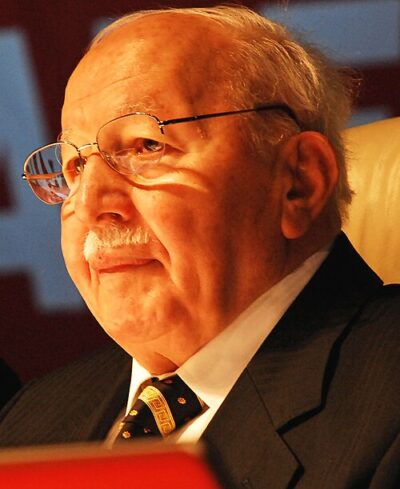
Necmettin Erbakan
Necmettin Erbakan was a Turkish politician and engineer who served as the 23rd Prime Minister of Turkey from 1996 to 1997. Born in 1926, he also had a career as a university teacher.
Erbakan's tenure as prime minister concluded when he was compelled to resign following pressure from the military. Later, Turkey's Constitutional Court prohibited him from engaging in politics, citing his alleged violation of the constitutional principle of secularism. He passed away in 2011.
Facts
28 facts · 2 confirmed by two sources · 4 cited · 22 from one source
Where this comes from
Papalocal keeps its own record. It started from these sources; what each one said is kept here as it was copied, so a change on their side never changes this page by itself. Tap one to read its version.
What Wikidata says · copied November 13, 2026 · revision 2568264976
- Described as
- 23rd Prime Minister of the Republic of Turkey (1926–2011)
- Born
- October 29, 1926 · 2 references
- Died
- February 27, 2011 · 4 references
- Born in
- Sinop · 1 reference
- Died in
- Ankara · 2 references
- Buried in
- Merkezefendi Cemetery
- Cause of death
- heart failure
- Citizen of
- Turkey
- Occupation
- politician · 2 references; engineer; university teacher
- Positions held
- member of the Grand National Assembly of Turkey; Prime Minister of Turkey (1996–1997); Leader of the Felicity Party (2010–2011) · 1 reference
- Political party
- Welfare Party (1987–1998); National Order Party (1970–1971); National Salvation Party (1973–1981); Virtue Party (1999–2003)
- Worked for
- Istanbul Technical University
- Education
- Istanbul Technical University; RWTH Aachen University; University of London; King Saud University · 1 reference; Istanbul High School · 1 reference; ITU Faculty of Mechanical Engineering
- Spouse
- Nermin Erbakan (1967–2005)
- Children
- Fatih Erbakan
- Siblings
- Akgün Erbakan
- Religion
- Sunni Islam
- Wikipedias with a page
- 63
Wikidata item Q243550 (wikidata.org/wiki/Q243550), public domain (CC0). Copied November 13, 2026.
What Wikipedia says · copied November 13, 2026 · revision 1377297110
Necmettin Erbakan (29 October 1926 – 27 February 2011) was a Turkish politician and political theorist who served as the 23rd prime minister of Turkey from 1996 to 1997. He was pressured by the military to step down as prime minister and was later banned from politics by the Constitutional Court of Turkey for purportedly violating the separation of religion and state as mandated by the constitution.
The political ideology and movement founded by Erbakan, Millî Görüş, argues that Turkey can develop with its own power by protecting its religious values and moving forward with faster steps by rivaling the Western countries in favor of closer relations to Muslim countries. With the Millî Görüş ideology, Erbakan was the founder and leader of several prominent Islamic political parties in Turkey from the 1970s to the 2010s, namely the National Order Party (MNP), the National Salvation Party (MSP), the Welfare Party (RP), the Virtue Party (FP), and the Felicity Party (SP).
His son Fatih Erbakan, is also a political party leader that follows Millî Görüş, namely the New Welfare Party.
- Born, in its opening lines
- October 29, 1926
- Died, in its opening lines
- February 27, 2011
From the Wikipedia article “Necmettin Erbakan” (en.wikipedia.org/wiki/Necmettin_Erbakan), by its contributors, under CC BY-SA 4.0 (creativecommons.org/licenses/by-sa/4.0/). Copied November 13, 2026; not changed.
Confirmed Two sources agree. Cited One source, and it names where it got it. One source One source, without a reference of its own. Sources disagree The sources disagree. We show the best-supported value and keep theirs below.
