
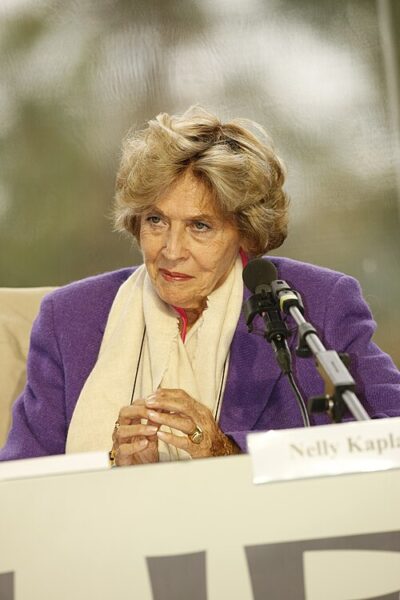
Nelly Kaplan
Nelly Kaplan was a French filmmaker and writer. Born April 11, 1931, in Buenos Aires. Died November 12, 2020, in Geneva. Educated at University of Buenos Aires. Awards include Commandeur des Arts et des Lettres, Knight of the Legion of Honour and Officer of the National Order of Merit.
Facts
21 facts · 2 confirmed by two sources · 8 cited · 11 from one source
Where this comes from
Papalocal keeps its own record. It started from these sources; what each one said is kept here as it was copied, so a change on their side never changes this page by itself. Tap one to read its version.
What Wikidata says · copied November 18, 2026 · revision 2555620364
- Described as
- French filmmaker and writer (1931–2020)
- Other names
- Belen
- Born
- April 11, 1931 · 6 references
- Died
- November 12, 2020 · 2 references
- Born in
- Buenos Aires · 2 references
- Died in
- Geneva · 1 reference
- Buried in
- La Roquette-sur-Siagne
- Cause of death
- COVID-19 · 1 reference
- Citizen of
- Argentina; France
- Occupation
- writer; filmmaker · 1 reference; film director · 2 references; screenwriter; essayist; cinematographer · 1 reference; director · 2 references; producer · 1 reference
- Education
- University of Buenos Aires
- Awards
- Commandeur des Arts et des Lettres (2005) · 1 reference; Knight of the Legion of Honour (1996); Officer of the National Order of Merit (2001) · 1 reference
- Field
- essay
- Wikipedias with a page
- 22
Wikidata item Q528421 (wikidata.org/wiki/Q528421), public domain (CC0). Copied November 18, 2026.
What Wikipedia says · copied November 18, 2026 · revision 1385018240
Nelly Kaplan (11 April 1931 – 12 November 2020) was an Argentine-born French writer and film director who focused on the arts, film, and filmmakers. She studied economics at the University of Buenos Aires. Passionate about cinema, she abruptly put her studies on hold to go to Paris in 1953 to represent the new Argentine film archive at an international convention and later became a correspondent for different Argentine newspapers. She had arrived with a resume highlighting her journalistic experience and a letter of introduction to Henri Langlois, founder and curator of the Cinémathèque Française, who introduced her to Abel Gance. Gance gave her the opportunity to work on the film La tour de Nesle.
She became Gance's assistant during the film and made and showed the program Magirama (triple screen) in Polyvision, then, still at Gance's side, she collaborated with him on Austerlitz (1960). He trusted her with the direction of all the second crew's action scenes during the filming of his movie Cyrano and d'Artagnan (Cyrano et d'Artagnan, 1964).
Meanwhile, she published her work about Magirama under the name Le Manifeste d'un art nouveau, with a preface by Philippe Soupault. In 1960, she published a film report entitled Le Sunlight of Austerlitz, through the Plon publishing house.
Beginning in 1961, she directed an entire series of art shorts, which won numerous prizes in various international festivals. Among these shorts were "Gustave Moreau," an analysis of the 19th century symbolist painter; "Rudolphe Bresdin," the engraver; "Dessins et merveilles," on the sketchbooks of Victor Hugo, as well as "Les années 25 ", " La Nouvelle Orangerie ", "Abel Gance hier et demain ", " A la source, la femme aimée", titles based on the secret notebooks of the painter André Masson.
Her first feature movie, A Very Curious Girl, was the focus of a Kaplan retrospective in 2019, Wild Things: The Ferocious Films of Nelly Kaplan. She filmed and produced a 1966 documentary, The Picasso Look, about the works of Picasso being delivered and displayed in Paris.
- Born, in its opening lines
- April 11, 1931
- Died, in its opening lines
- November 12, 2020
From the Wikipedia article “Nelly Kaplan” (en.wikipedia.org/wiki/Nelly_Kaplan), by its contributors, under CC BY-SA 4.0 (creativecommons.org/licenses/by-sa/4.0/). Copied November 18, 2026; not changed.
Confirmed Two sources agree. Cited One source, and it names where it got it. One source One source, without a reference of its own. Sources disagree The sources disagree. We show the best-supported value and keep theirs below.
