
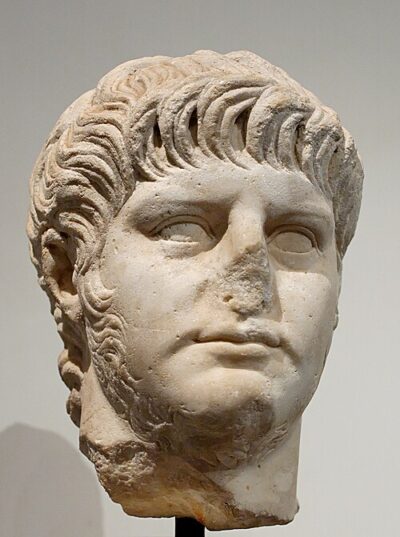
Nero
Nero was a fifth and last Roman Emperor of Julio-Claudian dynasty. Born December 15, 37, in Antium. Died June 9, 68, in Rome. Positions held include Roman emperor (54–68), ancient Roman senator and Roman consul.
Facts
25 facts · 0 confirmed by two sources · 4 cited · 20 from one source · 1 where the sources disagree
What’s different
- Father: we show Gnaeus Domitius Ahenobarbus (Sources disagree). Wikidata also lists Claudius
Where this comes from
Papalocal keeps its own record. It started from these sources; what each one said is kept here as it was copied, so a change on their side never changes this page by itself. Tap one to read its version.
What Wikidata says · copied November 16, 2026 · revision 2565595608
- Described as
- fifth and last Roman Emperor of Julio-Claudian dynasty (54–68)
- Other names
- Nero Claudius Caesar Drusus Germanicus, Nero Claudius Caesar Augustus Germanicus, Nero Claudius Drusus Germanicus Caesar, Emperor of Rome Nero, Nero Claudius Drusus Germanicus, Lucius Domitius Ahenobarbus
- Born
- December 15, 37 · 3 references
- Died
- June 9, 68 · 2 references
- Born in
- Antium
- Died in
- Rome
- Buried in
- Mausoleum of the Domitii Ahenobarbi
- Cause of death
- exsanguination
- Name at birth
- Lucius Domitius Ahenobarbus
- Citizen of
- Ancient Rome
- Occupation
- poet; politician; military personnel; musician
- Positions held
- Roman emperor (54–68); ancient Roman senator; Roman consul
- Spouse
- Claudia Octavia (53–62) · 2 references; Poppaea Sabina (62–65) · 1 reference; Statilia Messalina (66–68) · 1 reference; Sporus; Pythagoras
- Children
- Claudia Augusta
- Father
- Gnaeus Domitius Ahenobarbus; Claudius
- Mother
- Agrippina the Younger · 1 reference
- Religion
- ancient Roman religion
- Lived in
- Domus Aurea
- Wikipedias with a page
- 137
Wikidata item Q1413 (wikidata.org/wiki/Q1413), public domain (CC0). Copied November 16, 2026.
What Wikipedia says · copied November 16, 2026 · revision 1384404329
Nero Claudius Caesar Augustus Germanicus (born Lucius Domitius Ahenobarbus, later Nero Claudius Caesar Drusus Germanicus; 15 December AD 37 – 9 June AD 68) was Roman emperor from AD 54 until his suicide in AD 68. He was the final emperor of the Julio-Claudian dynasty, which comprised the first five emperors.
Nero was born at Antium in AD 37, the son of Gnaeus Domitius Ahenobarbus and Agrippina the Younger (great-granddaughter of the emperor Augustus). Nero was three when his father died. By the time Nero turned eleven, his mother married Emperor Claudius, who then adopted Nero as his heir. Upon Claudius's death in AD 54, Nero ascended to the throne with the backing of the Praetorian Guard and the Senate. In the early years of his reign, Nero was advised and guided by his mother Agrippina, his tutor Seneca the Younger, and his praetorian prefect Sextus Afranius Burrus, but sought to rule independently and rid himself of restraining influences. The power struggle between Nero and his mother reached its climax when he orchestrated her murder. Roman sources also implicate Nero in the deaths of both his wife Claudia Octavia – supposedly so he could marry Poppaea Sabina – and his stepbrother Britannicus.
Nero's practical contributions to Rome's governance focused on diplomacy, trade, and culture. He ordered the construction of amphitheaters, and promoted athletic games and contests. He made public appearances as an actor, poet, musician, and charioteer, which scandalized his aristocratic contemporaries as these occupations were usually the domain of slaves, public entertainers, and infamous persons. However, the provision of such entertainments made Nero popular among lower-class citizens. The costs involved were borne by local elites either directly or through taxation, and were much resented by the Roman aristocracy.
During Nero's reign, the general Corbulo fought the Roman–Parthian War of 58–63, and made peace with the hostile Parthian Empire. The Roman general Suetonius Paulinus quashed a major revolt in Britain led by queen Boudica. The Bosporan Kingdom was briefly annexed to the empire, and the First Jewish–Roman War began. When the Roman senator Vindex rebelled, with support from the eventual Roman emperor Galba, Nero was declared a public enemy and condemned to death in absentia. He fled Rome, and on 9 June AD 68 committed suicide. His death sparked a brief period of civil war known as the Year of the Four Emperors.
Most Roman sources offer overwhelmingly negative assessments of his personality and reign. Most contemporary sources describe him as tyrannical, self-indulgent, and debauched. The historian Tacitus claims the Roman people thought him compulsive and corrupt. Suetonius tells that many Romans believed the Great Fire of Rome was instigated by Nero to clear land for his planned "Golden House". Tacitus claims Nero seized Christians as scapegoats for the fire and had them burned alive, seemingly motivated not by public justice, but personal cruelty. Some modern historians question the reliability of ancient sources on Nero's tyrannical acts, considering his popularity among the Roman commoners. In the eastern provinces of the Empire, a popular legend arose that Nero had not died and would return. After his death, at least three leaders of short-lived, failed rebellions presented themselves as "Nero reborn" to gain popular support.
From the Wikipedia article “Nero” (en.wikipedia.org/wiki/Nero), by its contributors, under CC BY-SA 4.0 (creativecommons.org/licenses/by-sa/4.0/). Copied November 16, 2026; not changed.
Confirmed Two sources agree. Cited One source, and it names where it got it. One source One source, without a reference of its own. Sources disagree The sources disagree. We show the best-supported value and keep theirs below.
