
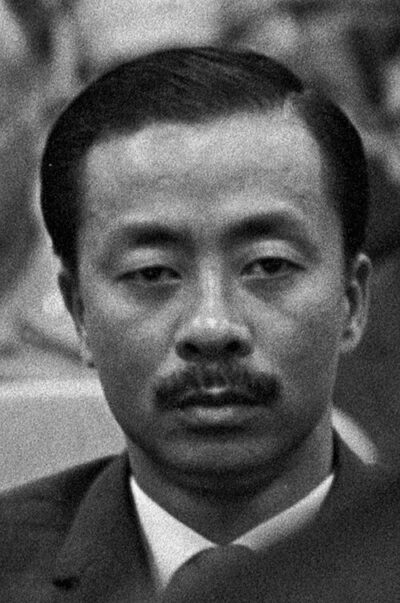
Nguyen Cao Ky
Nguyen Cao Ky was a Vietnamese politician and general. Born September 8, 1930, in Sơn Tây. Died July 23, 2011, in Kuala Lumpur. Positions held include vice president (1967–1971) and Prime Minister of the Republic of Vietnam (1965–1967).
Facts
22 facts · 2 confirmed by two sources · 8 cited · 12 from one source
Where this comes from
Papalocal keeps its own record. It started from these sources; what each one said is kept here as it was copied, so a change on their side never changes this page by itself. Tap one to read its version.
What Wikidata says · copied November 16, 2026 · revision 2562723539
- Described as
- Vietnamese politician and general (1930-2011)
- Born
- September 8, 1930 · 7 references
- Died
- July 23, 2011 · 7 references
- Born in
- Sơn Tây · 1 reference
- Died in
- Kuala Lumpur · 2 references
- Buried in
- Rose Hills Memorial Park
- Cause of death
- disease
- Citizen of
- South Vietnam
- Occupation
- politician · 2 references; military personnel; military officer · 1 reference; vice president · 1 reference
- Positions held
- vice president (1967–1971); Prime Minister of the Republic of Vietnam (1965–1967)
- Political party
- independent politician · 1 reference
- Field
- military affairs · 1 reference; politics · 1 reference
- Spouse
- Đặng Tuyết Mai · 1 reference
- Children
- Nguyễn Cao Kỳ Duyên
- Religion
- Buddhism
- Military branch
- South Vietnam Air Force · 1 reference
- Military rank
- major general · 1 reference; general · 1 reference
- Wikipedias with a page
- 28
Wikidata item Q372591 (wikidata.org/wiki/Q372591), public domain (CC0). Copied November 16, 2026.
What Wikipedia says · copied November 16, 2026 · revision 1384394982
Nguyễn Cao Kỳ (Vietnamese: [ŋwiən˦ˀ˥ kaːw˧˧ ki˨˩] ; 8 September 1930 – 23 July 2011) was a South Vietnamese military officer and politician who served as the chief of the Republic of Vietnam Air Force (RVNAF) in the 1960s, before leading the nation as the prime minister of South Vietnam in a military junta from 1965 to 1967. Then, until his retirement from politics in 1971, he served as vice president to bitter rival General Nguyễn Văn Thiệu, in a nominally civilian administration.
Born in Northern Vietnam, Kỳ joined the Vietnamese National Army of the French-backed State of Vietnam and started as an infantry officer before the French sent him off for pilot training. After the French withdrew from Vietnam and the nation was partitioned, Kỳ moved up the ranks of the Republic of Vietnam Air Force to become its leader. In November 1963, Kỳ participated in the coup that deposed president Ngô Đình Diệm and resulted in Diệm's assassination.
In 1964, Kỳ became prominent in junta politics, and was part of a group of young, aggressive officers dubbed the "Young Turks". Over the next two years, there were numerous successful and failed coup attempts. In September 1964, he helped put down a coup attempt by Generals Lâm Văn Phát and Dương Văn Đức against Nguyễn Khánh, and the following February he thwarted another attempt by Phát and Phạm Ngọc Thảo. His favored tactic was to send fighter jets into the air and threaten large-scale air strikes to force his opponents to back down. After the latter attempt, he also forced the Khánh into exile and became the leading member of the junta in mid-1965 by becoming prime minister, while General Thiệu was a figurehead chief of state. He gained notoriety for his flamboyant manner, womanizing, and risky and brash behavior, which deeply concerned South Vietnam's American allies and angered the Vietnamese public, many of whom regarded him as a "cowboy" and "hooligan". He cared little for public relations, and publicly made numerous controversial statements and threats.
Nevertheless, Kỳ and Thiệu were able to end the cycle of coups, and the Americans backed their regime. In 1966 Kỳ decided to purge rival General Nguyễn Chánh Thi from a command role, which provoked major unrest in Da Nang and Huế. He publicly threatened to kill the mayor of Đà Nẵng. Three months of large-scale demonstrations and riots paralyzed parts of the country, and after much maneuvering and some military battles, Kỳ's forces finally put down the uprising, and Thi was exiled, entrenching the former's grip on power.
In 1967, a transition to an elected government was scheduled, and after a power struggle within the military, Thiệu ran for the presidency with Kỳ as his running mate. To allow the two to work together, their fellow officers had agreed to have a military body controlled by Kỳ shape policy behind the scenes. The election was rigged to ensure that Thiệu and Kỳ's military ticket would win, and strong executive powers meant that the junta, in effect, still ruled. Leadership tensions persisted, and Thiệu prevailed, sidelining Kỳ supporters from key positions. Thiệu then enacted legislation to restrict candidacy eligibility for the 1971 election, banning almost all would-be opponents; Kỳ and the rest withdrew as they expected the election to be fraudulent; Thiệu went on to win the election uncontested, while Kỳ retired. With the fall of Saigon, Kỳ fled to the United States. He continued to heavily criticize both the communists and Thiệu, and the former prevented him from returning. However, in 2004, he became the first South Vietnamese leader to return to Vietnam, calling for national reconciliation between communist government and overseas anti-communists.
- Born, in its opening lines
- September 8, 1930
- Died, in its opening lines
- July 23, 2011
From the Wikipedia article “Nguyễn Cao Kỳ” (en.wikipedia.org/wiki/Nguyễn_Cao_Kỳ), by its contributors, under CC BY-SA 4.0 (creativecommons.org/licenses/by-sa/4.0/). Copied November 16, 2026; not changed.
Confirmed Two sources agree. Cited One source, and it names where it got it. One source One source, without a reference of its own. Sources disagree The sources disagree. We show the best-supported value and keep theirs below.
