
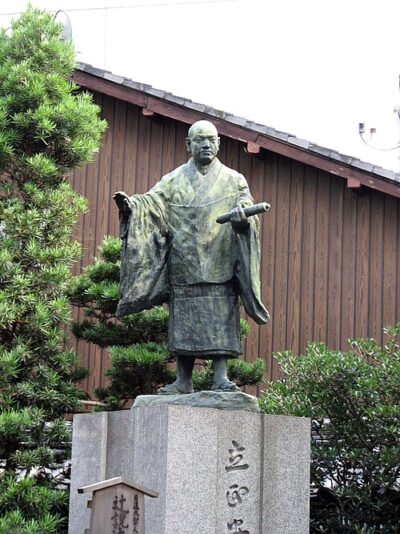
Nichiren
Nichiren was a Founder of Nichiren Buddhism in Japan. Born February 16, 1222, in Tanjō-ji Temple. Died November 14, 1282, in Ikegami. Known for Risshō Ankokuron, Kaimoku-sho and Kanjin Honzon Shō.
Facts
20 facts · 1 confirmed by two sources · 1 cited · 17 from one source · 1 where the sources disagree
What’s different
- Died: we show November 14, 1282 (Sources disagree). Wikipedia says October 13, 1282
Where this comes from
Papalocal keeps its own record. It started from these sources; what each one said is kept here as it was copied, so a change on their side never changes this page by itself. Tap one to read its version.
What Wikidata says · copied November 16, 2026 · revision 2558181138
- Described as
- Founder of Nichiren Buddhism in Japan
- Other names
- Dai-Nichiren (Great Nichiren), Risshō Daishi (Great Teacher of Rectification)
- Born
- February 16, 1222 · 2 references
- Died
- November 14, 1282 · 2 references
- Born in
- Tanjō-ji Temple
- Died in
- Ikegami
- Cause of death
- gastrointestinal system disease
- Citizen of
- Japan
- Occupation
- Buddhist monk; writer; teacher; philosopher · 1 reference; monk · 1 reference
- Sport
- go
- Known for
- Risshō Ankokuron; Kaimoku-sho; Kanjin Honzon Shō; The Selection of the Time; On Repaying Debts of Gratitude; Dai Gohonzon
- Field
- philosophy
- Religion
- Nichiren Buddhism
- Wikipedias with a page
- 45
Wikidata item Q311478 (wikidata.org/wiki/Q311478), public domain (CC0). Copied November 16, 2026.
What Wikipedia says · copied November 16, 2026 · revision 1378731753
Nichiren (日蓮; Japanese pronunciation: [ɲi.tɕiꜜ.ɾeɴ, ɲiꜜ.tɕi.ɾeɴ], 16 February 1222 – 13 October 1282) was a Japanese Buddhist monk and philosopher of the Kamakura period. His teachings form the basis of Nichiren Buddhism, a unique branch of Japanese Mahayana Buddhism based on the Lotus Sutra.
Nichiren declared that the Lotus Sutra alone contains the highest truth of Buddhism and that it is the only sutra suited for the Age of Dharma Decline. He insisted that the sovereign of Japan and its people should support only this form of Buddhism and eradicate all others, or they would face social collapse and environmental disasters. Nichiren advocated the faithful recitation of the title of the Lotus Sutra, Namu Myōhō Renge Kyō, as the only effective path to Buddhahood in this very life, a path which he saw as accessible to all people regardless of class, education or ability. Nichiren held that Shakyamuni and all other Buddhist deities were manifestations of the Original Eternal Buddha (本仏 Honbutsu) of the Lotus Sutra, which he equated with the Lotus Sutra itself and its title. He also declared that believers of the Lotus Sutra must propagate it even though this would lead to many difficulties and even persecution, which Nichiren understood as a way of "reading" the Lotus Sutra with one's very body. Nichiren believed that the spread of the Lotus Sutra teachings would lead to the creation of a Pure Land on earth.
Nichiren was a prolific writer and his biography, temperament, and the evolution of his beliefs has been gleaned primarily from his writings. He claimed to be the reincarnation of bodhisattva Viśiṣṭacāritra (Jōgyō), and designated six senior disciples, which later led to much disagreement after his death. Nichiren's harsh critiques of the Buddhist establishment led to many persecutions against him and his followers. He was exiled twice and some of his followers were imprisoned or killed. After his death, Nichiren’s followers continued to grow, making it one of Japan's largest Buddhist traditions. He was posthumously bestowed the title Nichiren Dai-Bosatsu (日蓮大菩薩; Great Bodhisattva Nichiren) by the Emperor Go-Kōgon in 1358. The title Risshō Daishi (立正大師; Great Teacher of Correction) was also later conferred by the Emperor Taishō in 1922.
Nichiren Buddhism today includes more than forty different officially registered organizations, some of which have significant international presence. These include traditional temple schools such as Nichiren-shū sects and Nichiren Shōshū, as well as modern lay movements such as Soka Gakkai, Risshō Kōsei Kai, Reiyūkai, Kenshōkai, Honmon Butsuryū-shū, Kempon Hokke, and Shōshinkai among many others. Each group has varying views of Nichiren's teachings, some being more exclusivist than the others. Some see Nichiren as being the Bodhisattva Viśiṣṭacāritra, while other sects claim that Nichiren was actually the Primordial or "True Buddha" (本仏, Honbutsu).
- Born, in its opening lines
- February 16, 1222
- Died, in its opening lines
- October 13, 1282
From the Wikipedia article “Nichiren” (en.wikipedia.org/wiki/Nichiren), by its contributors, under CC BY-SA 4.0 (creativecommons.org/licenses/by-sa/4.0/). Copied November 16, 2026; not changed.
Confirmed Two sources agree. Cited One source, and it names where it got it. One source One source, without a reference of its own. Sources disagree The sources disagree. We show the best-supported value and keep theirs below.
