
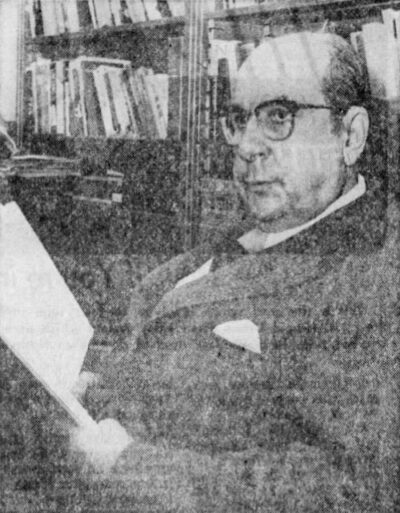
Nicholas Georgescu-Roegen
Nicholas Georgescu-Roegen was a mathematician, statistician and economist. Born February 4, 1906, in Constanța. Died October 30, 1994, in Nashville. Positions held include university teacher (1932–1946). Educated at University of Paris and University College London. Awards include Distinguished Fellow of the American Economic Association, Fellow of the Econometric Society and Guggenheim Fellowship.
Facts
28 facts · 2 confirmed by two sources · 10 cited · 16 from one source
Where this comes from
Papalocal keeps its own record. It started from these sources; what each one said is kept here as it was copied, so a change on their side never changes this page by itself. Tap one to read its version.
What Wikidata says · copied November 17, 2026 · revision 2567899700
- Described as
- mathematician, statistician and economist (1906-1994)
- Born
- February 4, 1906 · 1 reference
- Died
- October 30, 1994 · 1 reference
- Born in
- Constanța · 1 reference
- Died in
- Nashville · 1 reference
- Buried in
- Bellu Cemetery
- Cause of death
- diabetes
- Citizen of
- Romania
- Occupation
- mathematician · 2 references; economist · 1 reference; university teacher; statistician
- Positions held
- university teacher (1932–1946)
- Worked for
- University of Bucharest; Vanderbilt University
- Education
- University of Paris; University College London; University of Bucharest
- Member of
- American Academy of Arts and Sciences; Club of Rome; Econometric Society (1950–) · 1 reference; Romanian Academy
- Awards
- Distinguished Fellow of the American Economic Association; Fellow of the Econometric Society (1950) · 1 reference; Guggenheim Fellowship (1958) · 1 reference; honorary doctor of Louis Pasteur University (1976) · 1 reference
- Field
- mathematics · 1 reference; ecological economics · 1 reference; mathematical statistics · 1 reference
- Wikipedias with a page
- 26
Wikidata item Q1351160 (wikidata.org/wiki/Q1351160), public domain (CC0). Copied November 17, 2026.
What Wikipedia says · copied November 17, 2026 · revision 1374365307
Nicholas Georgescu-Roegen (born Nicolae Georgescu, 4 February 1906 – 30 October 1994) was a Romanian mathematician, statistician and economist. He is best known today for his 1971 magnum opus The Entropy Law and the Economic Process, in which he argued that all natural resources are irreversibly degraded when put to use in economic activity. A progenitor and a paradigm founder in economics, Georgescu-Roegen's work was decisive for the establishing of ecological economics as an independent academic sub-discipline in economics.
In the history of economic thought, Georgescu-Roegen was the first economist of some standing to theorise on the premise that all of earth's mineral resources will eventually be exhausted at some indeterminate future point. In his paradigmatic magnum opus, Georgescu-Roegen argues that economic scarcity is rooted in physical reality; that all natural resources are irreversibly degraded when put to use in economic activity; that the carrying capacity of earth – that is, earth's capacity to sustain human populations and consumption levels – is bound to decrease sometime in the future as earth's finite stock of mineral resources is being extracted and put to use; and consequently, that the world economy as a whole is heading towards an inevitable future collapse, ultimately bringing about human extinction. Due to the radical pessimism inherent to his work, based on the physical concept of entropy, the theoretical position of Georgescu-Roegen and his followers was later termed 'entropy pessimism'.
Georgescu-Roegen graduated from Sorbonne University in 1930 with a PhD in mathematical statistics with the highest honors. Early in his life, Georgescu-Roegen was the student and protégé of Joseph Schumpeter, who taught that irreversible evolutionary change and 'creative destruction' are inherent to capitalism. Later in life, Georgescu-Roegen was the teacher and mentor of Herman Daly, who then went on to develop the concept of a steady-state economy to impose permanent government restrictions on the flow of natural resources through the (world) economy.
As he brought natural resource flows into economic modelling and analysis, Georgescu-Roegen's work was decisive for the establishing of ecological economics as an independent academic sub-discipline in economics in the 1980s. In addition, the degrowth movement that formed in France and Italy in the early-2000s recognises Georgescu-Roegen as the main intellectual figure influencing the movement. Taken together, by the 2010s Georgescu-Roegen had educated, influenced and inspired at least three generations of people, including his contemporary peers, younger ecological economists, still younger degrowth organisers and activists, and others throughout the world.
Several economists have hailed Georgescu-Roegen as a man who lived well ahead of his time, and some historians of economic thought have proclaimed the ingenuity of his work. In spite of such appreciation, Georgescu-Roegen was never awarded the Nobel Prize in Economics, although benefactors from his native Romania were lobbying for it on his behalf. After Georgescu-Roegen's death, his work was praised by a surviving friend of the highest rank: Prominent Keynesian economist and Nobel Prize laureate Paul Samuelson professed that he would be delighted if the fame Georgescu-Roegen did not fully realise in his own lifetime were granted by posterity instead.
The inability or reluctance of most mainstream economists to recognise Georgescu-Roegen's work has been ascribed to the fact that much of his work reads like applied physics rather than economics, as this latter subject is generally taught and understood today.
Georgescu-Roegen's work was blemished somewhat by mistakes caused by his insufficient understanding of the physical science of thermodynamics. These mistakes have since generated some controversy, involving both physicists and ecological economists.
- Born, in its opening lines
- February 4, 1906
- Died, in its opening lines
- October 30, 1994
From the Wikipedia article “Nicholas Georgescu-Roegen” (en.wikipedia.org/wiki/Nicholas_Georgescu-Roegen), by its contributors, under CC BY-SA 4.0 (creativecommons.org/licenses/by-sa/4.0/). Copied November 17, 2026; not changed.
Confirmed Two sources agree. Cited One source, and it names where it got it. One source One source, without a reference of its own. Sources disagree The sources disagree. We show the best-supported value and keep theirs below.
