
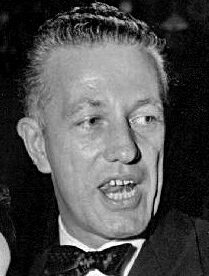
Nicholas Ray
Nicholas Ray was an American film director. Born August 7, 1911, in La Crosse. Died June 16, 1979, in New York City. Educated at University of Chicago and Lincoln Park High School.
Facts
17 facts · 2 confirmed by two sources · 9 cited · 6 from one source
Where this comes from
Papalocal keeps its own record. It started from these sources; what each one said is kept here as it was copied, so a change on their side never changes this page by itself. Tap one to read its version.
What Wikidata says · copied November 13, 2026 · revision 2567316842
- Described as
- American film director (1911-1979)
- Other names
- Nik Ray, Raymond Nicholas Kienzle
- Born
- August 7, 1911 · 11 references
- Died
- June 16, 1979 · 11 references
- Born in
- La Crosse
- Died in
- New York City · 2 references
- Buried in
- Oak Grove Cemetery · 1 reference
- Cause of death
- lung cancer
- Citizen of
- United States · 1 reference
- Occupation
- film director · 1 reference; screenwriter · 1 reference; actor · 1 reference; director · 2 references
- Worked for
- Binghamton University
- Education
- University of Chicago; Lincoln Park High School · 1 reference; La Crosse Central High School · 1 reference
- Spouse
- Gloria Grahame (1948–1952) · 1 reference
- Children
- Anthony Ray · 1 reference
- Wikipedias with a page
- 47
Wikidata item Q240677 (wikidata.org/wiki/Q240677), public domain (CC0). Copied November 13, 2026.
What Wikipedia says · copied November 13, 2026 · revision 1383148381
Nicholas Ray (born Raymond Nicholas Kienzle Jr., August 7, 1911 – June 16, 1979) was an American film director, screenwriter, and actor. Considered one of postwar American's most gifted, and ultimately, tragic filmmakers, he often clashed with the Hollywood studio system of the 1940s and 1950s, but would ultimately, influence future generations of filmmakers.
His best known work is Rebel Without a Cause (1955), starring James Dean, in his final role. He also directed They Live By Night (1948), In a Lonely Place (1950), Johnny Guitar (1954), Bigger Than Life (1956), and King of Kings (1961). Throughout the 1970s, he produced the experimental We Can't Go Home Again (1973), which was unfinished at the time of his death.
During his lifetime, Ray was nominated for the Academy Award for Best Story for Rebel Without a Cause, twice for the Golden Lion, for Bigger Than Life (1956) and Bitter Victory (1957), and a Palme d'Or for The Savage Innocents (1960). Three of his films were ranked by Cahiers du Cinéma in their Annual Top 10 Lists.
Ray's compositions within the CinemaScope frame and use of color are particularly well regarded and he was an important influence on the French New Wave, with Jean-Luc Godard famously writing, "... there is cinema. And the cinema is Nicholas Ray."
- Born, in its opening lines
- August 7, 1911
- Died, in its opening lines
- June 16, 1979
From the Wikipedia article “Nicholas Ray” (en.wikipedia.org/wiki/Nicholas_Ray), by its contributors, under CC BY-SA 4.0 (creativecommons.org/licenses/by-sa/4.0/). Copied November 13, 2026; not changed.
Confirmed Two sources agree. Cited One source, and it names where it got it. One source One source, without a reference of its own. Sources disagree The sources disagree. We show the best-supported value and keep theirs below.
