
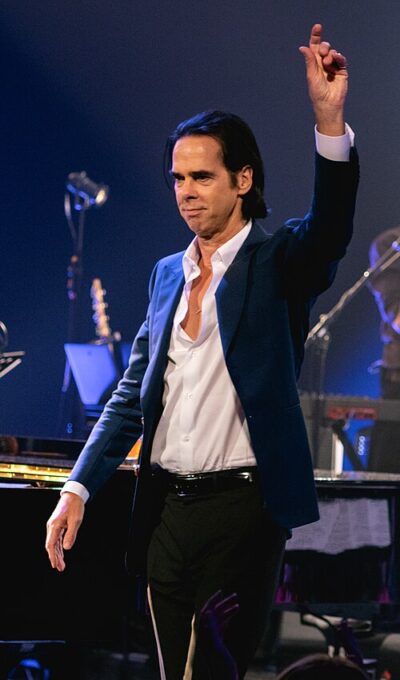
Nick Cave
Nick Cave is an Australian musician and singer. Born September 22, 1957, in Warracknabeal. Known for The Sick Bag Song, The Death of Bunny Munro and And the Ass Saw the Angel. Educated at Caulfield Grammar School and Wangaratta High School. Awards include Officer of the Order of Australia, Ivor Novello Awards and APRA Music Awards.
Facts
54 facts · 1 confirmed by two sources · 17 cited · 36 from one source
Where this comes from
Papalocal keeps its own record. It started from these sources; what each one said is kept here as it was copied, so a change on their side never changes this page by itself. Tap one to read its version.
What Wikidata says · copied November 16, 2026 · revision 2568794327
- Described as
- Australian musician and singer
- Other names
- Nicholas Edward Cave
- Born
- September 22, 1957 · 9 references
- Born in
- Warracknabeal · 4 references
- Name at birth
- Nicholas Edward Cave
- Citizen of
- Australia · 1 reference
- Occupation
- actor · 2 references; singer · 2 references; composer · 2 references; novelist; writer · 2 references; librettist; screenwriter · 1 reference; pianist
- Education
- Caulfield Grammar School; Wangaratta High School
- Member of
- Nick Cave and the Bad Seeds; Grinderman; The Birthday Party; The Boys Next Door
- Genre
- rock music; alternative rock; gothic rock; garage rock; country music; blues
- Instrument
- guitar; voice · 1 reference; piano · 1 reference
- Record label
- Mute Records
- Known for
- The Sick Bag Song; The Death of Bunny Munro; And the Ass Saw the Angel
- Awards
- Officer of the Order of Australia (2017) · 1 reference; Ivor Novello Awards (2014) · 1 reference; APRA Music Awards (1996) · 1 reference; ARIA Award for Single of the Year (1996); ARIA Award for Best Original Soundtrack, Cast or Show Album (1997) · 1 reference; ARIA Award for Best Male Artist (2 times) (2001, 2008); ARIA Award for Best Pop Release (1996); ARIA Award for Best Independent Release (2013); ARIA Award for Best Adult Contemporary Album (2013); Libera Award for Best Live Act; Fellow of the Royal Society of Literature (2022) · 1 reference
- Field
- rock music · 1 reference; film acting · 1 reference; film production · 1 reference; music · 1 reference
- Spouse
- Vivián Karnéiro (1990–1996); Susie Bick (1999–)
- Children
- Earl Cave; Arthur Cave; Tzéthro Kéiv; Louk Kéiv
- Website
- http://nickcave.com/; https://www.theredhandfiles.com/
- Wikipedias with a page
- 58
Wikidata item Q192668 (wikidata.org/wiki/Q192668), public domain (CC0). Copied November 16, 2026.
What Wikipedia says · copied November 16, 2026 · revision 1385540385
Nicholas Edward Cave (born 22 September 1957) is an Australian singer, musician and writer. He is the frontman of the rock band Nick Cave and the Bad Seeds. Known for his baritone voice, Cave's music is characterised by emotional intensity, a wide variety of influences and lyrical obsessions with death, religion, love, and violence.
Born and raised in rural Victoria, Cave studied art in Melbourne before fronting The Birthday Party, one of the city's leading post-punk bands, in the late 1970s. In 1980, the band moved to London, England. Disillusioned by their stay there, they evolved towards a darker and more challenging sound that helped inspire gothic rock, and they acquired a reputation as "the most violent live band in the world". Cave became recognised for his confrontational performances, his shock of black hair and pale, emaciated look. The band broke up soon after relocating to West Berlin in 1982. The following year, Cave formed Nick Cave and the Bad Seeds, later described as one of rock's "most redoubtable, enduring" bands. Much of their early material is set in a mythic American Deep South, drawing on spirituals and Delta blues, while Cave's preoccupation with Old Testament notions of good versus evil culminated in what has been called his signature song, "The Mercy Seat" (1988), and in his debut novel, And the Ass Saw the Angel (1989). In 1988, he appeared in Ghosts… of the Civil Dead, an Australian prison film which he both co-wrote and scored.
The 1990s saw Cave move between São Paulo and England and found inspiration in the New Testament. He went on to achieve mainstream success with quieter, piano-driven ballads, notably the Kylie Minogue duet "Where the Wild Roses Grow" (1996), and "Into My Arms" (1997). Turning increasingly to film in the 2000s, Cave wrote the Australian Western The Proposition (2005), also composing its soundtrack with frequent collaborator Warren Ellis. The pair's film score credits include The Assassination of Jesse James by the Coward Robert Ford (2007), The Road (2009) and Hell or High Water (2016). Their garage rock side project Grinderman has released two studio albums since 2006. In 2009, he released his second novel, The Death of Bunny Munro, and starred in the semi-fictional "day in the life" film 20,000 Days on Earth (2014). His more recent musical work features ambient and electronic elements, as well as increasingly abstract lyrics, informed in part by grief over his son Arthur's 2015 death, which is explored in the documentary One More Time with Feeling (2016) and the Bad Seeds' 2019 album Ghosteen. The band's 18th and latest album, Wild God, was released in 2024.
Since 2018, Cave has maintained The Red Hand Files, a newsletter he uses to respond to questions from fans. He has collaborated with the likes of Johnny Cash, Shane MacGowan and ex-partner PJ Harvey. His songs have also been covered by a wide range of artists, including Cash ("The Mercy Seat"), Metallica ("Loverman") and Snoop Dogg ("Red Right Hand"). He was inducted into the ARIA Hall of Fame in 2007, and he was named an Officer of the Order of Australia in 2017.
- Born, in its opening lines
- September 22, 1957
From the Wikipedia article “Nick Cave” (en.wikipedia.org/wiki/Nick_Cave), by its contributors, under CC BY-SA 4.0 (creativecommons.org/licenses/by-sa/4.0/). Copied November 16, 2026; not changed.
Confirmed Two sources agree. Cited One source, and it names where it got it. One source One source, without a reference of its own. Sources disagree The sources disagree. We show the best-supported value and keep theirs below.
