
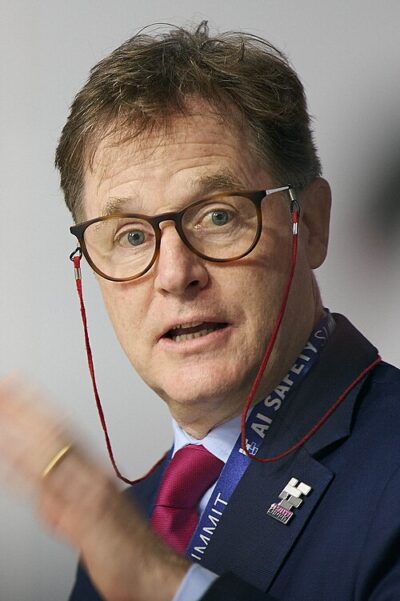
Nick Clegg
Nick Clegg is a British politician and media executive. Born January 7, 1967, in Chalfont St Giles. Positions held include Deputy Prime Minister of the United Kingdom (2010–2015), Lord President of the Council (2010–2015) and Leader of the Liberal Democrats (2007–2015). Educated at Robinson College and University of Minnesota. Awards include Knight Bachelor.
Facts
33 facts · 1 confirmed by two sources · 18 cited · 14 from one source
Where this comes from
Papalocal keeps its own record. It started from these sources; what each one said is kept here as it was copied, so a change on their side never changes this page by itself. Tap one to read its version.
What Wikidata says · copied November 16, 2026 · revision 2562708341
- Described as
- British politician and media executive (born 1967)
- Other names
- Nicholas Clegg, Nicholas William Peter Clegg, Nicholas "Nick" William Peter Clegg, Sir Nicholas William Peter Clegg
- Born
- January 7, 1967 · 7 references
- Born in
- Chalfont St Giles · 1 reference
- Citizen of
- United Kingdom
- Occupation
- politician · 1 reference; writer · 1 reference; communicator · 1 reference
- Positions held
- Deputy Prime Minister of the United Kingdom (2010–2015); Lord President of the Council (2010–2015); Leader of the Liberal Democrats (2007–2015); Member of the European Parliament (1999–2004); Liberal Democrat Home Affairs spokesman (2006–2007); Member of the Privy Council of the United Kingdom (2008–) · 1 reference; member of the 56th Parliament of the United Kingdom (2015–2017) · 1 reference; member of the 55th Parliament of the United Kingdom (2010–2015) · 1 reference; member of the 54th Parliament of the United Kingdom (2005–2010) · 1 reference
- Political party
- Liberal Democrats
- Worked for
- University of Sheffield · 1 reference; Facebook (2018–) · 1 reference
- Education
- Robinson College; University of Minnesota; Westminster School · 1 reference; Caldicott School; College of Europe
- Awards
- Knight Bachelor (2018) · 1 reference
- Spouse
- Miriam González Durántez (2000–) · 2 references
- Children
- Antonio Clegg · 1 reference; Alberto Clegg · 1 reference; Miguel Clegg · 1 reference
- Father
- Nicholas P. Clegg · 1 reference
- Mother
- Eulalia Hermance van den Wall Bake · 1 reference
- Religion
- agnostic atheism · 4 references
- Height
- 1.84 m (6 ft 0 in)
- Website
- http://www.nickclegg.org.uk/
- Wikipedias with a page
- 56
Wikidata item Q189947 (wikidata.org/wiki/Q189947), public domain (CC0). Copied November 16, 2026.
What Wikipedia says · copied November 16, 2026 · revision 1385848273
Sir Nicholas William Peter Clegg (born 7 January 1967) is a British retired politician and media executive who served as Deputy Prime Minister of the United Kingdom from 2010 to 2015, and president for global affairs at Facebook from 2022 to 2025. He was Leader of the Liberal Democrats from 2007 to 2015 and Member of Parliament (MP) for Sheffield Hallam from 2005 to 2017. He was then a public relations officer at Facebook from 2018 until his promotion in 2022. An "Orange Book" liberal, he has been associated with both socially liberal and economically liberal policies.
Born in Buckinghamshire, Clegg was educated at Westminster School before going on to study at the University of Cambridge, University of Minnesota, and College of Europe. He worked as a journalist for the Financial Times before becoming a Member of the European Parliament (MEP) in 1999. After his election to the House of Commons in 2005, Clegg served in a variety of leadership roles in the Liberal Democrats, most notably as spokesperson for Home Affairs, before being elected to succeed Menzies Campbell as party leader in 2007. During his tenure as leader, Clegg said that the Liberal Democrats had transcended left and right-wing politics and described the party as radical centrist. He supported reduced taxes, electoral reform, cuts on defence spending and an increased focus on environmental issues.
In the 2010 general election, Clegg's Liberal Democrats won 57 seats in the House of Commons. The Conservative Party, which failed to receive a majority, formed a coalition with the Liberal Democrats, and Clegg was appointed by Conservative leader David Cameron to serve as his Deputy Prime Minister. In this capacity, he became the first leader of the Liberal Democrats to answer for the Prime Minister's Questions, and used his influence in the position to pass the Fixed-term Parliaments Act. Controversy arose during this time surrounding the Liberal Democrats' decision to abandon their pledge to oppose increases in tuition fees, which had previously been a key issue that won the party support from students. During the party's time in coalition, the Liberal Democrats saw a significant drop in support, and the 2015 general election left the party with just 8 seats, which resulted in Clegg's ousting as Deputy Prime Minister and his resignation as party leader.
In 2016, following a referendum in which a majority supported leaving the European Union, Clegg returned to the Liberal Democrat frontbench, concurrently serving as Spokesperson for Exiting the European Union and for International Trade from July 2016 to June 2017. In the 2017 general election, Clegg was defeated in his constituency of Sheffield Hallam by Jared O'Mara of the Labour Party. He was appointed a Knight Bachelor in the 2018 New Year Honours for political and public service.
Clegg left politics after losing his seat and relocated to the United States, where in October 2018 he became vice‑president of global affairs and communications at Facebook, Inc. (renamed Meta Platforms in 2021). He was promoted to president for global affairs in 2022. Clegg announced he would step down from the role and leave Meta in 2025.
In March 2026 Clegg has joined the board of British AI Start up NScale.
- Born, in its opening lines
- January 7, 1967
From the Wikipedia article “Nick Clegg” (en.wikipedia.org/wiki/Nick_Clegg), by its contributors, under CC BY-SA 4.0 (creativecommons.org/licenses/by-sa/4.0/). Copied November 16, 2026; not changed.
Confirmed Two sources agree. Cited One source, and it names where it got it. One source One source, without a reference of its own. Sources disagree The sources disagree. We show the best-supported value and keep theirs below.
