
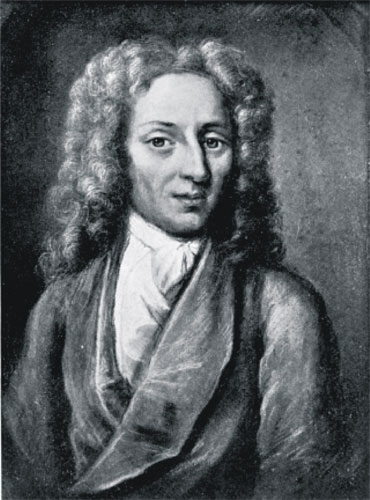
Nicolas Fatio de Duillier
Nicolas Fatio de Duillier was a Member of the Royal Society. Born February 16, 1664, in Basel. Died May 10, 1753, in Worcester. Known for zodiacal light and Jewel bearing. Awards include Fellow of the Royal Society.
Facts
15 facts · 2 confirmed by two sources · 4 cited · 9 from one source
Where this comes from
Papalocal keeps its own record. It started from these sources; what each one said is kept here as it was copied, so a change on their side never changes this page by itself. Tap one to read its version.
What Wikidata says · copied November 17, 2026 · revision 2566064616
- Described as
- Member of the Royal Society
- Born
- February 16, 1664 · 2 references
- Died
- May 10, 1753 · 1 reference
- Born in
- Basel · 2 references
- Died in
- Worcester · 1 reference
- Citizen of
- Republic of Geneva (1678–) · 1 reference
- Occupation
- astronomer · 1 reference; mathematician · 1 reference
- Member of
- Royal Society of London
- Known for
- zodiacal light · 1 reference; Jewel bearing · 1 reference
- Awards
- Fellow of the Royal Society
- Siblings
- Jean Christophe Fatio de Duillier · 1 reference
- Religion
- reformed · 1 reference
- Lived in
- Switzerland · 1 reference; England · 1 reference
- Wikipedias with a page
- 26
Wikidata item Q115774 (wikidata.org/wiki/Q115774), public domain (CC0). Copied November 17, 2026.
What Wikipedia says · copied November 17, 2026 · revision 1384695492
Nicolas Fatio de Duillier (also spelled Faccio or Facio; 16 February 1664 – 10 May 1753) was a Genevan mathematician, natural philosopher, astronomer, inventor, and religious campaigner. Born in Basel, Switzerland, Fatio mostly grew up in the then-independent Republic of Geneva, of which he was a citizen, before spending much of his adult life in England and Holland. Fatio is known for his collaboration with Giovanni Domenico Cassini on the correct explanation of the astronomical phenomenon of zodiacal light, for his "push" or "shadow" theory of gravitation, for inventing the integrating factor as a method for solving ordinary differential equations, for his close association with both Christiaan Huygens and Isaac Newton, and for his role in the Leibniz–Newton calculus controversy. He also invented and developed the first method for fabricating jewel bearings for mechanical watches and clocks.
Elected a Fellow of the Royal Society of London at the age of 24, Fatio never achieved the position and reputation that his early achievements and connections had promised. In 1706 he became involved with a millenarian religious sect, known in London as the "French prophets", and the following year he was sentenced to the pillory for sedition over his role in the publication of the prophecies of Élie Marion, the leader of that sect. Fatio travelled with the French prophets as a missionary, going as far as Smyrna before returning to Holland in 1713, and finally settling in England. His extreme religious views harmed his intellectual reputation, but Fatio continued to pursue technological, scientific, and theological researches until his death at the age of 89.
- Born, in its opening lines
- February 16, 1664
- Died, in its opening lines
- May 10, 1753
From the Wikipedia article “Nicolas Fatio de Duillier” (en.wikipedia.org/wiki/Nicolas_Fatio_de_Duillier), by its contributors, under CC BY-SA 4.0 (creativecommons.org/licenses/by-sa/4.0/). Copied November 17, 2026; not changed.
Confirmed Two sources agree. Cited One source, and it names where it got it. One source One source, without a reference of its own. Sources disagree The sources disagree. We show the best-supported value and keep theirs below.
