
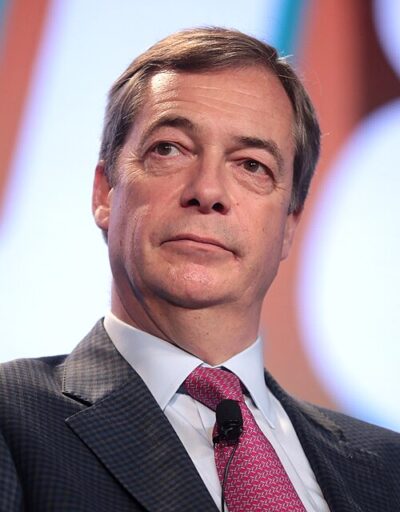
Nigel Farage
Nigel Farage is a British politician. Born April 3, 1964, in Farnborough. Positions held include Member of the European Parliament (1999–2020), Leader of the UK Independence Party (2006–2016) and member of the 59th Parliament of the United Kingdom (2024–). Educated at Dulwich College.
Facts
28 facts · 1 confirmed by two sources · 11 cited · 16 from one source
Where this comes from
Papalocal keeps its own record. It started from these sources; what each one said is kept here as it was copied, so a change on their side never changes this page by itself. Tap one to read its version.
What Wikidata says · copied November 16, 2026 · revision 2567536612
- Described as
- British politician
- Other names
- Mr. Brexit, Mr. Farage, Nigel Paul Farage
- Born
- April 3, 1964 · 3 references
- Born in
- Farnborough · 1 reference
- Name at birth
- Nigel Paul Farage
- Citizen of
- United Kingdom
- Occupation
- politician · 1 reference; autobiographer; commodity broker; spokesperson; broadcaster; party leader · 1 reference
- Positions held
- Member of the European Parliament (1999–2020) · 1 reference; Leader of the UK Independence Party (2006–2016); member of the 59th Parliament of the United Kingdom (2024–) · 1 reference
- Political party
- Conservative Party (1978–1993); UK Independence Party (1993–2018); Brexit Party (2019–2021); Reform UK (2024–) · 2 references
- Worked for
- Drexel Burnham Lambert (1982–1986); Crédit Lyonnais (1986–1994); Refco (1994–2003); Natixis (2003–)
- Education
- Dulwich College · 3 references
- Spouse
- Kirsten Farage (1999–) · 1 reference
- Father
- Guy Oscar Justus Farage · 1 reference
- Religion
- Church of England; Anglicanism
- Nickname
- Mr. Brexit · 1 reference
- Website
- https://nfarage.com · 1 reference
- Wikipedias with a page
- 81
Wikidata item Q318471 (wikidata.org/wiki/Q318471), public domain (CC0). Copied November 16, 2026.
What Wikipedia says · copied November 16, 2026 · revision 1385370144
Nigel Paul Farage (born 3 April 1964) is a British politician who has been Leader of Reform UK and Member of Parliament for Clacton since 2024. He was the leader of the UK Independence Party (UKIP) from 2006 to 2009 and from 2010 to 2016, and a member of the European Parliament (MEP) for South East England from 1999 until the United Kingdom's withdrawal from the European Union (EU) in 2020.
Farage was a member of the Conservative Party for 14 years, from 1978 to 1992. He has been a prominent Eurosceptic since the early 1990s and was first elected to the European Parliament in 1999. In 2004, he became the president of Europe of Freedom and Direct Democracy. Farage was elected UKIP's leader in 2006 and led the party at the 2009 European Parliament election, when it won the second-most votes in the UK. He stood unsuccessfully in Buckingham at the 2010 general election before returning as UKIP's leader later that year. At the 2014 European Parliament election, UKIP won the most seats in the UK, pressuring David Cameron to call the 2016 EU membership referendum. At the 2015 general election, Farage was an unsuccessful candidate in South Thanet.
After the referendum, Farage resigned as UKIP's leader. In 2018, he co-founded the Brexit Party (renamed Reform UK in 2021), which drew support from those frustrated by the delayed implementation of Brexit by the Conservative government, and won the most votes at the 2019 European Parliament election, becoming the largest single party in the parliament. At the 2024 general election Farage again became Reform UK's leader, and won in Clacton. In July 2026, whilst under investigation by the Parliamentary Commissioner for Standards over undeclared gifts including one of £5 million, Farage announced his resignation as MP for Clacton, triggering a by-election which he won with 63.3% of the vote.
- Born, in its opening lines
- April 3, 1964
From the Wikipedia article “Nigel Farage” (en.wikipedia.org/wiki/Nigel_Farage), by its contributors, under CC BY-SA 4.0 (creativecommons.org/licenses/by-sa/4.0/). Copied November 16, 2026; not changed.
Confirmed Two sources agree. Cited One source, and it names where it got it. One source One source, without a reference of its own. Sources disagree The sources disagree. We show the best-supported value and keep theirs below.
