
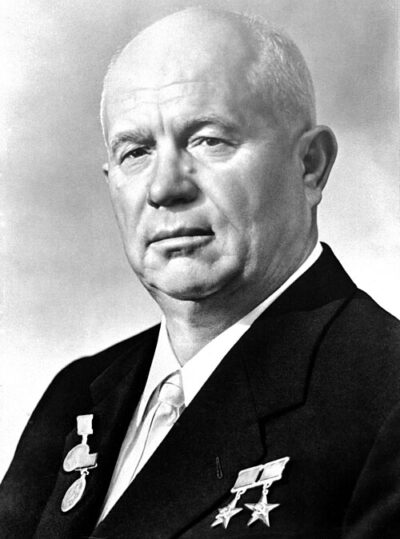
Nikita Khrushchev
Nikita Khrushchev was a leader of the Soviet Union from 1953 to 1964. Born April 3, 1894, in Kalinovka. Died September 11, 1971, in Moscow. Positions held include General Secretary of the Communist Party of the Soviet Union (1953–1964), Chairman of the Council of Ministers of the USSR (1958–1964) and First Secretary of the Communist Party of Ukraine (1938–1949). Educated at Industrial Academy and Donetsk National Technical University. Awards include Order of Lenin (7 times), Medal "For the Victory over Germany in the Great Patriotic War 1941–1945" and Hero of Socialist Labour (3 times).
Facts
47 facts · 1 confirmed by two sources · 5 cited · 40 from one source · 1 where the sources disagree
What’s different
- Born: we show April 3, 1894 (Sources disagree). Wikipedia says April 15, 1894
Where this comes from
Papalocal keeps its own record. It started from these sources; what each one said is kept here as it was copied, so a change on their side never changes this page by itself. Tap one to read its version.
What Wikidata says · copied November 16, 2026 · revision 2568153251
- Described as
- leader of the Soviet Union from 1953 to 1964
- Other names
- Nikita Sergeyevich Khrushchov, Khrushchov, Nikita Sergeyevich Khrushchyov, Khrushchyov, Nikita Sergeyevich Khrushchev, Khrushchev
- Born
- April 3, 1894 · 1 reference
- Died
- September 11, 1971 · 11 references
- Born in
- Kalinovka
- Died in
- Moscow · 2 references
- Buried in
- Novodevichy Cemetery · 2 references
- Cause of death
- myocardial infarction
- Citizen of
- Russian Empire; Russian Socialist Federative Soviet Republic (–1922); Soviet Union
- Occupation
- politician · 1 reference; military personnel · 1 reference; revolutionary
- Positions held
- General Secretary of the Communist Party of the Soviet Union (1953–1964); Chairman of the Council of Ministers of the USSR (1958–1964) · 1 reference; First Secretary of the Communist Party of Ukraine (1938–1949); First Secretary of the Moscow Communist Party (2 times) (1934–1950) · 1 reference
- Political party
- Communist Party of the Soviet Union (1918–)
- Education
- Industrial Academy (1929–); Donetsk National Technical University (1922–)
- Member of
- Central Committee of the Communist Party of the Soviet Union; Politburo of the Central Committee of the Communist Party of the Soviet Union (1939–1964)
- Awards
- Order of Lenin (7 times) (1935, 1944, 1948, 1954, 1957, 1961, 1964); Medal "For the Victory over Germany in the Great Patriotic War 1941–1945"; Hero of Socialist Labour (3 times) (1954, 1957, 1961); Hero of the Soviet Union (1964); Order of the Patriotic War, 1st class (1945); Order of Suvorov, 1st class (1945); Order of Suvorov, 2nd class (1943); Order of Kutuzov, 1st class (1943); Order of the Red Banner of Labour (1939); Medal "For the Defence of Stalingrad"; Medal "For the Restoration of the Black Metallurgy Enterprises of the South"; Medal "For the Development of Virgin Lands"; Medal "For Valiant Labour in the Great Patriotic War 1941–1945"; Medal "To a Partisan of the Patriotic War", 1st class; Jubilee Medal "In Commemoration of the 100th Anniversary of the Birth of Vladimir Ilyich Lenin"
- Field
- politics · 1 reference
- Spouse
- Nina Khrushcheva (1965–1971); Efrosinya Khrushcheva (1914–1919)
- Children
- Sergei Khrushchev; Leonid Khrushchev · 1 reference; Yulia Khrushcheva; Rada Adzhubey; Elena Evreinova
- Religion
- atheism
- Military branch
- Red Army · 1 reference
- Military rank
- lieutenant general (1943–)
- Wikipedias with a page
- 171
Wikidata item Q35314 (wikidata.org/wiki/Q35314), public domain (CC0). Copied November 16, 2026.
What Wikipedia says · copied November 16, 2026 · revision 1384665564
Nikita Sergeyevich Khrushchev (15 April [O.S. 3 April] 1894 – 11 September 1971) was the First Secretary of the Communist Party of the Soviet Union from 1953 to 1964 and the Chairman of the Council of Ministers from 1958 to 1964. As leader of the Soviet Union, he shocked the world by denouncing his predecessor Joseph Stalin, embarking on a campaign of de-Stalinization, and presiding over the Cuban Missile Crisis in 1962.
Born in a village near Kursk, Khrushchev was employed as a metal worker during his youth and was a political commissar in the Russian Civil War. Under the sponsorship of Lazar Kaganovich, he rose through the ranks of the Soviet hierarchy. During Stalin's rule, he actively supported the Great Purge and approved thousands of arrests, and in 1938 was sent to govern the Ukrainian SSR, where he continued the purges. During World War II, Khrushchev was again a commissar, serving as an intermediary between Stalin and his generals. He was also present at the Battle of Stalingrad, a fact in which he took great pride. After the war, Khrushchev returned to Ukraine before eventually being recalled to Moscow as one of Stalin's close advisers.
On 5 March 1953, the death of Stalin triggered a power struggle in which Khrushchev ultimately emerged victorious upon consolidating his authority as First Secretary of the party's Central Committee and eliminating his rival Lavrentiy Beria. On 25 February 1956, at the 20th Party Congress, he delivered the "Secret Speech", which denounced Stalin's purges and ushered in a less repressive era in the Soviet Union. His domestic policies, aimed at bettering the lives of ordinary citizens, were often ineffective, especially in agriculture, though his anti-religious campaign was more successful. Hoping eventually to rely on missiles for national defense, Khrushchev ordered major cuts in conventional forces. Despite such cuts, Khrushchev's time in office saw the tensest years of the Cold War, culminating in the 1962 Cuban Missile Crisis.
As leader of the Soviet Union, Khrushchev enjoyed considerable popularity during the late 1950s due to the successful launching of Sputnik in 1957 as well as favorable outcomes in the 1956 Suez Crisis, 1957 Syrian Crisis, and the 1960 U-2 incident. However, by the early 1960s, Khrushchev's hold on power had been significantly weakened by his domestic policy failures and handling of the Cuban Missile Crisis. As a result, his rivals consolidated enough support among the nomenklatura to oust him from the Soviet leadership on 14 October 1964. Following his forced retirement, Khrushchev spent much of his time composing a series of lengthy memoirs which were smuggled to the West and published in part in 1970. He died the next year in his dacha.
- Born, in its opening lines
- April 15, 1894
- Died, in its opening lines
- September 11, 1971
From the Wikipedia article “Nikita Khrushchev” (en.wikipedia.org/wiki/Nikita_Khrushchev), by its contributors, under CC BY-SA 4.0 (creativecommons.org/licenses/by-sa/4.0/). Copied November 16, 2026; not changed.
Confirmed Two sources agree. Cited One source, and it names where it got it. One source One source, without a reference of its own. Sources disagree The sources disagree. We show the best-supported value and keep theirs below.
