
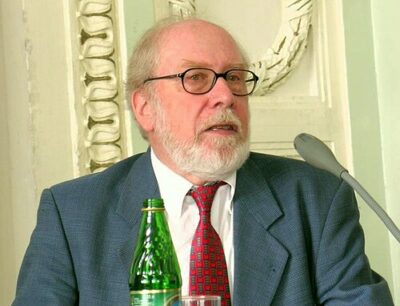
Niklaus Wirth
Niklaus Wirth was a Swiss computer scientist. Born February 15, 1934, in Winterthur. Died January 1, 2024, in Zurich. Known for Pascal, ALGOL W and Euler. Educated at ETH Zurich and Laval University. Awards include Pour le Mérite for Sciences and Arts order, Turing Award and IEEE Emanuel R. Piore Award.
Facts
46 facts · 2 confirmed by two sources · 20 cited · 24 from one source
Where this comes from
Papalocal keeps its own record. It started from these sources; what each one said is kept here as it was copied, so a change on their side never changes this page by itself. Tap one to read its version.
What Wikidata says · copied November 16, 2026 · revision 2568951755
- Described as
- Swiss computer scientist (1934–2024)
- Other names
- Niklaus Emil Wirth, Niklaus E. Wirth
- Born
- February 15, 1934 · 5 references
- Died
- January 1, 2024 · 3 references
- Born in
- Winterthur · 2 references
- Died in
- Zurich · 1 reference
- Citizen of
- Switzerland
- Occupation
- computer scientist · 1 reference; engineer; programmer; university teacher; inventor; electrical engineer · 1 reference
- Worked for
- Palo Alto Research Center; University of Zurich · 1 reference; ETH Zurich (1968–1999) · 1 reference; Stanford University
- Education
- ETH Zurich (–1959); Laval University (–1960); University of California, Berkeley (–1963)
- Member of
- Berlin-Brandenburg Academy of Sciences and Humanities; German Academy of Science and Engineering; American Academy of Arts and Sciences (2003–) · 1 reference; Association for Computing Machinery (1994–) · 1 reference; Academia Europaea (2007–) · 1 reference
- Known for
- Pascal; ALGOL W; Euler; PL360; Oberon; Modula; Modula-2
- Awards
- Pour le Mérite for Sciences and Arts order; Turing Award (1984) · 2 references; IEEE Emanuel R. Piore Award (1983) · 1 reference; Computer History Museum Fellow (2004) · 1 reference; Computer Pioneer Award (1987) · 1 reference; Programming Languages Achievement Award (2007) · 1 reference; Marcel Benoist Prize (1989) · 1 reference; ACM Fellow (1994) · 1 reference; honorary doctorate of the Masaryk University (1999) · 1 reference; honorary doctorate at the Laval University (1987) · 1 reference; honorary doctorate (1997) · 1 reference
- Field
- information technology; informatics · 1 reference; computer programming · 1 reference
- Religion
- reformed · 1 reference
- Website
- https://people.inf.ethz.ch/wirth/
- Wikipedias with a page
- 59
Wikidata item Q92604 (wikidata.org/wiki/Q92604), public domain (CC0). Copied November 16, 2026.
What Wikipedia says · copied November 16, 2026 · revision 1377419832
Niklaus Emil Wirth (IPA: ) (15 February 1934 – 1 January 2024) was a Swiss computer scientist. He designed a series of programming languages, among them Pascal, Modula-2 and Oberon, and he led the construction of the Lilith and Ceres workstations at ETH Zurich. In 1984 he received the Turing Award, generally recognized as the highest distinction in computer science, "for developing a sequence of innovative computer languages".
Wirth studied electrical engineering at ETH Zurich and completed his doctorate at the University of California, Berkeley, in 1963. He taught at Stanford University until 1967, and was a professor at ETH Zurich from 1968 until he retired in 1999. At ETH he helped to establish computer science as a separate field of study, and he twice headed its Department of Computer Science. Pascal became a standard language for teaching programming around the world, and his paper "Program Development by Stepwise Refinement" (1971) and his book Algorithms + Data Structures = Programs (1976) became classic texts.
Throughout his career Wirth argued that software and hardware should be as simple as possible. He built the systems that he taught, often with small teams, and he criticized the size and complexity of commercial software. His essay "A Plea for Lean Software" (1995) popularized the adage now known as Wirth's law.
- Born, in its opening lines
- February 15, 1934
- Died, in its opening lines
- January 1, 2024
From the Wikipedia article “Niklaus Wirth” (en.wikipedia.org/wiki/Niklaus_Wirth), by its contributors, under CC BY-SA 4.0 (creativecommons.org/licenses/by-sa/4.0/). Copied November 16, 2026; not changed.
Confirmed Two sources agree. Cited One source, and it names where it got it. One source One source, without a reference of its own. Sources disagree The sources disagree. We show the best-supported value and keep theirs below.
