
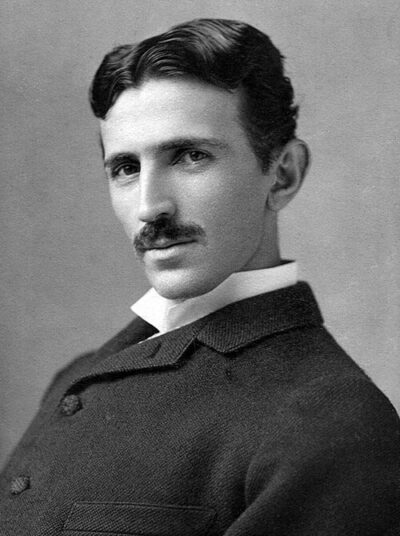
Nikola Tesla
Nikola Tesla was a Serbian-American engineer and inventor. Born July 10, 1856, in Nikola Tesla Memorial Center. Died January 7, 1943, in New Yorker Hotel. Educated at Karlovac Gymnasium and Graz University of Technology. Awards include Edison Medal, IEEE Fellow and Knight Grand Cross of the Order of the White Eagle.
Facts
52 facts · 2 confirmed by two sources · 31 cited · 19 from one source
Where this comes from
Papalocal keeps its own record. It started from these sources; what each one said is kept here as it was copied, so a change on their side never changes this page by itself. Tap one to read its version.
What Wikidata says · copied November 13, 2026 · revision 2567566127
- Described as
- Serbian-American engineer and inventor (1856–1943)
- Other names
- Nicola Tesla, Tesla
- Born
- July 10, 1856 · 8 references
- Died
- January 7, 1943 · 10 references
- Born in
- Nikola Tesla Memorial Center · 3 references
- Died in
- New Yorker Hotel · 5 references
- Buried in
- Nikola Tesla Museum, Belgrade, Serbia · 1 reference
- Cause of death
- myocardial infarction · 2 references
- Name at birth
- Никола Тесла · 1 reference
- Citizen of
- Austrian Empire (–1867) · 1 reference; Hungary (1867–1918); United States (1891–) · 1 reference
- Occupation
- inventor · 3 references; electrical engineer · 3 references; physicist · 3 references; electrician · 2 references; mechanical engineer · 1 reference; futurist
- Worked for
- Tesla Electric Light & Manufacturing (1886–) · 1 reference; Westinghouse Electric Corporation (1888–) · 1 reference
- Education
- Karlovac Gymnasium (1870–1873) · 1 reference; Graz University of Technology (1875–1878) · 1 reference; Charles University · 1 reference
- Member of
- Institute of Electrical and Electronics Engineers · 1 reference; Serbian Academy of Sciences and Arts (1894–1943) · 1 reference
- Awards
- Edison Medal (1916) · 1 reference; IEEE Fellow; Knight Grand Cross of the Order of the White Eagle · 1 reference; Elliott Cresson Medal (1894) · 1 reference; John Scott Award (1934) · 1 reference; Knight Grand Cross of the Order of Saint Sava; National Inventors Hall of Fame (1975) · 1 reference; Honorary doctor of the University of Zagreb · 1 reference; Grand cross of the Order of the White Lion (1936); Fellow of the American Association for the Advancement of Science; Honorary doctor of the Technical University of Graz; Order of the Crown; Order of Prince Danilo I; doctor honoris causa from the University of Paris (1937) · 2 references; Order of the White Lion
- Field
- electrical engineering · 1 reference; mechanical engineering · 1 reference; physicist · 1 reference; mechanics · 1 reference; inventor · 1 reference
- Father
- Milutin Tesla · 1 reference
- Mother
- Đuka Mandic · 1 reference
- Siblings
- Marica Tesla Kosanović · 1 reference
- Religion
- Serbian Orthodox Church · 1 reference
- Lived in
- Smiljan (1856–1870); Karlovac (1870–1873); Graz (1875–1878) · 1 reference; Prague (1880–1881); Budapest (1881–1882)
- Wikipedias with a page
- 221
Wikidata item Q9036 (wikidata.org/wiki/Q9036), public domain (CC0). Copied November 13, 2026.
What Wikipedia says · copied November 13, 2026 · revision 1384927900
Nikola Tesla (10 July 1856 – 7 January 1943) was a Serbian-American engineer, futurist, and inventor. He is known for his contributions to the design of the modern alternating current (AC) electricity supply system.
Born and raised in the Austro-Hungarian Empire, Tesla first studied engineering and physics in the 1870s without receiving a degree. He then gained practical experience in the early 1880s working in telephony and at Continental Edison in the new electric power industry. In 1884, he migrated to the United States, where he became a naturalized citizen. He worked for a short time at the Edison Machine Works in New York City before he struck out on his own. With the help of partners to finance and market his ideas, Tesla set up laboratories and companies in New York to develop a range of electrical and mechanical devices. His AC induction motor and related polyphase AC patents, licensed by Westinghouse Electric in 1888, earned him a considerable amount of money and became the cornerstone of the polyphase system, which Westinghouse marketed.
Tesla conducted a range of experiments with mechanical oscillators/generators, electrical discharge tubes, and early X-ray imaging among other things, in an attempt to develop inventions he could patent and market. He built a wirelessly controlled boat, one of the first wirelessly controlled vehicles ever produced. Tesla became well known as an inventor and demonstrated his achievements to celebrities and wealthy patrons at his lab. He was noted for his showmanship at public lectures. Throughout the 1890s, Tesla pursued his ideas for wireless lighting and worldwide wireless electric power distribution in his high-voltage, high-frequency power experiments in New York and Colorado Springs. In 1893, he made pronouncements on the possibility of wireless communication with his devices. Tesla tried to put these ideas to practical use in his unfinished Wardenclyffe Tower project, an intercontinental wireless communication and power transmitter, but ran out of funding before he could complete it.
After Wardenclyffe, Tesla experimented with a series of inventions in the 1910s and 1920s with varying degrees of success. Having spent most of his money, Tesla lived in a series of New York hotels, leaving behind unpaid bills. He died in New York City in January 1943. Tesla's work fell into relative obscurity following his death, until 1960, when the General Conference on Weights and Measures named the International System of Units (SI) measurement of magnetic flux density the tesla in his honor. There has been a resurgence in popular interest in Tesla since the 1990s. In 2013, Time magazine named him one of the 100 most significant figures of all time.
- Born, in its opening lines
- July 10, 1856
- Died, in its opening lines
- January 7, 1943
From the Wikipedia article “Nikola Tesla” (en.wikipedia.org/wiki/Nikola_Tesla), by its contributors, under CC BY-SA 4.0 (creativecommons.org/licenses/by-sa/4.0/). Copied November 13, 2026; not changed.
Confirmed Two sources agree. Cited One source, and it names where it got it. One source One source, without a reference of its own. Sources disagree The sources disagree. We show the best-supported value and keep theirs below.
