
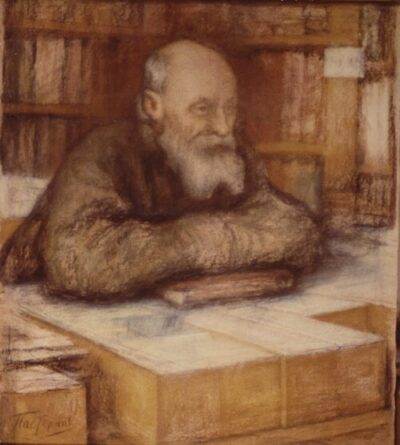
Nikolai Fyodorovich Fyodorov
Nikolai Fyodorovich Fyodorov was a Russian philosopher and life extensionist. Born June 9, 1829, in Klyuchi. Died December 28, 1903, in Moscow.
Facts
12 facts · 2 confirmed by two sources · 4 cited · 6 from one source
What’s different
- Born: we show June 9, 1829 (Confirmed). Wikidata also lists May 26, 1829 and 1828
- Died: we show December 28, 1903 (Confirmed). Wikidata also lists December 15, 1903
Where this comes from
Papalocal keeps its own record. It started from these sources; what each one said is kept here as it was copied, so a change on their side never changes this page by itself. Tap one to read its version.
What Wikidata says · copied November 16, 2026 · revision 2558183329
- Described as
- Russian philosopher and life extensionist (1829-1903)
- Born
- May 26, 1829; June 9, 1829 · 1 reference; 1828 · 1 reference
- Died
- December 15, 1903 · 2 references; December 28, 1903 · 1 reference
- Born in
- Klyuchi
- Died in
- Moscow · 1 reference
- Citizen of
- Russian Empire
- Occupation
- philosopher · 1 reference; librarian · 1 reference; writer · 1 reference
- Field
- philosophy; library science · 1 reference
- Father
- Pavel Gagarin
- Website
- http://nffedorov.ru
- Wikipedias with a page
- 35
Wikidata item Q463723 (wikidata.org/wiki/Q463723), public domain (CC0). Copied November 16, 2026.
What Wikipedia says · copied November 16, 2026 · revision 1384947433
Nikolai Fyodorovich Fyodorov (Russian: Николай Фёдорович Фёдоров; 9 June 1829 – 28 December 1903) was a Russian religious philosopher, futurologist, library scientist, and educator. He started the movement of Russian cosmism which was a precursor of transhumanism.
Fyodorov advocated radical life extension, physical immortality and even resurrection of the dead, using scientific methods.
He was called the "Socrates of Moscow." He was referred to with respect and admiration by Leo Tolstoy, Fyodor Dostoevsky, and V. S. Solovyov. His ideas influenced a diverse group of people, from early rocket scientists like Konstantin Tsiolkovsky to artists and composers, including Alexander Scriabin. He dreamed of resurrecting people, not wanting to be reconciled to the death of even one person. With the help of science, he intended to gather scattered molecules and atoms to "put them into the bodies of the fathers".
Fyodorov gave science a place next to art and religion in the Common Task of uniting humanity, including the dead, who must in the future be reunited with the living. He held that "we can become immortal and godlike through rational efforts and that our moral obligation is to create a heaven to be shared by all who ever lived." He was a devout member of the Russian Orthodox Christian Church, but was never a clergyman.
- Born, in its opening lines
- June 9, 1829
- Died, in its opening lines
- December 28, 1903
From the Wikipedia article “Nikolai Fyodorov (philosopher)” (en.wikipedia.org/wiki/Nikolai_Fyodorov_(philosopher)), by its contributors, under CC BY-SA 4.0 (creativecommons.org/licenses/by-sa/4.0/). Copied November 16, 2026; not changed.
Confirmed Two sources agree. Cited One source, and it names where it got it. One source One source, without a reference of its own. Sources disagree The sources disagree. We show the best-supported value and keep theirs below.
