
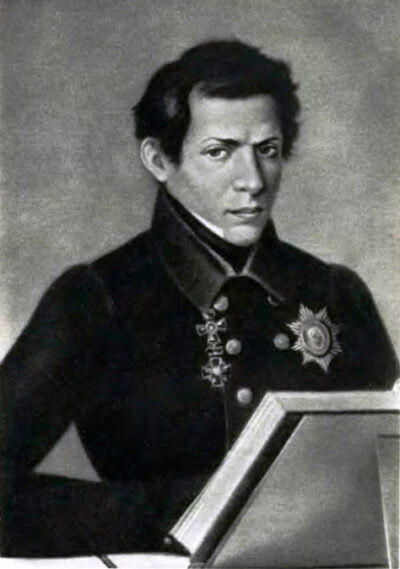
Nikolai Ivanovich Lobachevsky
Nikolai Ivanovich Lobachevsky was a Russian mathematician. Born November 20, 1792, in Nizhny Novgorod. Died February 12, 1856, in Kazan. Positions held include rector (1827–1846). Known for hyperbolic geometry, Test of Lobachevsky and Graeffe's method. Educated at Kazan Imperial University. Awards include Order of Saint Anna, 1st class, Order of Saint Anna, 2nd class and Order of Saint Stanislaus, 1st class.
Facts
30 facts · 0 confirmed by two sources · 11 cited · 17 from one source · 2 where the sources disagree
What’s different
- Born: we show November 20, 1792 (Sources disagree). Wikipedia says December 1, 1792
- Died: we show February 12, 1856 (Sources disagree). Wikipedia says February 24, 1856
Where this comes from
Papalocal keeps its own record. It started from these sources; what each one said is kept here as it was copied, so a change on their side never changes this page by itself. Tap one to read its version.
What Wikidata says · copied November 16, 2026 · revision 2564793357
- Described as
- Russian mathematician (1792–1856)
- Other names
- Nicholas Lobachevski, Nikolai Lobachevsky
- Born
- November 20, 1792 · 3 references
- Died
- February 12, 1856 · 4 references
- Born in
- Nizhny Novgorod · 1 reference
- Died in
- Kazan · 1 reference
- Buried in
- Arskoe cemetery · 1 reference
- Name at birth
- Николай Иванович Лобачевский · 1 reference
- Citizen of
- Russian Empire
- Occupation
- mathematician · 1 reference; university teacher · 1 reference
- Positions held
- rector (1827–1846) · 1 reference
- Worked for
- Kazan Imperial University (1814–1846) · 1 reference
- Education
- Kazan Imperial University (1807–1811) · 1 reference
- Member of
- Göttingen Academy of Sciences and Humanities in Lower Saxony
- Known for
- hyperbolic geometry; Test of Lobachevsky; Graeffe's method; Lobachevsky integral formula
- Awards
- Order of Saint Anna, 1st class (1852) · 1 reference; Order of Saint Anna, 2nd class (1836) · 1 reference; Order of Saint Stanislaus, 1st class (1844) · 1 reference; Order of Saint Stanislaus, 2nd class (1833) · 1 reference; Order of St. Vladimir, 4th class (1824) · 1 reference; Order of St. Vladimir the Equal-to-the-Apostles (3rd class) (1842) · 1 reference
- Field
- geometry · 1 reference; algebra; mathematical analysis; probability theory; trigonometry; mathematics · 1 reference
- Spouse
- Varvara Alexeyevna Moiseyeva (1832–) · 1 reference
- Wikipedias with a page
- 100
Wikidata item Q129199 (wikidata.org/wiki/Q129199), public domain (CC0). Copied November 16, 2026.
What Wikipedia says · copied November 16, 2026 · revision 1375161818
Nikolai Ivanovich Lobachevsky (; Russian: Никола́й Ива́нович Лобаче́вский, IPA: [nʲɪkɐˈlaj ɪˈvanəvʲɪtɕ ləbɐˈtɕefskʲɪj] ; 1 December [O.S. 20 November] 1792 – 24 February [O.S. 12 February] 1856) was a Russian mathematician and geometer, known primarily for his work on hyperbolic geometry, otherwise known as Lobachevskian geometry, and also for his fundamental study on Dirichlet integrals, known as the Lobachevsky integral formula.
William Kingdon Clifford called Lobachevsky the "Copernicus of Geometry" due to the revolutionary character of his work.
- Born, in its opening lines
- December 1, 1792
- Died, in its opening lines
- February 24, 1856
From the Wikipedia article “Nikolai Lobachevsky” (en.wikipedia.org/wiki/Nikolai_Lobachevsky), by its contributors, under CC BY-SA 4.0 (creativecommons.org/licenses/by-sa/4.0/). Copied November 16, 2026; not changed.
Confirmed Two sources agree. Cited One source, and it names where it got it. One source One source, without a reference of its own. Sources disagree The sources disagree. We show the best-supported value and keep theirs below.
