
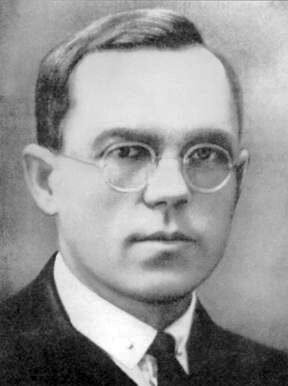
Nikolai Kondratiev
Nikolai Kondratiev was a Soviet economist. Born March 4, 1892, in Galuevskaya. Died September 17, 1938, in Kommunarka shooting ground. Positions held include Member of the Russian Constituent Assembly (1917–1918) and director (1920–1930). Educated at Faculty of Law, Saint Petersburg State University. Awards include Fellow of the Econometric Society.
Facts
28 facts · 2 confirmed by two sources · 7 cited · 19 from one source
What’s different
- Born: we show March 4, 1892 (Confirmed). Wikidata also lists March 16, 1892
Where this comes from
Papalocal keeps its own record. It started from these sources; what each one said is kept here as it was copied, so a change on their side never changes this page by itself. Tap one to read its version.
What Wikidata says · copied November 16, 2026 · revision 2546507624
- Described as
- Soviet economist (1892-1938)
- Other names
- Nikolai Dmitriyevich Kondratiev
- Born
- March 4, 1892 · 1 reference; March 16, 1892 · 1 reference
- Died
- September 17, 1938 · 2 references
- Born in
- Galuevskaya
- Died in
- Kommunarka shooting ground · 1 reference
- Buried in
- Kommunarka shooting ground
- Cause of death
- execution by shooting · 1 reference
- Citizen of
- Russian Empire; Russian Republic; Russian Socialist Federative Soviet Republic; Soviet Union
- Occupation
- economist · 1 reference; politician
- Positions held
- Member of the Russian Constituent Assembly (1917–1918); director (1920–1930)
- Political party
- Socialist Revolutionary Party (–1919)
- Worked for
- Russian University of Cooperation; Moscow City People’s University; Peter’s Agricultural Academy · 1 reference; Moscow Narodny Bank; Pomgol; Institute of Conjuncture; USSR People's Commissariat of Agriculture; Gosplan
- Education
- Faculty of Law, Saint Petersburg State University (–1914) · 1 reference
- Member of
- Econometric Society (1933–) · 1 reference
- Awards
- Fellow of the Econometric Society (1933) · 1 reference
- Field
- economics
- Children
- Elena Kondratieva
- Wikipedias with a page
- 37
Wikidata item Q312799 (wikidata.org/wiki/Q312799), public domain (CC0). Copied November 16, 2026.
What Wikipedia says · copied November 16, 2026 · revision 1384454227
Nikolai Dmitriyevich Kondratiev (; also Kondratieff; Russian: Никола́й Дми́триевич Кондра́тьев; 4 March 1892 – 17 September 1938) was a Russian Soviet economist and proponent of the New Economic Policy (NEP) best known for the business cycle theory known as Kondratiev waves. Despite being a Soviet citizen, he was not a Marxian economist.
Kondratiev became an early leading figure of Soviet economics and promoted the NEP's system of small private free market enterprises in the Soviet Union. Kondratiev's theory that Western capitalist economies have long term (50-to-60-year) cycles of boom followed by depression gained recognition inside and outside the Soviet Union.
Kondratiev was condemned and imprisoned in 1930, but continued to work until his execution during the Great Purge in 1938. Some of his work was published, for the first time, posthumously.
- Born, in its opening lines
- March 4, 1892
- Died, in its opening lines
- September 17, 1938
From the Wikipedia article “Nikolai Kondratiev” (en.wikipedia.org/wiki/Nikolai_Kondratiev), by its contributors, under CC BY-SA 4.0 (creativecommons.org/licenses/by-sa/4.0/). Copied November 16, 2026; not changed.
Confirmed Two sources agree. Cited One source, and it names where it got it. One source One source, without a reference of its own. Sources disagree The sources disagree. We show the best-supported value and keep theirs below.
