
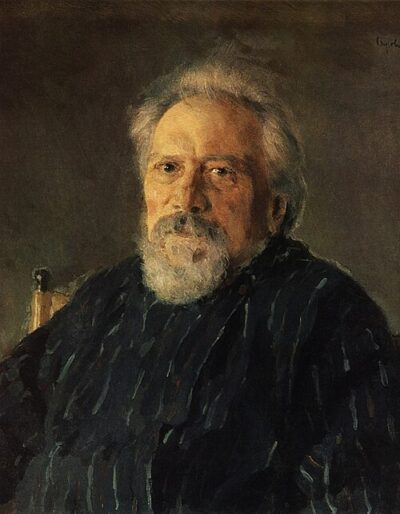
Nikolai Leskov
Nikolai Leskov was a Russian writer. Born February 4, 1831. Died February 21, 1895, in Saint Petersburg. Known for Lady Macbeth of the Mtsensk District.
Facts
18 facts · 0 confirmed by two sources · 3 cited · 13 from one source · 2 where the sources disagree
What’s different
- Born: we show February 4, 1831 (Sources disagree). Wikipedia says February 16, 1831
- Died: we show February 21, 1895 (Sources disagree). Wikipedia says March 5, 1895
Where this comes from
Papalocal keeps its own record. It started from these sources; what each one said is kept here as it was copied, so a change on their side never changes this page by itself. Tap one to read its version.
What Wikidata says · copied November 16, 2026 · revision 2565596989
- Described as
- Russian writer (1831–1895)
- Other names
- M. Stebnitsky, Nikolai Semyonovich Leskov, N.S. Ljeskow
- Born
- February 4, 1831 · 3 references
- Died
- February 21, 1895 · 3 references
- Died in
- Saint Petersburg · 1 reference
- Buried in
- Volkovo Cemetery Writer's Walkways
- Cause of death
- asthma
- Citizen of
- Russian Empire
- Occupation
- writer · 5 references; journalist; novelist; playwright; prose writer · 1 reference; opinion journalist · 1 reference; short story writer; librettist · 1 reference
- Genre
- short novel · 1 reference; sketch story · 1 reference; skaz · 1 reference
- Known for
- Lady Macbeth of the Mtsensk District · 1 reference
- Wikipedias with a page
- 60
Wikidata item Q209004 (wikidata.org/wiki/Q209004), public domain (CC0). Copied November 16, 2026.
What Wikipedia says · copied November 16, 2026 · revision 1380020081
Nikolai Semyonovich Leskov (Russian: Никола́й Семёнович Леско́в; 16 February [O.S. 4 February] 1831 – 5 March [O.S. 21 February] 1895) was a Russian novelist, short-story writer, playwright, and journalist, who also wrote under the pseudonym M. Stebnitsky. Praised for his unique writing style and innovative experiments in form, and held in high esteem by Leo Tolstoy, Anton Chekhov and Maxim Gorky among others, Leskov is credited with creating a comprehensive picture of contemporary Russian society using mostly short literary forms. His major works include Lady Macbeth of Mtsensk (1865), which was later made into an opera by Shostakovich; The Cathedral Folk (1872); The Enchanted Wanderer (1873); and "The Tale of Cross-eyed Lefty from Tula and the Steel Flea" (1881).
Leskov received his formal education at the Oryol Lyceum. In 1847 Leskov joined the Oryol criminal court office, later transferring to Kyiv, where he worked as a clerk, attended university lectures, mixed with local people, and took part in various student circles. In 1857 Leskov quit his job as a clerk and went to work for the private trading company Scott & Wilkins owned by Alexander Scott, his aunt's Scottish husband.
His literary career began in the early 1860s with the publication of his short story The Extinguished Flame (1862), and his novellas Musk-Ox (May 1863) and The Life of a Peasant Woman (September, 1863). His first novel No Way Out was published under the pseudonym M. Stebnitsky in 1864. From the mid-1860s to the mid-1880s Leskov published a wide range of works, including journalism, sketches, short stories, and novels. Leskov's major works, many of which continue to be published in modern versions, were written during this time. A number of his later works were banned because of their satirical treatment of the Russian Orthodox Church and its functionaries. Leskov died on 5 March 1895, aged 64, and was interred in the Volkovo Cemetery in Saint Petersburg, in the section reserved for literary figures.
- Born, in its opening lines
- February 16, 1831
- Died, in its opening lines
- March 5, 1895
From the Wikipedia article “Nikolai Leskov” (en.wikipedia.org/wiki/Nikolai_Leskov), by its contributors, under CC BY-SA 4.0 (creativecommons.org/licenses/by-sa/4.0/). Copied November 16, 2026; not changed.
Confirmed Two sources agree. Cited One source, and it names where it got it. One source One source, without a reference of its own. Sources disagree The sources disagree. We show the best-supported value and keep theirs below.
