
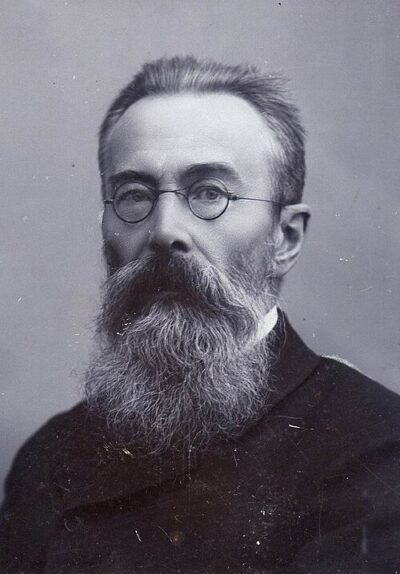
Nikolai Rimsky-Korsakov
Nikolai Rimsky-Korsakov was a Russian composer. Born March 6, 1844, in Tikhvin. Died June 8, 1908, in Lyubensk. Known for Scheherazade, Symphony No. 1 and The Golden Cockerel. Educated at Naval Cadet Corps.
Facts
33 facts · 0 confirmed by two sources · 6 cited · 25 from one source · 2 where the sources disagree
What’s different
- Born: we show March 6, 1844 (Sources disagree). Wikipedia says March 18, 1844
- Died: we show June 8, 1908 (Sources disagree). Wikipedia says June 21, 1908
Where this comes from
Papalocal keeps its own record. It started from these sources; what each one said is kept here as it was copied, so a change on their side never changes this page by itself. Tap one to read its version.
What Wikidata says · copied November 16, 2026 · revision 2570046490
- Described as
- Russian composer (1844–1908)
- Other names
- Nikolai Rimsky-Korsakoff, Nikolai Andreyevich Rimsky-Korsakoff, Nikolay Rimskiy-Korsakov, Rimsky-Korsakow, N. Rimsky-Korsakoff, Rimsky-Korsakoff, Rimski-Korsakov, Nikolai Rimski-Korsakov, Nikolai Andreyevich Rimsky-Korsakov, Nikolay Rimsky-Korsakov, Rimskij-Korsakov, Rimsky-Korsakov
- Born
- March 6, 1844 · 2 references
- Died
- June 8, 1908 · 2 references
- Born in
- Tikhvin · 6 references
- Died in
- Lyubensk · 4 references
- Buried in
- Tikhvin Cemetery
- Cause of death
- myocardial infarction
- Citizen of
- Russian Empire
- Occupation
- composer · 5 references; conductor · 1 reference; musicologist; autobiographer; music educator; music theorist; university teacher; military personnel · 1 reference
- Worked for
- Saint Petersburg Conservatory
- Education
- Naval Cadet Corps (1856–)
- Member of
- The Five
- Genre
- opera; symphony; classical music
- Instrument
- piano · 1 reference
- Known for
- Scheherazade; Symphony No. 1; The Golden Cockerel
- Spouse
- Nadezhda Rimskaya-Korsakova · 1 reference
- Children
- Andrey Rimsky-Korsakov; Mikhail Rimsky-Korsakov · 1 reference; Vladimir Rimsky-Korsakov
- Father
- Andrey Rimsky-Korsakov
- Mother
- Sofia Skaryatina
- Siblings
- Voin Rimsky-Korsakov · 1 reference
- Religion
- Eastern Orthodoxy
- Wikipedias with a page
- 93
Wikidata item Q93227 (wikidata.org/wiki/Q93227), public domain (CC0). Copied November 16, 2026.
What Wikipedia says · copied November 16, 2026 · revision 1385844803
Nikolai Andreyevich Rimsky-Korsakov (18 March 1844 – 21 June 1908) was a Russian composer, a member of the group of composers known as The Five. His best-known orchestral compositions—Capriccio Espagnol, the Russian Easter Festival Overture, and the symphonic suite Scheherazade—are staples of the classical music repertoire, along with suites and excerpts from some of his fifteen operas. Scheherazade is an example of his frequent use of fairy-tale and folk subjects. He was the husband of the composer Nadezhda Rimskaya-Korsakova.
Rimsky-Korsakov believed in developing a nationalistic style of classical music, employing Russian folk song and lore along with exotic harmonic, melodic and rhythmic elements in a practice known as musical orientalism, and eschewing traditional Western compositional methods. Rimsky-Korsakov appreciated Western musical techniques after he became a professor of musical composition, harmony, and orchestration at the Saint Petersburg Conservatory in 1871. He undertook a rigorous three-year program of self-education and became a master of Western methods, incorporating them alongside the influences of Mikhail Glinka and fellow members of The Five. Rimsky-Korsakov's techniques of composition and orchestration were further enriched by his exposure to the works of Richard Wagner.
For much of his life, Rimsky-Korsakov combined his composition and teaching with a career in the Russian armed forces—first as an officer in the Imperial Russian Navy, then as the civilian Inspector of Naval Bands. He wrote that he developed a passion for the ocean in childhood from reading books and hearing of his older brother's exploits in the navy. This love of the sea may have influenced him to write two of his best-known orchestral works, the musical tableau Sadko (not to be confused with his later opera of the same name) and Scheherazade. As Inspector of Naval Bands, Rimsky-Korsakov expanded his knowledge of woodwind and brass playing, which enhanced his abilities in orchestration. He passed this knowledge to his students, and also posthumously through a textbook on orchestration that was completed by his son-in-law Maximilian Steinberg.
Rimsky-Korsakov left a considerable body of original Russian nationalist compositions. He prepared works by The Five for performance, which brought them into the active classical repertoire (although there is controversy over his editing of the works of Modest Mussorgsky), and shaped a generation of younger composers and musicians during his decades as an educator. Rimsky-Korsakov is therefore considered "the main architect" of what the classical-music public considers the "Russian style". His influence on younger composers was especially important, as he served as a transitional figure between the autodidactism exemplified by Glinka and The Five, and professionally trained composers, who became the norm in Russia by the closing years of the 19th century. While Rimsky-Korsakov's style was based on those of Glinka, Balakirev, Hector Berlioz, Franz Liszt and, for a brief period, Wagner, he "transmitted this style directly to two generations of Russian composers" and influenced non-Russian composers including Maurice Ravel, Claude Debussy, Paul Dukas, and Ottorino Respighi.
- Born, in its opening lines
- March 18, 1844
- Died, in its opening lines
- June 21, 1908
From the Wikipedia article “Nikolai Rimsky-Korsakov” (en.wikipedia.org/wiki/Nikolai_Rimsky-Korsakov), by its contributors, under CC BY-SA 4.0 (creativecommons.org/licenses/by-sa/4.0/). Copied November 16, 2026; not changed.
Confirmed Two sources agree. Cited One source, and it names where it got it. One source One source, without a reference of its own. Sources disagree The sources disagree. We show the best-supported value and keep theirs below.
