
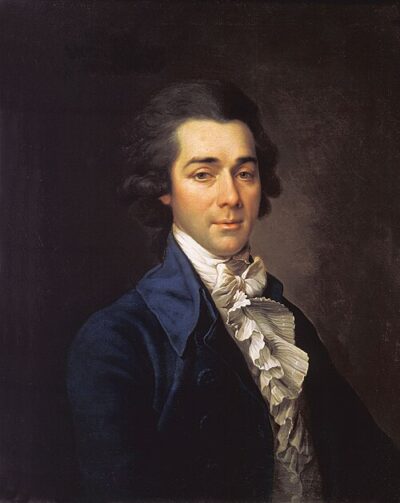
Nikolay Alexandrovich Lvov
Nikolay Alexandrovich Lvov was a Russian artist and architect. Born May 4, 1753, in Nikolskoe. Died January 2, 1804, in Moscow. Known for Priory Palace.
Facts
18 facts · 1 confirmed by two sources · 4 cited · 12 from one source · 1 where the sources disagree
What’s different
- Born: we show May 4, 1753 (Confirmed). Wikidata also lists 1751
- Died: we show January 2, 1804 (Sources disagree). Wikidata also lists December 22, 1803
Where this comes from
Papalocal keeps its own record. It started from these sources; what each one said is kept here as it was copied, so a change on their side never changes this page by itself. Tap one to read its version.
What Wikidata says · copied November 18, 2026 · revision 2569061491
- Described as
- Russian artist and architect (1753-1804)
- Other names
- Nikolay L'vov, Nikolay Aleksandrovich L'vov, Nikolaj Aleksandrovič L'vov, N.A. Lvov, Nikolay Aleksandrovich Lvov
- Born
- May 4, 1753; 1751 · 2 references
- Died
- December 22, 1803; January 2, 1804 · 1 reference
- Born in
- Nikolskoe
- Died in
- Moscow
- Citizen of
- Russian Empire
- Occupation
- anthropologist; linguist; poet · 1 reference; architect · 2 references; composer · 1 reference; actor · 1 reference; graphic artist · 1 reference; writer · 1 reference
- Known for
- Priory Palace
- Spouse
- Maria Alexeevna Dyakova
- Children
- Vera Lvova; Aleksandr Lvov; Elizaveta Nikolaevna Lvova
- Wikipedias with a page
- 20
Wikidata item Q51131 (wikidata.org/wiki/Q51131), public domain (CC0). Copied November 18, 2026.
What Wikipedia says · copied November 18, 2026 · revision 1342482353
Nikolay Aleksandrovich Lvov (Russian: Николай Александрович Львов; May 4, 1753 – December 21, 1803) was a Russian artist of the Age of Enlightenment. Lvov, an amateur of noble lineage, was a polymath who contributed to geology, history, graphic arts and poetry, but is known primarily as an architect and ethnographer, compiler of the first significant collection of Russian folk songs (the Lvov-Prach collection).
Lvov's architecture represented the second, "strict" generation of neoclassicism stylistically close to Giacomo Quarenghi. Lvov worked in Saint Petersburg but his best works survived in the countryside, especially his native Tver Governorate. He redesigned the external appearance of Peter and Paul Fortress and created an unprecedented Trinity Church combining a Roman rotunda with one-of-a-kind pyramidal bell tower. He adapted rammed earth technology to the environment of Northern Russia and used it in his extant Priory Palace in Gatchina; Lvov's construction school, established in 1797, trained over 800 craftsmen. He managed geological surveys and published a treatise on the coals from Donets Basin and Moscow Basin. He experimented with coal pyrolysis, proposed new uses for coal tar and sulphur, and wrote a reference book on heating and ventilation.
Lvov designed the badges of the Order of St. Vladimir and the Order of St. Anna, translated works by Anacreon, Palladio, Petrarch, Sappho and the Saga of King Harald into Russian language, wrote libretto for opera and vaudeville, researched Russian chronicles and published one of the first versions of the bylina of Dobrynya Nikitich. In 1783, he became one of the first 36 members of the Russian Academy.
In 1931, Vladislav Khodasevich called Lvov "an intelligent and subtle connoisseur of everything ... who was not destined to do anything remarkable." Later researchers appreciated Lvov's contribution: Richard Taruskin considered Lvov's collection of folk songs "the greatest and most culturally significant of Russian folk collections", Philip Bohlman credited discovery of Russian folk art "all from the actions of a single individual, Lvov", William Craft Brumfield called Lvov "one of the greatest neoclassical architects produced in the reign of Catherine the Great... neoclassical aesthetics at its purest".
- Born, in its opening lines
- May 4, 1753
- Died, in its opening lines
- December 21, 1803
From the Wikipedia article “Nikolay Lvov” (en.wikipedia.org/wiki/Nikolay_Lvov), by its contributors, under CC BY-SA 4.0 (creativecommons.org/licenses/by-sa/4.0/). Copied November 18, 2026; not changed.
Confirmed Two sources agree. Cited One source, and it names where it got it. One source One source, without a reference of its own. Sources disagree The sources disagree. We show the best-supported value and keep theirs below.
