
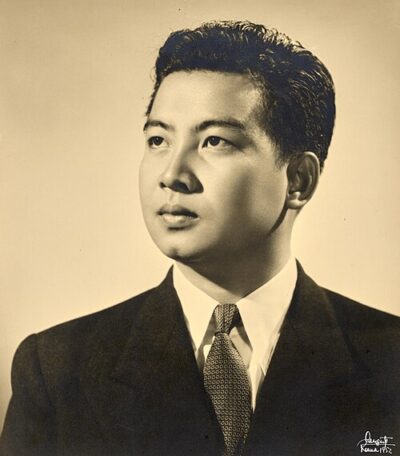
Norodom Sihanouk
Norodom Sihanouk was a Cambodian monarch and politician. Born October 31, 1922, in Phnom Penh. Died October 15, 2012, in Beijing. Positions held include Prime Minister of Cambodia (4 times) (1945–1962), King of Cambodia (2 times) (1941–2004) and king (1960–1970). Known for The little prince, Twilight and My Village at Sunset. Educated at Cavalry Training School Saumur. Awards include Order of Suvorov, 1st class, Order of the Nile and Collar of the Supreme Order of the Chrysanthemum.
Facts
64 facts · 2 confirmed by two sources · 8 cited · 54 from one source
Where this comes from
Papalocal keeps its own record. It started from these sources; what each one said is kept here as it was copied, so a change on their side never changes this page by itself. Tap one to read its version.
What Wikidata says · copied November 16, 2026 · revision 2565533937
- Described as
- Cambodian monarch and politician (1922–2012)
- Other names
- Sihanouk, Prince Sihanouk, King Norodom Sihanouk, King Sihanouk, Prince Norodom Sihanouk, Narottama Sīhanu
- Born
- October 31, 1922 · 9 references
- Died
- October 15, 2012 · 3 references
- Born in
- Phnom Penh · 1 reference
- Died in
- Beijing · 1 reference
- Buried in
- Silver Pagoda, Phnom Penh
- Cause of death
- myocardial infarction
- Citizen of
- Cambodia
- Occupation
- politician · 1 reference; film director; actor; singer; musician; composer; screenwriter · 1 reference; ruler · 1 reference
- Positions held
- Prime Minister of Cambodia (4 times) (1945–1962); King of Cambodia (2 times) (1941–2004); king (1960–1970); president (1975–1976)
- Political party
- Sangkum; National United Front for an Independent, Neutral, Peaceful and Cooperative Cambodia
- Education
- Cavalry Training School Saumur · 1 reference
- Instrument
- clarinet; saxophone; piano; accordion
- Known for
- The little prince; Twilight; My Village at Sunset; See Angkor and Die
- Awards
- Order of Suvorov, 1st class; Order of the Nile; Collar of the Supreme Order of the Chrysanthemum; Grand Cross of the Legion of Honour; Grand cross of the Order of the Dragon of Annam; Thiri Thudhamma Thingaha; Order of the Royal House of Chakri; Grand cross of the Order of the White Lion; Order of Sikatuna; Grand Cross of the Order of Polonia Restituta; Imperial Order of the Yoke and Arrows; Grand Cross of the Cross of Military Merit with White Decoration (1956) · 1 reference; National Order of Vietnam; Order of the Crown of the Realm; Grand cross of the Order of the Million Elephants and the White Parasol
- Spouse
- Norodom Monineath (1952–2012) · 1 reference; Mam Manivan Phanivong; Phat Kanhol (1943–1944) · 1 reference; Sisowath Pongsanmoni (1944–1951) · 1 reference; Sisowath Monikessan (1941–1946)
- Children
- Norodom Arunrasmy · 1 reference; Norodom Ranariddh · 1 reference; Norodom Sihamoni · 1 reference; Norodom Narindrapong; Norodom Chakrapong; Norodom Yuvaneath; Norodom Buppha Devi; Norodom Kantha Bopha · 1 reference; Norodom Naradipo; Norodom Sujata
- Father
- Norodom Suramarit
- Mother
- Sisowath Kossamak
- Religion
- Theravāda
- Website
- http://www.norodomsihanouk.info
- Wikipedias with a page
- 91
Wikidata item Q160318 (wikidata.org/wiki/Q160318), public domain (CC0). Copied November 16, 2026.
What Wikipedia says · copied November 16, 2026 · revision 1384858666
Norodom Sihanouk (; 31 October 1922 – 15 October 2012) was King, Chief of State and Prime Minister of Cambodia. He is known as Samdech Euv (meaning "King Father") or by his nickname The Pink Prince. During his lifetime, Cambodia was under various regimes, from French colonial rule (until 1953), a Japanese puppet state (1945), an independent kingdom (1953–1970), a military republic (1970–1975), the Khmer Rouge regime (1975–1979), a Vietnamese-backed communist regime (1979–1989), a transitional communist regime (1989–1993) to eventually another kingdom (since 1993).
Sihanouk was the only child of Prince Norodom Suramarit and Princess Sisowath Kossamak, daughter of King Sisowath Monivong. When his grandfather Monivong died in 1941, Sihanouk became king amidst French colonial rule. After the Japanese occupation of Cambodia during World War II, he secured Cambodian independence from France in 1953. He abdicated in 1955 and was succeeded by his father, Suramarit, so as to directly participate in politics. Sihanouk's political party, Sangkum, won the general elections that year, and he became prime minister of Cambodia. He governed the country under one-party rule and suppressed political dissent. After his father died in 1960, Sihanouk assumed a new position as Chief of State of Cambodia.
Officially neutral in foreign relations, Sihanouk was closer to the communist bloc in practice. The 1970 Cambodian coup d'état ousted him, and he fled to China and North Korea, forming a government-in-exile and a resistance movement there. He encouraged Cambodians to fight the new government and backed the Khmer Rouge during the Cambodian Civil War. He returned as figurehead head of state after the Khmer Rouge's victory in 1975. His relations with the new Khmer Rouge government soured, and in 1976 he resigned. He was placed under house arrest until Vietnamese forces overthrew the Khmer Rouge in 1979.
Sihanouk went into exile again and in 1981 formed FUNCINPEC, a monarchist resistance party. The following year, he became president of the Coalition Government of Democratic Kampuchea (CGDK), a broad coalition of anti-Vietnamese resistance factions which retained Cambodia's seat at the United Nations, making him Cambodia's internationally recognized head of state. In the late 1980s, informal talks were carried out to end hostilities between the Vietnam-supported People's Republic of Kampuchea and the CGDK. In 1990, the Supreme National Council of Cambodia was formed as a transitional body to oversee Cambodia's sovereign matters, with Sihanouk as its president. The 1991 Paris Peace Accords were signed, and the UN Transitional Authority in Cambodia (UNTAC) was established the following year. The UNTAC organized the general elections in 1993, and a coalition government, jointly led by his son Norodom Ranariddh and Hun Sen, was subsequently formed. Sihanouk was reinstated as Cambodia's king. He abdicated again in 2004, and the Royal Council of the Throne chose his son Norodom Sihamoni as his successor. Sihanouk died in Beijing in 2012.
Between 1941 and 2006, Sihanouk produced and directed 50 films, some of which he acted in. The films, later described as being of low quality, often featured nationalistic elements, as did a number of the songs he wrote. Some of his songs were about his wife Monique, the nations neighboring Cambodia, and the communist leaders who supported him in his exile. In the 1980s, Sihanouk held concerts for diplomats in New York City. He also participated in concerts at his palace during his second reign. Sihanouk is remembered for his role in shaping modern Cambodia, particularly in leading the country to independence, although his reputation was damaged by his association with the Khmer Rouge in the 1970s.
- Born, in its opening lines
- October 31, 1922
- Died, in its opening lines
- October 15, 2012
From the Wikipedia article “Norodom Sihanouk” (en.wikipedia.org/wiki/Norodom_Sihanouk), by its contributors, under CC BY-SA 4.0 (creativecommons.org/licenses/by-sa/4.0/). Copied November 16, 2026; not changed.
Confirmed Two sources agree. Cited One source, and it names where it got it. One source One source, without a reference of its own. Sources disagree The sources disagree. We show the best-supported value and keep theirs below.
