
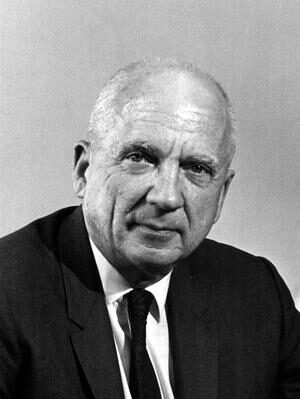
Norris Bradbury
Norris Bradbury was an American physicist. Born May 30, 1909, in Santa Barbara. Died August 20, 1997, in Los Alamos. Educated at Pomona College and University of California, Berkeley. Awards include Department of Defense Medal for Distinguished Public Service, Enrico Fermi Award and Legionnaire of Legion of Merit.
Facts
20 facts · 2 confirmed by two sources · 5 cited · 13 from one source
Where this comes from
Papalocal keeps its own record. It started from these sources; what each one said is kept here as it was copied, so a change on their side never changes this page by itself. Tap one to read its version.
What Wikidata says · copied November 16, 2026 · revision 2512680834
- Described as
- American physicist
- Other names
- Norris Edwin Bradbury
- Born
- May 30, 1909 · 1 reference
- Died
- August 20, 1997 · 2 references
- Born in
- Santa Barbara · 1 reference
- Died in
- Los Alamos
- Buried in
- Guaje Pines Cemetery · 1 reference
- Cause of death
- infectious disease
- Citizen of
- United States · 1 reference
- Occupation
- physicist · 1 reference; nuclear physicist
- Worked for
- Stanford University
- Education
- Pomona College; University of California, Berkeley
- Member of
- Phi Beta Kappa Society; National Academy of Sciences (1951–)
- Awards
- Department of Defense Medal for Distinguished Public Service; Enrico Fermi Award (1970) · 1 reference; Legionnaire of Legion of Merit; Fellow of the American Physical Society
- Field
- physics
- Military branch
- United States Navy
- Wikipedias with a page
- 21
Wikidata item Q322456 (wikidata.org/wiki/Q322456), public domain (CC0). Copied November 16, 2026.
What Wikipedia says · copied November 16, 2026 · revision 1373073840
Norris Edwin Bradbury (May 30, 1909 – August 20, 1997) was an American physicist who served as director of the Los Alamos National Laboratory for 25 years from 1945 to 1970. He succeeded Robert Oppenheimer, who personally chose Bradbury for the position of director after working closely with him on the Manhattan Project during World War II. Bradbury was in charge of the final assembly of "the Gadget", detonated in July 1945 for the Trinity test.
Bradbury took charge at Los Alamos at a difficult time. Staff were leaving in droves, living conditions were poor and there was a possibility that the laboratory would close. He managed to persuade enough staff to stay and got the University of California to renew the contract to manage the laboratory. He pushed continued development of nuclear weapons, transforming them from laboratory devices to production models. Numerous improvements made them safer, more reliable and easier to store and handle, and made more efficient use of scarce fissionable materiel.
In the 1950s Bradbury oversaw the development of thermonuclear weapons, although a falling-out with Edward Teller over the priority given to their development led to the creation of a rival nuclear weapons laboratory, the Lawrence Livermore Laboratory. In later years, he branched out, constructing the Los Alamos Meson Physics Facility to develop the laboratory's role in nuclear science, and during the Space Race of the 1960s, the laboratory developed the Nuclear Engine for Rocket Vehicle Application (NERVA). The Bradbury Science Museum is named in his honor.
- Born, in its opening lines
- May 30, 1909
- Died, in its opening lines
- August 20, 1997
From the Wikipedia article “Norris Bradbury” (en.wikipedia.org/wiki/Norris_Bradbury), by its contributors, under CC BY-SA 4.0 (creativecommons.org/licenses/by-sa/4.0/). Copied November 16, 2026; not changed.
Confirmed Two sources agree. Cited One source, and it names where it got it. One source One source, without a reference of its own. Sources disagree The sources disagree. We show the best-supported value and keep theirs below.
