
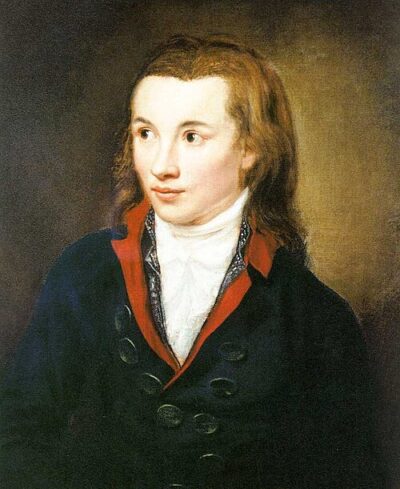
Novalis
Novalis was a German poet and writer. Born May 2, 1772, in Wiederstedt. Died March 25, 1801, in Weißenfels. Known for Heinrich von Ofterdingen and Hymns to the Night. Educated at Leipzig University and University of Jena.
Facts
26 facts · 2 confirmed by two sources · 6 cited · 18 from one source
Where this comes from
Papalocal keeps its own record. It started from these sources; what each one said is kept here as it was copied, so a change on their side never changes this page by itself. Tap one to read its version.
What Wikidata says · copied November 16, 2026 · revision 2563980746
- Described as
- German poet and writer (1772-1801)
- Other names
- Georg Philipp Friedrich Freiherr von Hardenberg, Friedrich von Hardenberg, Georg Friedrich Philipp von Hardenberg
- Born
- May 2, 1772 · 12 references
- Died
- March 25, 1801 · 13 references
- Born in
- Wiederstedt · 1 reference
- Died in
- Weißenfels · 1 reference
- Buried in
- Alter Friedhof · 1 reference
- Cause of death
- bleeding
- Name at birth
- Georg Friedrich Philipp von Hardenberg
- Citizen of
- Electorate of Saxony
- Occupation
- poet · 1 reference; lyricist; philosopher; engineer; literary theorist · 1 reference; writer · 2 references
- Education
- Leipzig University; University of Jena (1790–1794); University of Wittenberg; Freiberg University of Mining and Technology (1797–)
- Known for
- Heinrich von Ofterdingen; Hymns to the Night
- Father
- Heinrich Ulrich Erasmus von Hardenberg
- Mother
- Auguste Bernhardine von Hardenberg
- Siblings
- Carl von Hardenberg; Anton von Hardenberg; Sidonie von Hardenberg
- Religion
- Lutheranism
- Wikipedias with a page
- 114
Wikidata item Q60684 (wikidata.org/wiki/Q60684), public domain (CC0). Copied November 16, 2026.
What Wikipedia says · copied November 16, 2026 · revision 1385488048
Georg Philipp Friedrich von Hardenberg (2 May 1772 – 25 March 1801), better known by his pen name Novalis (; German: [noˈvaːlɪs]), was a German aristocrat and polymath, who was a poet, novelist, philosopher and mystic. He is regarded as an influential figure in Jena Romanticism.
Novalis was born into a minor branch of the Hardenberg family in Electoral Saxony. He was the second of eleven children; his early household observed a strict Pietist faith. He studied law at the University of Jena, the University of Leipzig, and the University of Wittenberg. While at Jena, he published his first poem and befriended the playwright and fellow poet Friedrich Schiller. In Leipzig, he met Friedrich Schlegel, and the two became lifelong friends. Novalis completed his law degree in 1794 at the age of 22. He then worked as a legal assistant in Tennstedt immediately after graduating. There, he met Sophie von Kühn. The following year Novalis and Sophie became secretly engaged. Sophie became severely ill soon after the engagement and died just after her 15th birthday. Sophie's early death had a life-long impact on Novalis and his writing.
Novalis enrolled at the Freiberg University of Mining and Technology in 1797, where he studied a wide number of disciplines including electricity, medicine, chemistry, physics, mathematics, mineralogy and natural philosophy. He conversed with many of the formative figures of Early German Romanticism, including Goethe, Friedrich Schelling, Jean Paul and August Schlegel. After finishing his studies, Novalis served as a director of salt mines in Saxony and later in Thuringia. During this time, Novalis wrote major poetic and literary works, including Hymns to the Night. By August 1800, he fell terminally ill with a severe lung condition, rendering him unable to continue his professional duties. In 1800, he began showing signs of illness, which is thought to have been either tuberculosis or cystic fibrosis, and died on 25 March 1801 at the age of 28.
Novalis's early reputation as a romantic poet was primarily based on his literary works, which were published by his friends Friedrich Schlegel and Ludwig Tieck shortly after his death, in 1802. These works include the collection of poems, Hymns to the Night and Spiritual Hymns, and his unfinished novels, Heinrich von Ofterdingen and The Novices at Sais. Schlegel and Tieck published only a small sample of his philosophical and scientific writings.
The depth of Novalis's knowledge in fields like philosophy and natural science came to be more broadly appreciated with the more extensive publication of his notebooks in the twentieth century. Novalis was not only well read in his chosen disciplines; he also sought to integrate his knowledge with his art. This goal is evident in his use of the fragment, a literary form in which he wrote alongside Friedrich Schlegel, publishing his pieces in Schlegel's journal, Athenaeum. The fragment allowed him to synthesize poetry, philosophy, and science into a single art form that could be used to address a wide variety of topics. Just as Novalis's literary works have established his reputation as a poet, the notebooks and fragments have subsequently established his intellectual role in the formation of Early German Romanticism.
- Born, in its opening lines
- May 2, 1772
- Died, in its opening lines
- March 25, 1801
From the Wikipedia article “Novalis” (en.wikipedia.org/wiki/Novalis), by its contributors, under CC BY-SA 4.0 (creativecommons.org/licenses/by-sa/4.0/). Copied November 16, 2026; not changed.
Confirmed Two sources agree. Cited One source, and it names where it got it. One source One source, without a reference of its own. Sources disagree The sources disagree. We show the best-supported value and keep theirs below.
