
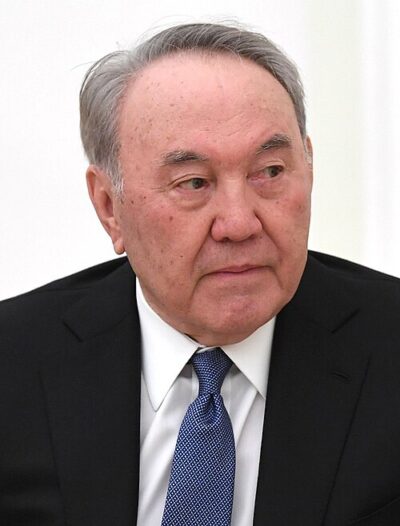
Nursultan Nazarbayev
Nursultan Nazarbayev is a President of Kazakhstan from 1991 to 2019. Born July 6, 1940, in Shamalgan. Positions held include President of Kazakhstan (1991–2019), Chairman of the Council of Ministers of the Kazakh SSR (1984–1989) and deputy of the Supreme Soviet of the Soviet Union. Awards include Hero of the Kazakhstan, Order of Fatherland and Order of the Golden Eagle.
Facts
46 facts · 1 confirmed by two sources · 2 cited · 43 from one source
Where this comes from
Papalocal keeps its own record. It started from these sources; what each one said is kept here as it was copied, so a change on their side never changes this page by itself. Tap one to read its version.
What Wikidata says · copied November 16, 2026 · revision 2564447279
- Described as
- President of Kazakhstan from 1991 to 2019
- Other names
- Nursultan Abishuly Nazarbayev, Nursultan Abishevich Nazarbayev, Nūrsūltan Äbışūly Nazarbaev, Nursultan A. Nazarbayev, Nūrsūltan Nazarbaev
- Born
- July 6, 1940 · 4 references
- Born in
- Shamalgan
- Citizen of
- Soviet Union; Kazakhstan
- Occupation
- politician · 1 reference
- Positions held
- President of Kazakhstan (1991–2019); Chairman of the Council of Ministers of the Kazakh SSR (1984–1989); deputy of the Supreme Soviet of the Soviet Union; Member of the Supreme Council of the Kazakh SSR; Chair of Amanat (1999–2022); Member of the Politburo of the CPSU Central Committee (1990–1991); First Secretary of the Central Committee of the Communist Party of Kazakhstan (1989–1991); Chairman of the Council of CIS Heads of State (2 times) (2006–2015) · 1 reference; Chairman of the Supreme Council of the Kazakh SSR (1990) · 1 reference
- Political party
- Communist Party of the Soviet Union; People's Union of Kazakhstan Unity; Fatherland; Nur Otan
- Member of
- National Academy of Sciences of the Republic of Kazakhstan; Politburo of the Central Committee of the Communist Party of the Soviet Union
- Awards
- Hero of the Kazakhstan; Order of Fatherland; Order of the Golden Eagle; Medal "10 Years of Independence of the Republic of Kazakhstan"; Medal commemorating 10 years of the Parliament of the Republic of Kazakhstan; Medal for 100 years of Kazakhstan Railways; medal commemorating 50 years of the Virgin Lands; Astana Medal; Medal "10 years of Astana"; medal "for 20 years of Kazakhstan's independence"; Medal "20 Years of the Military Forces of Kazakhstan"; Medal for the 20th anniversary of the Constitution of Kazakhstan; Order of the Red Banner of Labour (1972); Order of the Badge of Honour (1972); Jubilee Medal "70 Years of the Armed Forces of the USSR"
- Field
- politics · 1 reference
- Spouse
- Sara Nazarbayeva
- Children
- Darigha Nazarbaeva · 1 reference; Dinara Nazarbayeva; Aliya Nazarbayeva
- Siblings
- Bolat Nazarbayev
- Religion
- Sunni Islam (1991–); atheism (–1991)
- Military rank
- supreme commander · 1 reference
- Height
- 1.70 m (5 ft 7 in)
- Website
- http://www.akorda.kz
- Wikipedias with a page
- 114
Wikidata item Q57394 (wikidata.org/wiki/Q57394), public domain (CC0). Copied November 16, 2026.
What Wikipedia says · copied November 16, 2026 · revision 1385067636
Nursultan Abishuly Nazarbayev (born 6 July 1940) is a Kazakh politician who served as the first president of Kazakhstan from 1991 to 2019. He also held the special title of Elbasy from 2010 to 2022 and chairman of the Security Council from 1991 to 2022.
Nazarbayev's political career began in the Soviet era, where he joined the Communist Party of the Soviet Union in 1962 while working as a steel factory worker. Rising through the party ranks, he became Prime Minister of the Kazakh SSR in 1984 and First Secretary of the Communist Party of Kazakhstan in 1989. In 1990, the Supreme Soviet elected him as the president of Kazakhstan. Nazarbayev played a key role in navigating Kazakhstan through the dissolution of the Soviet Union, leading to the country's independence in 1991. In the country’s first direct 1991 presidential election, Nazarbayev appeared on the ballot without opposition and secured an overwhelming victory. In 1995, ruling by decree, Nazarbayev extended his presidency through a referendum and adopted a new constitution that expanded his powers. He was re-elected in an undemocratic 1999 election, deemed eligible to run again in 2005 by a Supreme Court ruling, and benefited from a 2007 constitutional amendment solely exempting term limits for him, allowing undemocratic re-elections in 2011 and 2015.
In March 2019, following a wave of protests and increasing discontent, Nazarbayev announced his resignation, handing over power to Kassym-Jomart Tokayev. Tokayev was elected president in a snap election in June 2019. While Nazarbayev stepped down from the presidency, he remained a powerful figure in Kazakh politics, retaining influence through his leadership of the Assembly of People of Kazakhstan and the Nur Otan party. He also chaired the Security Council until his dismissal in 2022. Nazarbayev's power was diminished following the 2022 unrest, which led to a constitutional referendum that stripped him of many privileges and titles, including his membership in the Senate and the Constitutional Council. By 2023, he had lost most of his official titles, signaling the end of his political dominance.
Nazarbayev was one of the longest-ruling non-royal leaders in the world, having led Kazakhstan for nearly three decades, excluding chairmanship of the Security Council after the end of his presidency. He has often been referred to as a dictator due to his consolidation of power and autocratic rule. His tenure was marred by widespread authoritarianism, significant human rights abuses, nepotism, and systemic corruption. His leadership was further characterized by a pervasive cult of personality, with his image and influence deeply entrenched in the nation's political and social landscape. Nazarbayev gained recognition for his efforts in nuclear disarmament, renouncing Kazakhstan's inherited nuclear arsenal, and closing the Semipalatinsk Test Site.
- Born, in its opening lines
- July 6, 1940
From the Wikipedia article “Nursultan Nazarbayev” (en.wikipedia.org/wiki/Nursultan_Nazarbayev), by its contributors, under CC BY-SA 4.0 (creativecommons.org/licenses/by-sa/4.0/). Copied November 16, 2026; not changed.
Confirmed Two sources agree. Cited One source, and it names where it got it. One source One source, without a reference of its own. Sources disagree The sources disagree. We show the best-supported value and keep theirs below.
