
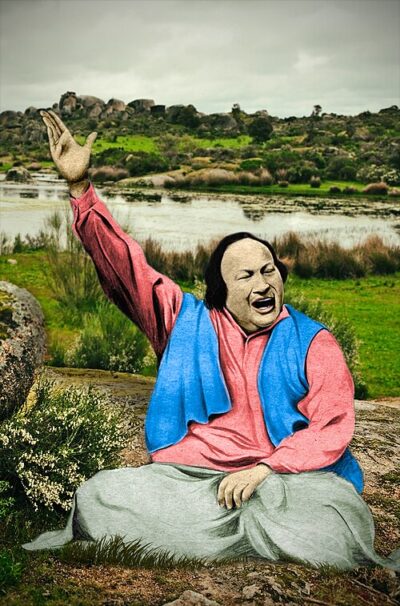
Nusrat Fateh Ali Khan
Nusrat Fateh Ali Khan was a Pakistani musician, primarily a singer of qawwali. Born October 13, 1948, in Faisalabad. Died August 16, 1997, in London. Awards include Pride of Performance, Nigar Awards and Fukuoka Asian Culture Prize.
Facts
29 facts · 2 confirmed by two sources · 5 cited · 22 from one source
Where this comes from
Papalocal keeps its own record. It started from these sources; what each one said is kept here as it was copied, so a change on their side never changes this page by itself. Tap one to read its version.
What Wikidata says · copied November 16, 2026 · revision 2567317811
- Described as
- Pakistani musician, primarily a singer of qawwali (1948-1997)
- Other names
- Nusrat Fatih Ali Khan, Nusrat Fateh Ali Khan & Party, Pervez Fateh Ali Khan
- Born
- October 13, 1948 · 5 references
- Died
- August 16, 1997 · 5 references
- Born in
- Faisalabad · 1 reference
- Died in
- London · 1 reference
- Buried in
- Faisalabad · 1 reference
- Cause of death
- cardiac arrest
- Citizen of
- Pakistan
- Occupation
- singer · 1 reference; composer · 1 reference; music educator; storyteller; recording artist; musician · 1 reference
- Genre
- qawwali; ghazal
- Instrument
- Indian harmonium; voice
- Record label
- Real World Records; EMI; Virgin; Oriental Star Agencies; Rehmat Gramophone House
- Awards
- Pride of Performance; Nigar Awards; Fukuoka Asian Culture Prize (1996); Lux Style Awards
- Father
- Fateh Ali Khan
- Siblings
- Farrukh Fateh Ali Khan
- Religion
- Islam
- Wikipedias with a page
- 60
Wikidata item Q299073 (wikidata.org/wiki/Q299073), public domain (CC0). Copied November 16, 2026.
What Wikipedia says · copied November 16, 2026 · revision 1384009606
Ustad Nusrat Fateh Ali Khan (13 October 1948 – 16 August 1997), also known as NFAK, was a Pakistani singer, Hindustani classical vocalist, songwriter, multi-instrumentalist, composer, and music director. While primarily being associated with qawwali, a form of Sufi devotional music from Pakistan and India, he belonged to the historic Qawwal Bachchon ka Gharana (Delhi Gharana) and was trained in pure classical khayal architecture under his father Ustad Fateh Ali Khan and later uncle Ustad Mubarak Ali Khan and Ustad Salamat Ali Khan. Though widely celebrated for his qawwali performances, his standing as a master of Shastriya Sangeet (classical music) was validated by the classical community when he received the Hafiz Ali Khan Award in 1997. He ranks as one of the most influential South Asian singers of all time. Widely recognised as the "Shahanshah-e-Qawwali" (lit. 'the King of Kings of Qawwali'), he has been recognised as one of the 50 Great Voices by NPR and 200 Greatest Singers of All Time by Rolling Stone. The New York Times named Khan the greatest qawwali singer of his generation. while Credited with introducing Qawwali music to international audiences, he was known for his vocal abilities and could perform at a high level of intensity for several hours.
Born in West Punjab, Khan had his first public performance at the age of 15 at his father's chelum. He became the head of the family qawwali party in 1971 and added his unique style of sargam, khayal, and rhythm to his family's legacy. He was signed by Oriental Star Agencies, based in Birmingham, England, in the early 1980s. Khan went on to release movie scores and albums in Europe, India, Japan, Pakistan, and the United States. He engaged in collaborations and experiments with Western artists, becoming a well-known world music artist. He toured extensively, performing in over 40 countries. In addition to popularising qawwali music, he also had a profound impact on contemporary South Asian popular music, including Pakistani pop, Indian pop, and Bollywood music. He was also a master of Hindustani classical music.
- Born, in its opening lines
- October 13, 1948
- Died, in its opening lines
- August 16, 1997
From the Wikipedia article “Nusrat Fateh Ali Khan” (en.wikipedia.org/wiki/Nusrat_Fateh_Ali_Khan), by its contributors, under CC BY-SA 4.0 (creativecommons.org/licenses/by-sa/4.0/). Copied November 16, 2026; not changed.
Confirmed Two sources agree. Cited One source, and it names where it got it. One source One source, without a reference of its own. Sources disagree The sources disagree. We show the best-supported value and keep theirs below.
