
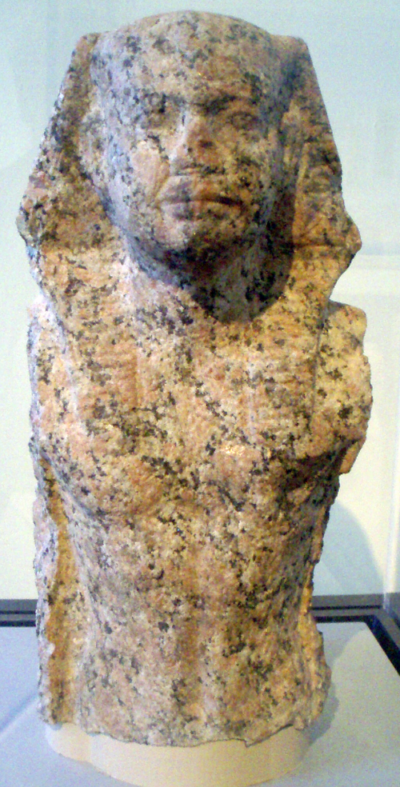
Nyuserre Ini
Nyuserre Ini was an ancient Egyptian pharaoh of the 5th Dynasty. Born 25th century BC. Died 2430 BC. Positions held include pharaoh and pharaohs of Fifth Dynasty of Egypt.
Facts
13 facts · 0 confirmed by two sources · 0 cited · 13 from one source
Where this comes from
Papalocal keeps its own record. It started from these sources; what each one said is kept here as it was copied, so a change on their side never changes this page by itself. Tap one to read its version.
What Wikidata says · copied November 16, 2026 · revision 2553824489
- Described as
- ancient Egyptian pharaoh of the 5th Dynasty
- Born
- 25th century BC
- Died
- 2430 BC
- Buried in
- Pyramid of Nyuserre Ini
- Citizen of
- Ancient Egypt
- Occupation
- statesperson
- Positions held
- pharaoh; pharaohs of Fifth Dynasty of Egypt
- Spouse
- Reptynub · 1 reference
- Children
- Princess Khamerernebty · 1 reference
- Father
- Neferirkare Kakai
- Mother
- Khentkaus II
- Siblings
- Neferefre; Khentakawess III · 1 reference
- Wikipedias with a page
- 40
Wikidata item Q269200 (wikidata.org/wiki/Q269200), public domain (CC0). Copied November 16, 2026.
What Wikipedia says · copied November 16, 2026 · revision 1381185599
Nyuserre Ini (also Niuserre Ini or Neuserre Ini; in Greek known as Rathurês, Ῥαθούρης; died c. 2422 BC) was an Ancient Egyptian king, the sixth ruler of the Fifth Dynasty during the Old Kingdom period. He is credited with a reign of 24 to 36 years depending on the scholar, and likely lived in the second half of the 25th century BCE. Nyuserre was the younger son of Neferirkare Kakai and queen Khentkaus II, and the brother of the short-lived king Neferefre. He may have succeeded his brother directly, as indicated by much later historical sources. Alternatively, Shepseskare may have reigned between the two as advocated by Miroslav Verner, albeit only for a few weeks or months at the most. The relation of Shepseskare with Neferefre and Nyuserre remains highly uncertain. Nyuserre was in turn succeeded by Menkauhor Kaiu, who could have been his nephew and a son of Neferefre.
Nyuserre was the most prolific builder of his dynasty, having built three pyramids for himself and his queens and completed a further three for his father, mother and brother, all in the necropolis of Abusir. He built the largest surviving temple to the sun god Ra constructed during the Old Kingdom, named Shesepibre or "Joy of the heart of Ra". He also completed the Nekhenre, the Sun temple of Userkaf in Abu Gorab, and the valley temple of Menkaure in Giza. In doing so, he was the first king since Shepseskaf, last ruler of the Fourth Dynasty, to pay attention to the Giza necropolis, a move which may have been an attempt to legitimise his rule following the troubled times surrounding the unexpected death of his brother Neferefre.
There is little evidence for military action during Nyuserre's reign; the Egyptian state continued to maintain trade relations with Byblos on the Levantine coast and to send mining and quarrying expeditions to Sinai and Lower Nubia. Nyuserre's reign saw the growth of the administration, and the effective birth of the nomarchs, provincial governors who, for the first time, were sent to live in the provinces they administered rather than at the pharaoh's court.
As with other Old Kingdom pharaohs, Nyuserre benefited from a funerary cult established at his death. In Nyuserre's case, this official state-sponsored cult existed for centuries, surviving the chaotic First Intermediate Period and lasting until the Twelfth Dynasty of the Middle Kingdom. In parallel, a spontaneous popular cult appeared, with people venerating Nyuserre under his birth name "Iny". In this cult, Nyuserre played a role similar to that of a saint, being invoked as an intercessor between the believer and the gods. It left little archaeological evidence and seems to have continued until the New Kingdom, nearly 1,000 years after his death.
From the Wikipedia article “Nyuserre Ini” (en.wikipedia.org/wiki/Nyuserre_Ini), by its contributors, under CC BY-SA 4.0 (creativecommons.org/licenses/by-sa/4.0/). Copied November 16, 2026; not changed.
Confirmed Two sources agree. Cited One source, and it names where it got it. One source One source, without a reference of its own. Sources disagree The sources disagree. We show the best-supported value and keep theirs below.
