
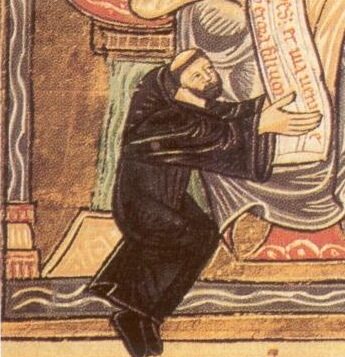
Odo of Cluny
Odo of Cluny was a benedictine monk, second abbott of Cluny. Born 878, in Le Mans. Died November 18, 942, in Tours. Positions held include Abbot of Cluny, abbot of Saint-Pons-de-Thomières and abbot. Known for Collationes, Vita sancti Geraldi Auriliacensis and Vita sancti Gregorii.
Facts
17 facts · 2 confirmed by two sources · 6 cited · 9 from one source
Where this comes from
Papalocal keeps its own record. It started from these sources; what each one said is kept here as it was copied, so a change on their side never changes this page by itself. Tap one to read its version.
What Wikidata says · copied November 16, 2026 · revision 2567918410
- Described as
- benedictine monk, second abbott of Cluny
- Born
- 878 · 3 references
- Died
- November 18, 942 · 1 reference
- Born in
- Le Mans · 2 references
- Died in
- Tours · 2 references
- Citizen of
- West Francia
- Occupation
- writer · 1 reference; hagiographer; musicologist · 1 reference; composer · 2 references
- Positions held
- Abbot of Cluny; abbot of Saint-Pons-de-Thomières; abbot · 1 reference
- Known for
- Collationes; Vita sancti Geraldi Auriliacensis; Vita sancti Gregorii; Epitome moralium sancti Gregorii in Job
- Religion
- Catholic Church
- Wikipedias with a page
- 31
Wikidata item Q454553 (wikidata.org/wiki/Q454553), public domain (CC0). Copied November 16, 2026.
What Wikipedia says · copied November 16, 2026 · revision 1385559467
Odo of Cluny (French: Odon; c. 878 – 18 November 942) was the second abbot of Cluny.
Born to a noble family, he served as a page at the court of Aquitaine. He became a canon of the Church of St. Martin in Tours and continued his education in Paris under Remigius of Auxerre. Upon returning to Tours, Odo became disillusioned with the life of a canon and subsequently entered the Benedictine abbey at Baume, where he became superior of the abbey school.
Odo joined Abbot Berno at Cluny and, when Berno died in 927, was elected his successor. While abbot, he also managed the priory at Romainmôtier. Next, he undertook the reform of Fleury Abbey. He encouraged the monks to adhere more closely to the original Rule of Saint Benedict. In 931, the Pope authorized Odo to continue his work in the monasteries of Aquitaine. He enacted the various Cluniac Reforms of France and Italy. In 937, he went to Rome and was given the Basilica of Saint Paul Outside the Walls. He also sent his aides to Monte Cassino and Subiaco.
Odo initiated the practice among the monasteries following Cluny to hold an annual commemoration of all the faithful departed on the day after All Saints' Day.
He is venerated as a saint by the Catholic and Eastern Orthodox Churches. His feast day is 18 November.
There is only one contemporary biography of him, the Vita Odonis written by John of Salerno.
- Born, in its opening lines
- c. 878
- Died, in its opening lines
- November 18, 942
From the Wikipedia article “Odo of Cluny” (en.wikipedia.org/wiki/Odo_of_Cluny), by its contributors, under CC BY-SA 4.0 (creativecommons.org/licenses/by-sa/4.0/). Copied November 16, 2026; not changed.
Confirmed Two sources agree. Cited One source, and it names where it got it. One source One source, without a reference of its own. Sources disagree The sources disagree. We show the best-supported value and keep theirs below.
