
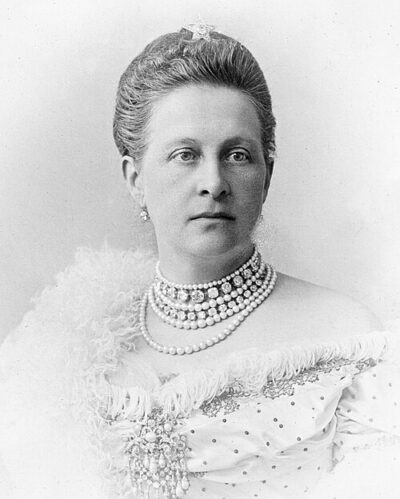
Olga Constantinovna of Russia
Olga Constantinovna of Russia was a Queen of the Hellenes. Born August 22, 1851, in Pavlovsk. Died June 18, 1926, in Rome. Positions held include Regent of Greece. Awards include Grand Cross of the Order of the Redeemer, Dame of the Order of Queen Maria Luisa and Dame Grand Cordon of the Order of Saint Catherine.
Facts
34 facts · 1 confirmed by two sources · 7 cited · 23 from one source · 3 where the sources disagree
What’s different
- Born: we show August 22, 1851 (Sources disagree). Wikipedia says September 3, 1851
- Died in: we show Rome (Sources disagree). Wikidata also lists Pau
- Buried in: we show Florence (Sources disagree). Wikidata also lists Tatoi Royal Cemetery
Where this comes from
Papalocal keeps its own record. It started from these sources; what each one said is kept here as it was copied, so a change on their side never changes this page by itself. Tap one to read its version.
What Wikidata says · copied November 16, 2026 · revision 2565435912
- Described as
- Queen of the Hellenes (1851–1926)
- Other names
- Olga of Greece, Queen Olga of Greece
- Born
- August 22, 1851 · 5 references
- Died
- June 18, 1926 · 3 references
- Born in
- Pavlovsk · 1 reference
- Died in
- Rome · 1 reference; Pau · 1 reference
- Buried in
- Florence; Tatoi Royal Cemetery
- Citizen of
- Russian Empire; Kingdom of Greece
- Occupation
- consort; aristocrat; charity worker; philanthropist
- Positions held
- Regent of Greece
- Awards
- Grand Cross of the Order of the Redeemer · 1 reference; Dame of the Order of Queen Maria Luisa · 1 reference; Dame Grand Cordon of the Order of Saint Catherine · 1 reference
- Field
- government · 1 reference
- Spouse
- George I of Greece (1867–1913) · 5 references
- Children
- Constantine I of Greece; Prince George of Greece and Denmark · 1 reference; Princess Alexandra of Greece and Denmark; Prince Nicholas of Greece and Denmark; Princess Maria of Greece and Denmark; Prince Andrew of Greece and Denmark; Prince Christopher of Greece and Denmark · 1 reference; Princess Olga of Greece and Denmark · 1 reference
- Father
- Grand Duke Konstantin Nikolayevich of Russia · 3 references
- Mother
- Princess Alexandra of Saxe-Altenburg
- Siblings
- Grand Duchess Vera Konstantinovna of Russia; Grand Duke Vyacheslav Constantinovich of Russia; Grand Duke Dimitri Constantinovich of Russia; Grand Duke Konstantin Konstantinovich of Russia; Grand Duke Nicholas Constantinovich of Russia
- Religion
- Eastern Orthodoxy
- Military rank
- admiral
- Wikipedias with a page
- 46
Wikidata item Q155178 (wikidata.org/wiki/Q155178), public domain (CC0). Copied November 16, 2026.
What Wikipedia says · copied November 16, 2026 · revision 1375165832
Olga Constantinovna of Russia (Greek: Όλγα; 3 September [O.S. 22 August] 1851 – 18 June 1926) was Queen of Greece as the wife of King George I. She was briefly the regent of Greece in 1920.
A member of the Romanov dynasty, Olga was the oldest daughter of Grand Duke Constantine Nikolaievich and his wife, Princess Alexandra of Saxe-Altenburg. She spent her childhood in the Russian Empire, primarily Saint Petersburg, Congress Poland, and the Crimea, and married George in 1867 at the age of sixteen. At first, she felt ill at ease in the Kingdom of Greece, but she quickly became involved in social and charitable work. She founded hospitals and schools, but her attempt to promote a new, more accessible, Greek translation of the Gospels sparked riots by religious conservatives.
On the assassination of her husband in 1913, Olga returned to Russia. When the First World War broke out, she set up a military hospital in Pavlovsk Palace, which belonged to her brother. She was trapped in the palace after the Russian Revolution of 1917, until the Danish embassy intervened, allowing her to escape to Switzerland. Olga could not return to Greece as her eldest son, King Constantine I, had been deposed.
In October 1920, Olga returned to Athens on the fatal illness of her grandson King Alexander of Greece. After his death, she was appointed regent (in November) until the restoration of Constantine I the following month. After the defeat of the Greeks in the Greco-Turkish War of 1919–22 the Greek royal family were again exiled and Olga spent the last years of her life in the United Kingdom, France and Italy.
- Born, in its opening lines
- September 3, 1851
- Died, in its opening lines
- June 18, 1926
From the Wikipedia article “Olga Constantinovna of Russia” (en.wikipedia.org/wiki/Olga_Constantinovna_of_Russia), by its contributors, under CC BY-SA 4.0 (creativecommons.org/licenses/by-sa/4.0/). Copied November 16, 2026; not changed.
Confirmed Two sources agree. Cited One source, and it names where it got it. One source One source, without a reference of its own. Sources disagree The sources disagree. We show the best-supported value and keep theirs below.
