
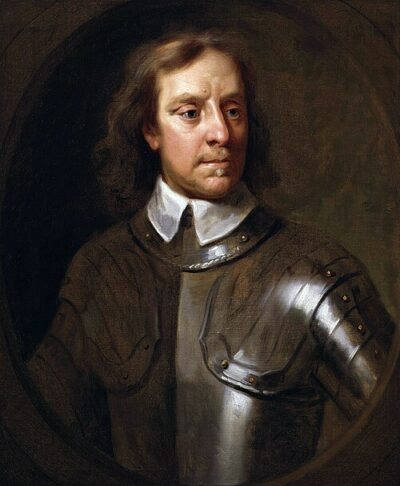
Oliver Cromwell
Oliver Cromwell was an English military and political leader. Born April 25, 1599, in Huntingdon. Died September 3, 1658, in Palace of Whitehall. Positions held include Member of Parliament in the Parliament of England (2 times) (1628–1649), Lord Protector (1653–1658) and Member of the 1628-29 Parliament. Educated at Sidney Sussex College.
Facts
41 facts · 2 confirmed by two sources · 18 cited · 21 from one source
Where this comes from
Papalocal keeps its own record. It started from these sources; what each one said is kept here as it was copied, so a change on their side never changes this page by itself. Tap one to read its version.
What Wikidata says · copied November 16, 2026 · revision 2564814369
- Described as
- English military and political leader (1599–1658)
- Other names
- Noll Cromwell, Lord Protector, Copper Nose, Olyver Cromwell, Old Noll, Cromwellian, Head of the Protectorate, Olliver Cromwell, Oliver Cromwell, Lord Protector of England
- Born
- April 25, 1599 · 5 references
- Died
- September 3, 1658 · 5 references
- Born in
- Huntingdon · 4 references
- Died in
- Palace of Whitehall · 1 reference
- Buried in
- Westminster Abbey
- Cause of death
- malaria
- Citizen of
- Kingdom of England (1599–); Commonwealth of England (1649–)
- Occupation
- military leader; politician · 1 reference; farmer · 1 reference; army officer
- Positions held
- Member of Parliament in the Parliament of England (2 times) (1628–1649); Lord Protector (1653–1658); Member of the 1628-29 Parliament · 1 reference; Member of the April 1640 Parliament · 1 reference; Member of the 1640-42 Parliament · 1 reference; Member of the 1653 Parliament; Member of the 1648-53 Parliament; Member of the 1642-48 Parliament; Chancellor of the University of Oxford (1650–1657)
- Political party
- Whigs · 1 reference
- Education
- Sidney Sussex College
- Member of
- Short Parliament; list of regicides of King Charles I
- Field
- agriculture
- Spouse
- Elizabeth Cromwell (1620–) · 2 references
- Children
- Richard Cromwell · 1 reference; Bridget Cromwell · 2 references; Mary Cromwell, Countess Fauconberg · 1 reference; Elizabeth Claypole; Henry Cromwell · 1 reference; Frances Cromwell · 1 reference; Robert Cromwell · 1 reference; Oliver Cromwell · 1 reference
- Father
- Robert Cromwell · 2 references
- Mother
- Elizabeth Steward · 3 references
- Siblings
- Robina Cromwell · 1 reference
- Religion
- congregationalist polity; Puritans
- Military rank
- colonel
- Wikipedias with a page
- 125
Wikidata item Q44279 (wikidata.org/wiki/Q44279), public domain (CC0). Copied November 16, 2026.
What Wikipedia says · copied November 16, 2026 · revision 1385488434
Oliver Cromwell (25 April 1599 – 3 September 1658) was an English statesman and soldier, widely regarded as one of the most important figures in British history. He came to prominence during the Wars of the Three Kingdoms, initially as a senior commander in the Parliamentarian army and later as a republican politician. A leading advocate of the execution of Charles I in January 1649, which led to the establishment of the Commonwealth of England, Cromwell ruled as Lord Protector from December 1653 until his death in September 1658.
Although elected Member of Parliament (MP) for Huntingdon in 1628, much of Cromwell's life prior to 1640 was marked by financial and personal failure. He became a religious Independent in the 1630s, and thereafter believed his successes were the result of divine providence. In 1640, he served as MP for Cambridge in the Short and Long Parliaments. He joined the Parliamentarian army when the First English Civil War began in August 1642 and quickly demonstrated his military prowess. In 1645, he was appointed commander of the New Model Army cavalry under Thomas Fairfax, and he played a key role in winning the English Civil War.
The execution of Charles I and exile of his son Charles II, followed by military victories in Ireland and Scotland, firmly established the Commonwealth and Cromwell's dominance of the new regime. In December 1653, he was named Lord Protector, a position he retained for the remaining five years of his life. After his death in 1658, he was succeeded by his son Richard, whose weakness led to a power vacuum. This culminated in the 1660 Stuart Restoration, after which Cromwell's body was removed from Westminster Abbey and hanged at Tyburn on 30 January 1661 as a posthumous execution. His head was cut off and displayed on the roof of Westminster Hall. It remained there until at least 1684, then spent the next three centuries in a succession of private collections before being reburied in 1960.
Cromwell's historical reputation is continually debated. He is a controversial figure due to his use of military force to acquire and retain political power, his role in the execution of Charles I, his virulent anti-Catholic policies, and the brutality of his 1649 conquest of Ireland. Winston Churchill described Cromwell as a military dictator, while others view him a hero of liberty.
First proposed in 1856, his statue outside the Houses of Parliament was not erected until 1895, with most of the funds privately supplied by Prime Minister Archibald Primrose.
- Born, in its opening lines
- April 25, 1599
- Died, in its opening lines
- September 3, 1658
From the Wikipedia article “Oliver Cromwell” (en.wikipedia.org/wiki/Oliver_Cromwell), by its contributors, under CC BY-SA 4.0 (creativecommons.org/licenses/by-sa/4.0/). Copied November 16, 2026; not changed.
Confirmed Two sources agree. Cited One source, and it names where it got it. One source One source, without a reference of its own. Sources disagree The sources disagree. We show the best-supported value and keep theirs below.
