
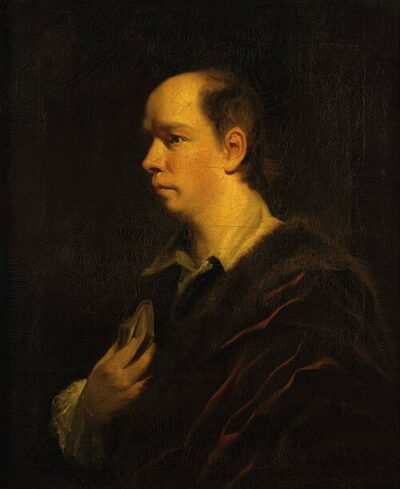
Oliver Goldsmith
Oliver Goldsmith was an Anglo-Irish writer, poet, and physician (d. 1774). Born November 10, 1728, in Elphin. Died April 4, 1774, in London. Known for The Vicar of Wakefield and She Stoops to Conquer. Educated at University of Edinburgh and Trinity College, Dublin.
Facts
25 facts · 2 confirmed by two sources · 15 cited · 8 from one source
Where this comes from
Papalocal keeps its own record. It started from these sources; what each one said is kept here as it was copied, so a change on their side never changes this page by itself. Tap one to read its version.
What Wikidata says · copied November 16, 2026 · revision 2568751178
- Described as
- Anglo-Irish writer, poet, and physician (d. 1774)
- Other names
- Oliver Goldsmit, Olver Goldsmith, Oliverus Goldsmith, Oliverio Goldsmith, Inspired Idiot, Olivier Goldsmith, Doctor Goldsmith, Solomon Winlove, Tom Telescope, Dottor Golssmith, James Willington
- Born
- November 10, 1728 · 6 references
- Died
- April 4, 1774 · 9 references
- Born in
- Elphin · 2 references
- Died in
- London · 8 references
- Buried in
- Temple Church, London · 1 reference
- Cause of death
- kidney failure
- Citizen of
- Kingdom of Ireland · 1 reference
- Occupation
- physician · 1 reference; physician writer; poet · 7 references; playwright · 4 references; literary critic; novelist · 3 references; writer · 9 references; essayist · 1 reference
- Education
- University of Edinburgh; Trinity College, Dublin; Sligo Grammar School
- Known for
- The Vicar of Wakefield; She Stoops to Conquer
- Field
- creative and professional writing · 1 reference; prose · 1 reference; poetry · 1 reference; drama · 1 reference; medicine · 1 reference
- Wikipedias with a page
- 83
Wikidata item Q236236 (wikidata.org/wiki/Q236236), public domain (CC0). Copied November 16, 2026.
What Wikipedia says · copied November 16, 2026 · revision 1385311669
Oliver Goldsmith (10 November 1728 – 4 April 1774) was an Anglo-Irish poet, novelist, playwright, and hack writer. He produced literary works in a variety of genres and is considered one of the most versatile writers of the Georgian era. His works are known for their realistic depictions of British society, and his comedy plays for the English stage are considered second in importance only to those of playwright William Shakespeare. Credited with introducing sentimentalism in English literature in 18th-century Great Britain, several of Goldsmith's publications are popular classics of the period, including his only novel, The Vicar of Wakefield (1766), and the comedy play She Stoops to Conquer (1773).
He wrote the play The Good-Natur'd Man (1768) and is additionally thought by commentators such as Washington Irving to have written the children's novel The History of Little Goody Two-Shoes (1765), one of the earliest classical works of children's literature. Goldsmith also produced a number of poems during his career, such as The Deserted Village (1770), and contributed to the flourishing of idyllic poetry during the Georgian era.
After spending his early years in Dublin, he settled in London in 1756, where he met many of the writers who shaped his later career, and the majority of his works were written after this period. His first works were published in his The Citizen of the World series in 1760, often under the pseudonym James Willington. Beginning in the 1760s, he maintained a close friendship with Samuel Johnson, another prolific English writer who played a significant role in promoting his poems. His personal mentorship and guidance resulted in Goldsmith expanding his literary writings to include political works. This long-term collaboration between the two authors has been described as "one of the most fruitful intellectual partnerships in 18th-century English letters." In 1764, he became one of the earliest members of Johnson's literary intellectual circle, popularly known as The Club. Although Goldsmith wrote extensively to supplement his income, he was constantly in financial debt and regularly suffered from ill health. He died in 1774 in London at the age of 45 and was buried in Temple Church.
During the 19th century, Goldsmith became regarded as a seminal figure of sentimental literature, having influenced later English authors Charles Dickens, Jane Austen, George Eliot, and Mary Shelley, all of whom mentioned his characters in their own novels. He continues to be held in high regard in his native Ireland and Great Britain, with many statues, libraries, schools, and streets named after him. Since his death, his magnum opus, The Vicar of Wakefield, has retained its reputation as one of the best-known novels of 18th-century English literature, and his play She Stoops to Conquer remains an influential study in theater classes.
- Born, in its opening lines
- November 10, 1728
- Died, in its opening lines
- April 4, 1774
From the Wikipedia article “Oliver Goldsmith” (en.wikipedia.org/wiki/Oliver_Goldsmith), by its contributors, under CC BY-SA 4.0 (creativecommons.org/licenses/by-sa/4.0/). Copied November 16, 2026; not changed.
Confirmed Two sources agree. Cited One source, and it names where it got it. One source One source, without a reference of its own. Sources disagree The sources disagree. We show the best-supported value and keep theirs below.
