
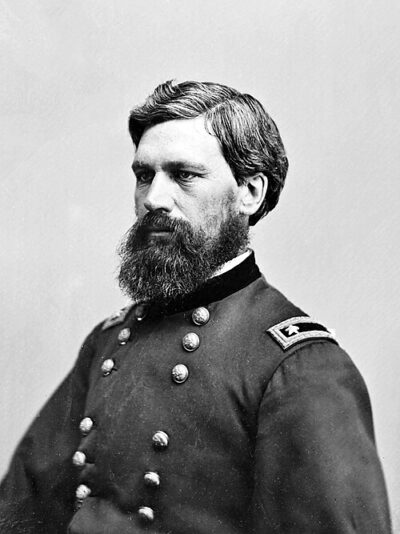
Oliver Otis Howard
Oliver Otis Howard was an United States Army Medal of Honor recipient and Union Army general. Born November 8, 1830, in Leeds. Died October 26, 1909, in Burlington. Positions held include President of Howard University (1869–1874). Educated at Bowdoin College and United States Military Academy. Awards include Medal of Honor and Knight of the Legion of Honour.
Facts
24 facts · 2 confirmed by two sources · 9 cited · 13 from one source
Where this comes from
Papalocal keeps its own record. It started from these sources; what each one said is kept here as it was copied, so a change on their side never changes this page by itself. Tap one to read its version.
What Wikidata says · copied November 16, 2026 · revision 2568189348
- Described as
- United States Army Medal of Honor recipient and Union Army general (1830–1909)
- Other names
- Oliver O. Howard, O. O. Howard
- Born
- November 8, 1830 · 4 references
- Died
- October 26, 1909 · 4 references
- Born in
- Leeds · 1 reference
- Died in
- Burlington · 1 reference
- Buried in
- Lakeview Cemetery · 1 reference
- Citizen of
- United States
- Occupation
- military officer; historian; biographer; writer · 1 reference
- Positions held
- President of Howard University (1869–1874) · 1 reference
- Political party
- Republican Party
- Worked for
- Howard University
- Education
- Bowdoin College; United States Military Academy; North Yarmouth Academy
- Awards
- Medal of Honor (1893) · 1 reference; Knight of the Legion of Honour (1884) · 1 reference
- Children
- Elizabeth Ann Howard
- Father
- Rowland Bailey Howard · 1 reference
- Mother
- Eliza M. Gilmore · 1 reference
- Military branch
- Union Army; United States Army
- Military rank
- major general
- Wikipedias with a page
- 23
Wikidata item Q736934 (wikidata.org/wiki/Q736934), public domain (CC0). Copied November 16, 2026.
What Wikipedia says · copied November 16, 2026 · revision 1382938455
Oliver Otis Howard (November 8, 1830 – October 26, 1909) was a career United States Army officer and a Union general in the Civil War. As a brigade commander in the Army of the Potomac, Howard lost his right arm while leading his men against Confederate forces at the Battle of Fair Oaks/Seven Pines in June 1862, an action which later earned him the Medal of Honor. As a corps commander, he suffered a major defeat at Chancellorsville and his performance was questioned at Gettysburg in May and July 1863. However, he recovered from possible career setbacks as a successful corps and later army commander, commanding the Army of the Tennessee from July 27, 1864, until May 19, 1865, leading the army in the battles of Ezra Church, Battle of Jonesborough, Sherman's March to the Sea, and the Carolinas campaign in the Western Theater.
Known as the "Christian General" because he tried to base his policy decisions on his deep, evangelical piety, he was given charge of the Freedmen's Bureau in mid-1865, with the mission of integrating the former slaves into Southern society and politics during the second phase of the Reconstruction Era. Howard took charge of labor policy, setting up a system that required freed people to work on former plantation land under pay scales fixed by the Bureau, on terms negotiated by the Bureau with white land owners. Howard's Bureau was primarily responsible for the legal affairs of the freedmen. He attempted to protect freed Black people from hostile conditions but lacked adequate power and was repeatedly frustrated by President Andrew Johnson.
Howard's allies the Radical Republicans won control of Congress in the 1866 elections and imposed Radical Reconstruction, with the result that freedmen were given the vote. With the help and advice of the Bureau, freedmen joined Republican coalitions and won at the ballot boxes of most of the southern states. Howard was also a leader in promoting higher education for freedmen, most notably in founding Howard University in Washington, D.C., of which he is the namesake. He served as its president from 1867 to 1873, and he aided in the charter of both Howard University and Atlanta University (now Clark Atlanta University) in 1867.
After 1874, Howard commanded troops in the West, conducting a famous campaign against the Nez Perce tribe, led by Chief Joseph. Utley (1987) concludes that his leadership against the Apaches in 1872, Nez Perce in 1877, Bannocks and Paiutes in 1878, and the Sheepeaters in 1879 all add up to a lengthy record, although he did not fight as much as George Custer or Nelson Miles.
- Born, in its opening lines
- November 8, 1830
- Died, in its opening lines
- October 26, 1909
From the Wikipedia article “Oliver Otis Howard” (en.wikipedia.org/wiki/Oliver_Otis_Howard), by its contributors, under CC BY-SA 4.0 (creativecommons.org/licenses/by-sa/4.0/). Copied November 16, 2026; not changed.
Confirmed Two sources agree. Cited One source, and it names where it got it. One source One source, without a reference of its own. Sources disagree The sources disagree. We show the best-supported value and keep theirs below.
