
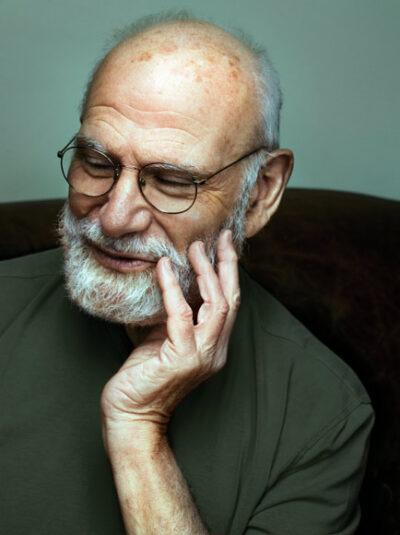
Oliver Sacks
Oliver Sacks was a British neurologist and writer. Born July 9, 1933, in Willesden. Died August 30, 2015, in Greenwich Village. Known for The Man Who Mistook His Wife for a Hat and Awakenings. Educated at The Queen's College and St Paul's School. Awards include Guggenheim Fellowship, Commander of the Order of the British Empire and George Polk Award.
Facts
40 facts · 2 confirmed by two sources · 10 cited · 28 from one source
Where this comes from
Papalocal keeps its own record. It started from these sources; what each one said is kept here as it was copied, so a change on their side never changes this page by itself. Tap one to read its version.
What Wikidata says · copied November 16, 2026 · revision 2563959426
- Described as
- British neurologist and writer (1933–2015)
- Other names
- Oliver Wolf Sacks, Oliver W. Sacks
- Born
- July 9, 1933 · 12 references
- Died
- August 30, 2015 · 12 references
- Born in
- Willesden
- Died in
- Greenwich Village · 1 reference
- Cause of death
- liver metastasis · 1 reference
- Citizen of
- United Kingdom
- Occupation
- writer · 2 references; chemist; physician writer; neurologist · 1 reference; science communicator; screenwriter; university teacher; physician · 2 references
- Worked for
- Columbia University (2007–2012); Grossman School of Medicine · 1 reference; Albert Einstein College of Medicine; University of Warwick; Yeshiva University · 1 reference
- Education
- The Queen's College (1951–1958); St Paul's School; Hall School
- Member of
- American Academy of Arts and Letters (1996–2015); American Academy of Arts and Sciences · 1 reference
- Known for
- The Man Who Mistook His Wife for a Hat; Awakenings
- Awards
- Guggenheim Fellowship · 1 reference; Commander of the Order of the British Empire (2008–); George Polk Award (1993); Lewis Thomas Prize (2001); Hawthornden Prize (1974); Oskar Pfister Award (1988); Emperor Has No Clothes Award (2005); honorary doctorate from the Pontifical Catholic University of Peru; Fellow of the American Association for the Advancement of Science (2013) · 1 reference; Bodley Medal (2003) · 1 reference
- Field
- neurology
- Religion
- atheism
- Lived in
- New York City (1965–)
- Website
- http://www.oliversacks.com/
- Wikipedias with a page
- 57
Wikidata item Q258662 (wikidata.org/wiki/Q258662), public domain (CC0). Copied November 16, 2026.
What Wikipedia says · copied November 16, 2026 · revision 1384397297
Oliver Wolf Sacks (9 July 1933 – 30 August 2015) was a British neurologist, naturalist, historian of science, and writer.
Born in London, Sacks received his medical degree in 1958 from The Queen's College, Oxford, before moving to the United States, where he spent most of his career. He interned at Mount Zion Hospital in San Francisco and completed his residency in neurology and neuropathology at the University of California, Los Angeles (UCLA). Later, he served as neurologist at Beth Abraham Hospital's chronic-care facility in the Bronx, where he worked with a group of survivors of the 1920s sleeping sickness encephalitis lethargica epidemic, who had been unable to move on their own for decades. His treatment of those patients became the basis of his 1973 book Awakenings, which was adapted into an Academy Award-nominated feature film, in 1990, starring Robin Williams and Robert De Niro. His other best-selling books were mostly collections of case studies of people, including himself, with neurological disorders. He also published hundreds of articles (both peer-reviewed scientific articles and articles for a general audience), about neurological disorders, history of science, natural history, and nature. Journals and letters written by Sacks, discovered after his death, indicate that some of his work was embellished or exaggerated.
The New York Times called him a "poet laureate of contemporary medicine", and "one of the great clinical writers of the 20th century". Some of his books were adapted for plays by major playwrights, feature films, animated short films, opera, dance, fine art, and musical works in the classical genre. His book The Man Who Mistook His Wife for a Hat, which describes the case histories of some of his patients, became the basis of an opera of the same name. The television series Brilliant Minds is based on his life.
- Born, in its opening lines
- July 9, 1933
- Died, in its opening lines
- August 30, 2015
From the Wikipedia article “Oliver Sacks” (en.wikipedia.org/wiki/Oliver_Sacks), by its contributors, under CC BY-SA 4.0 (creativecommons.org/licenses/by-sa/4.0/). Copied November 16, 2026; not changed.
Confirmed Two sources agree. Cited One source, and it names where it got it. One source One source, without a reference of its own. Sources disagree The sources disagree. We show the best-supported value and keep theirs below.
