
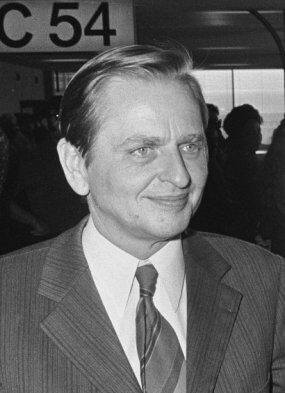
Olof Palme
Olof Palme was a Swedish Prime Minister (1969–76, 1982–86). Born January 30, 1927, in Svea artillery regiment parish. Died February 28, 1986, in Sveavägen. Positions held include Prime Minister of Sweden (2 times) (1969–1986), President of the Nordic Council (1979) and party leader (1969–1986). Educated at Stockholm University and Kenyon College. Awards include Jawaharlal Nehru Award for International Understanding, Collar of the Order of the White Lion and Four Freedoms Award – Freedom from Fear.
Facts
38 facts · 2 confirmed by two sources · 27 cited · 9 from one source
Where this comes from
Papalocal keeps its own record. It started from these sources; what each one said is kept here as it was copied, so a change on their side never changes this page by itself. Tap one to read its version.
What Wikidata says · copied November 16, 2026 · revision 2564267007
- Described as
- Swedish Prime Minister (1969–76, 1982–86)
- Other names
- Sven Olof Joachim Palme
- Born
- January 30, 1927 · 14 references
- Died
- February 28, 1986 · 11 references
- Born in
- Svea artillery regiment parish · 2 references
- Died in
- Sveavägen · 1 reference
- Buried in
- Adolf Fredrik Church cemetery · 1 reference
- Cause of death
- gunshot wound
- Name at birth
- Sven Olof Joachim Palme
- Citizen of
- Sweden
- Occupation
- politician · 1 reference
- Positions held
- Prime Minister of Sweden (2 times) (1969–1986) · 1 reference; President of the Nordic Council (1979); party leader (1969–1986); Minister of Ecclesiastics (1967) · 1 reference; Minister for Education and Science (1968–1969); Minister for Communications and Regional Policy (1965–1967) · 1 reference; Minister of Youth Affairs (1963–1965) · 1 reference; member of the First Chamber (1958–1968) · 1 reference; member of the Second Chamber (1969–1970) · 1 reference; member of the Swedish Riksdag (3 times) (1971–1985) · 1 reference
- Political party
- Swedish Social Democratic Party · 1 reference
- Education
- Stockholm University (1949–) · 1 reference; Kenyon College · 1 reference; Beskowska skolan (1934–1937) · 1 reference; Sigtunaskolan Humanistiska Läroverket (–1944) · 1 reference
- Awards
- Jawaharlal Nehru Award for International Understanding (1985) · 1 reference; Collar of the Order of the White Lion (2000) · 1 reference; Four Freedoms Award – Freedom from Fear (1986) · 2 references; Order of the Companions of O. R. Tambo (2002) · 1 reference; Order of Eduardo Mondlane, 1st class (1988) · 2 references
- Spouse
- Lisbet Palme (1956–1986) · 1 reference; Jelena Rennerová (1949–1952) · 1 reference
- Children
- Joakim Palme · 1 reference; Mårten Palme · 1 reference; Mattias Järvinen Palme · 1 reference
- Father
- Gunnar Palme · 1 reference
- Mother
- Elisabeth Sophia von Knieriem · 2 references
- Siblings
- Claës Palme
- Website
- http://www.palmecenter.org/
- Wikipedias with a page
- 90
Wikidata item Q53713 (wikidata.org/wiki/Q53713), public domain (CC0). Copied November 16, 2026.
What Wikipedia says · copied November 16, 2026 · revision 1384674043
Sven Olof Joachim Palme (; Swedish: [ˈûːlɔf ˈpâlːmɛ] ; 30 January 1927 – 28 February 1986) was a Swedish politician and statesman who served as Prime Minister of Sweden from 1969 to 1976 and 1982 to 1986. Palme led the Swedish Social Democratic Party from 1969 until his assassination in 1986.
A longtime protégé of Prime Minister Tage Erlander, he became Prime Minister of Sweden and Chairman of the Social Democratic Party in 1969. He left office after failing to form a government after the 1976 general election, which ended 40 years of unbroken rule by the Social Democratic Party. While he served as a Leader of the Opposition, he also served as special mediator of the United Nations in the Iran–Iraq War, and was President of the Nordic Council in 1979. He faced a second defeat in 1979, but he returned as prime minister after electoral victories in 1982 and 1985, and served until his death.
Palme was a pivotal and polarizing figure domestically as well as in international politics from the 1960s onward. Domestically, Palme pursued a left-wing and social democratic agenda for the country, including switching to unicameralism in the constitution, expanding the welfare state, advocating for womens' rights, and pushing for nuclear power, although his last term was more moderate due to Sweden's economic troubles. Many of his economic views were opposed by Sweden's business community. Materially, his reforms resulted in a reduction in infant mortality, an increase in the basic old-age pension replacement rate, and an increase in minimum replacement rate in healthcare earnings, among other improvements.
He followed a policy of non-alignment towards the superpowers, frequently criticising both Soviet and American foreign policy. He supported numerous liberation movements and Third World governments. He was the first Western head of government to visit communist Cuba after its revolution. He publicly opposed numerous authoritarian regimes, including those of Francisco Franco of Spain, Augusto Pinochet of Chile, Leonid Brezhnev of the Soviet Union, António de Oliveira Salazar of Portugal, Gustáv Husák of Czechoslovakia, and South Africa's apartheid system. His 1972 condemnation of American bombings in Hanoi resulted in a temporary freeze in Sweden–United States relations.
Palme's assassination on a Stockholm street on 28 February 1986 was the first murder of a national leader in Sweden since Gustav III in 1792, and had a great impact across Scandinavia. Local convict and addict Christer Pettersson was originally convicted of the murder in Stockholm District Court but was unanimously acquitted by the Svea Court of Appeal. On 10 June 2020, Swedish prosecutors announced that there was "reasonable evidence" that Stig Engström had killed Palme. As Engström had killed himself in 2000, the authorities announced that the investigation into Palme's death was to be closed. The 2020 conclusion has faced widespread criticism from lawyers, police officers and journalists, decrying the evidence as only circumstantial, and – by the prosecutors' own admission – too weak to ensure a trial had the suspect been alive. The true identity of his assassin remains unknown.
- Born, in its opening lines
- January 30, 1927
- Died, in its opening lines
- February 28, 1986
From the Wikipedia article “Olof Palme” (en.wikipedia.org/wiki/Olof_Palme), by its contributors, under CC BY-SA 4.0 (creativecommons.org/licenses/by-sa/4.0/). Copied November 16, 2026; not changed.
Confirmed Two sources agree. Cited One source, and it names where it got it. One source One source, without a reference of its own. Sources disagree The sources disagree. We show the best-supported value and keep theirs below.
