
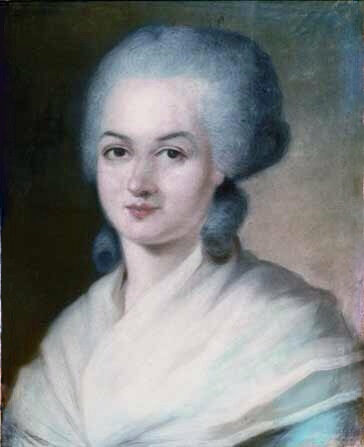
Olympe de Gouges
Olympe de Gouges was a French playwright and political activist. Born May 7, 1748, in Montauban. Died November 3, 1793, in Paris. Known for Declaration of the Rights of Woman and the Female Citizen and Zamore et Mirza.
Facts
23 facts · 2 confirmed by two sources · 7 cited · 14 from one source
Where this comes from
Papalocal keeps its own record. It started from these sources; what each one said is kept here as it was copied, so a change on their side never changes this page by itself. Tap one to read its version.
What Wikidata says · copied November 16, 2026 · revision 2559068154
- Described as
- French playwright and political activist (1748–1793)
- Other names
- Marie Olympe de Gouges, Marie Gouze, Marie Olympe
- Born
- May 7, 1748 · 8 references
- Died
- November 3, 1793 · 6 references
- Born in
- Montauban · 3 references
- Died in
- Paris · 1 reference
- Cause of death
- decapitation · 1 reference
- Name at birth
- Marie Gouze
- Citizen of
- France · 2 references
- Occupation
- playwright · 1 reference; journalist; philosopher; writer · 1 reference; politician; author · 1 reference; feminist · 1 reference
- Political party
- Girondists
- Member of
- Society of the Friends of Truth (1791–)
- Known for
- Declaration of the Rights of Woman and the Female Citizen; Zamore et Mirza
- Field
- abolitionism; feminism
- Spouse
- Louis-Yves Aubry (1765–)
- Children
- Pierre Aubry de Gouges
- Religion
- deism
- Wikipedias with a page
- 79
Wikidata item Q206972 (wikidata.org/wiki/Q206972), public domain (CC0). Copied November 16, 2026.
What Wikipedia says · copied November 16, 2026 · revision 1383671079
Olympe de Gouges (French: [ɔlɛ̃p də ɡuʒ] ; born Marie Gouze; 7 May 1748 – 3 November 1793) was a French playwright and political activist. She is best known for her Declaration of the Rights of Woman and of the Female Citizen and other writings on women's rights and abolitionism.
Born in southwestern France, de Gouges began her prolific career as a playwright in Paris in the 1780s. A passionate advocate of human rights, she was one of France's earliest public opponents of slavery. Her plays and pamphlets spanned a wide variety of issues including divorce and marriage, children's rights, unemployment and social security. In addition to her being a playwright and political activist, she was also a small time actress prior to the Revolution. De Gouges welcomed the outbreak of the French Revolution but soon became disenchanted when equal rights were not extended to women. In 1791, in response to the 1789 Declaration of the Rights of Man and of the Citizen, de Gouges published her Declaration of the Rights of Woman and of the Female Citizen, in which she challenged the practice of male authority and advocated for equal rights for women.
De Gouges was associated with the moderate Girondins and opposed the execution of Louis XVI. Her increasingly vehement writings, which attacked Maximilien Robespierre's radical Montagnards and the Revolutionary government during the Reign of Terror, led to her eventual arrest and execution by guillotine in 1793.
- Born, in its opening lines
- May 7, 1748
- Died, in its opening lines
- November 3, 1793
From the Wikipedia article “Olympe de Gouges” (en.wikipedia.org/wiki/Olympe_de_Gouges), by its contributors, under CC BY-SA 4.0 (creativecommons.org/licenses/by-sa/4.0/). Copied November 16, 2026; not changed.
Confirmed Two sources agree. Cited One source, and it names where it got it. One source One source, without a reference of its own. Sources disagree The sources disagree. We show the best-supported value and keep theirs below.
