
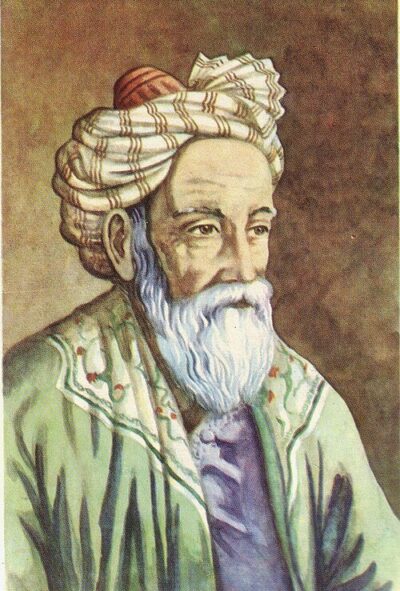
Omar Khayyám
Omar Khayyám was a Persian mathematician and poet. Born May 18, 1048, in Nishapur. Died December 4, 1131, in Nishapur. Known for Rubáiyát of Omar Khayyám and Solar Hijri calendar.
Facts
23 facts · 2 confirmed by two sources · 10 cited · 10 from one source · 1 where the sources disagree
What’s different
- Born: we show May 18, 1048 (Confirmed). Wikidata also lists 1048
- Born in: we show Nishapur (Sources disagree). Wikidata also lists Hira
Where this comes from
Papalocal keeps its own record. It started from these sources; what each one said is kept here as it was copied, so a change on their side never changes this page by itself. Tap one to read its version.
What Wikidata says · copied November 16, 2026 · revision 2570023363
- Described as
- Persian mathematician and poet (1048–1131)
- Other names
- Omar Khayyam, Hakim Omar Khayyám
- Born
- May 18, 1048 · 4 references; 1048 · 2 references
- Died
- December 4, 1131 · 4 references
- Born in
- Nishapur · 2 references; Hira
- Died in
- Nishapur · 2 references
- Buried in
- Omar Khayyam Mausoleum
- Name at birth
- غیاث الدین ابو الفتح عمر بن ابراهیم خیام نیشاپوری · 1 reference
- Citizen of
- Seljuk Empire
- Occupation
- mathematician · 4 references; astronomer · 1 reference; poet · 2 references; lyricist; philosopher · 2 references; musician; astrologer; writer · 3 references
- Genre
- ruba'i
- Known for
- Rubáiyát of Omar Khayyám; Solar Hijri calendar
- Field
- poetry · 1 reference; mathematics · 1 reference; astronomy · 1 reference
- Religion
- Islam; atheism
- Wikipedias with a page
- 168
Wikidata item Q35900 (wikidata.org/wiki/Q35900), public domain (CC0). Copied November 16, 2026.
What Wikipedia says · copied November 16, 2026 · revision 1381181355
Omar Khayyam (1048–1131) was a Persian poet and polymath, known for his contributions to mathematics, astronomy, philosophy, and Persian literature. He was born in Nishapur, Iran and lived during the Seljuk era, around the time of the First Crusade.
As a mathematician, Omar Khayyam was the first to provide a general solution for all third-degree polynomials by using the intersection of two conic sections, a method often later attributed to Descartes. Unlike Descartes, Khayyam performed these geometric calculations by selecting a unit length while strictly adhering to the rule of homogeneity. Additionally, in his work On the Division of a Quarter of a Circle, he attempted to derive approximate numerical solutions for cubic equations using trigonometric tables. He also contributed to a deeper understanding of Euclid's parallel axiom. The Saccheri quadrilateral is sometimes called a Khayyam–Saccheri quadrilateral to credit Omar Khayyam, who described it in his 11th-century book Risāla fī šarḥ mā aškala min muṣādarāt kitāb Uqlīdis (Explanations of the difficulties in the postulates of Euclid). As an astronomer, he calculated the duration of the solar year with remarkable precision and accuracy, and designed the Jalali calendar, a solar calendar with a very precise 33-year intercalation cycle
which provided the basis for the Persian calendar that is still in use after nearly a millennium.
There is a tradition of attributing poetry to Omar Khayyam, written in the form of quatrains (rubāʿiyāt رباعیات). This poetry became widely known to the English-reading world in a translation by Edward FitzGerald (Rubaiyat of Omar Khayyam, 1859), which enjoyed great success in the Orientalism of the fin de siècle.
- Born, in its opening lines
- 1048
- Died, in its opening lines
- 1131
From the Wikipedia article “Omar Khayyam” (en.wikipedia.org/wiki/Omar_Khayyam), by its contributors, under CC BY-SA 4.0 (creativecommons.org/licenses/by-sa/4.0/). Copied November 16, 2026; not changed.
Confirmed Two sources agree. Cited One source, and it names where it got it. One source One source, without a reference of its own. Sources disagree The sources disagree. We show the best-supported value and keep theirs below.
