
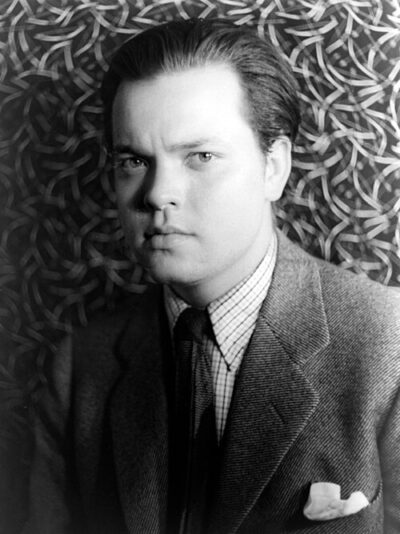
Orson Welles
Orson Welles was an American actor and filmmaker. Born May 6, 1915, in Kenosha. Died October 10, 1985, in Los Angeles. Educated at Todd Seminary for Boys and School of the Art Institute of Chicago. Awards include Academy Award for Best Writing, Original Screenplay, Palme d'Or and Academy Honorary Award.
Facts
45 facts · 2 confirmed by two sources · 15 cited · 28 from one source
Where this comes from
Papalocal keeps its own record. It started from these sources; what each one said is kept here as it was copied, so a change on their side never changes this page by itself. Tap one to read its version.
What Wikidata says · copied November 13, 2026 · revision 2568626737
- Described as
- American actor and filmmaker (1915–1985)
- Other names
- George Welles, George Orson Welles
- Born
- May 6, 1915 · 18 references
- Died
- October 10, 1985 · 19 references
- Born in
- Kenosha · 1 reference
- Died in
- Los Angeles · 2 references
- Buried in
- Ronda · 1 reference
- Cause of death
- myocardial infarction
- Name at birth
- George Orson Welles
- Citizen of
- United States
- Occupation
- film director · 1 reference; actor · 1 reference; screenwriter · 2 references; film producer · 2 references; magician; character actor; playwright · 1 reference; radio personality
- Education
- Todd Seminary for Boys; School of the Art Institute of Chicago
- Member of
- Académie des beaux-arts
- Genre
- drama film; mystery film; action film; thriller film; psychological thriller film; film noir
- Awards
- Academy Award for Best Writing, Original Screenplay (1942) · 1 reference; Palme d'Or (1952); Academy Honorary Award (1970); Golden Lion (1970); honorary doctorate from the University of Paris-VII (1974) · 1 reference; AFI Life Achievement Award (1975); Commander of the Legion of Honour (1982) · 2 references; National Board of Review Award for Best Film; star on Hollywood Walk of Fame · 1 reference
- Spouse
- Rita Hayworth (1943–1948) · 1 reference; Paola Mori (1955–1985); Virginia Nicolson (1934–1940) · 2 references
- Children
- Beatrice Welles; Rebecca Welles · 1 reference; Chris Welles Feder
- Father
- Richard H. Welles · 1 reference
- Mother
- Beatrice Ives Welles · 1 reference
- Religion
- Christianity; atheism
- Height
- 1.83 m (6 ft 0 in)
- Wikipedias with a page
- 114
Wikidata item Q24829 (wikidata.org/wiki/Q24829), public domain (CC0). Copied November 13, 2026.
What Wikipedia says · copied November 13, 2026 · revision 1385502991
George Orson Welles (May 6, 1915 – October 10, 1985) was an American actor and filmmaker. Remembered for his innovative work in film, radio, and theatre, he is considered among the greatest and most influential filmmakers of all time.
Aged 21, Welles directed high-profile stage productions for the Federal Theatre Project in New York City—starting with a celebrated 1936 adaptation of Macbeth with an African-American cast, and ending with the political musical The Cradle Will Rock in 1937. He and John Houseman then founded the Mercury Theatre, an independent repertory theatre company that presented Broadway productions through 1941—beginning with a modern, politically charged Caesar (1937) and ending with the premiere of Richard Wright's Native Son. In 1938, his radio anthology series The Mercury Theatre on the Air gave Welles the platform to find international fame as the director and narrator of a radio adaptation of H. G. Wells's novel The War of the Worlds, which caused some listeners to believe a Martian invasion was occurring. The event rocketed the 23-year-old to notoriety, drawing offers from Hollywood studios and culminating in what is regarded as the greatest contract ever offered to a filmmaker.
His first film was Citizen Kane (1941), which he co-wrote, produced, directed and starred in as the title character, Charles Foster Kane. It has been consistently ranked as one of the greatest films ever made. He directed 12 other features, the most acclaimed of which include The Magnificent Ambersons (1942), The Lady from Shanghai (1947), Othello (1951), Touch of Evil (1958), The Trial (1962), and Chimes at Midnight (1966). His distinctive directorial style featured layered and nonlinear narrative forms, dramatic lighting, unusual camera angles, sound techniques borrowed from radio, deep focus shots and long takes. Welles struggled for creative control while working within the studio system and later worked as an independent filmmaker, though he often failed to secure financing for his projects. He also acted in other directors' films, playing Rochester in Jane Eyre (1943), Harry Lime in The Third Man (1949), and Cardinal Wolsey in A Man for All Seasons (1966).
Welles has been praised as "the ultimate auteur". He received an Academy Award and three Grammy Awards among other honors and accolades such as the Golden Lion in 1947, the Palme D'Or in 1952, the Academy Honorary Award in 1970, the AFI Life Achievement Award in 1975, and the British Film Institute Fellowship in 1983. British Film Institute polls in 2002 voted him the greatest film director ever. In 2018, he was included in the list of the greatest Hollywood actors of all time by The Daily Telegraph.
- Born, in its opening lines
- May 6, 1915
- Died, in its opening lines
- October 10, 1985
From the Wikipedia article “Orson Welles” (en.wikipedia.org/wiki/Orson_Welles), by its contributors, under CC BY-SA 4.0 (creativecommons.org/licenses/by-sa/4.0/). Copied November 13, 2026; not changed.
Confirmed Two sources agree. Cited One source, and it names where it got it. One source One source, without a reference of its own. Sources disagree The sources disagree. We show the best-supported value and keep theirs below.
