
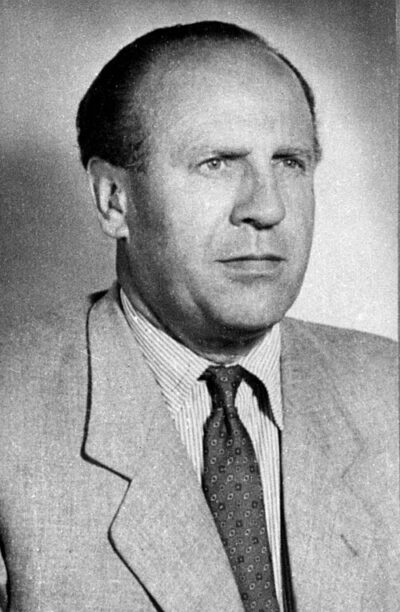
Oskar Schindler
Oskar Schindler was a German industrialist and Holocaust rescuer. Born April 28, 1908, in Svitavy. Died October 9, 1974, in Hildesheim. Awards include Righteous Among the Nations, Order of St. Sylvester and Officer's Cross of the Order of Merit of the Federal Republic of Germany.
Facts
26 facts · 2 confirmed by two sources · 8 cited · 16 from one source
Where this comes from
Papalocal keeps its own record. It started from these sources; what each one said is kept here as it was copied, so a change on their side never changes this page by itself. Tap one to read its version.
What Wikidata says · copied November 16, 2026 · revision 2569137638
- Described as
- German industrialist and Holocaust rescuer (1908–1974)
- Born
- April 28, 1908 · 9 references
- Died
- October 9, 1974 · 8 references
- Born in
- Svitavy · 1 reference
- Died in
- Hildesheim · 2 references
- Buried in
- Mount Zion
- Cause of death
- liver failure
- Citizen of
- Nazi Germany; West Germany · 1 reference
- Occupation
- entrepreneur · 1 reference; industrialist · 1 reference; salesperson; businessperson; resistance fighter; factory owner · 1 reference
- Political party
- Nazi Party (1939–) · 1 reference; Sudeten German Party
- Awards
- Righteous Among the Nations (1993) · 1 reference; Order of St. Sylvester (1968); Officer's Cross of the Order of Merit of the Federal Republic of Germany (1965) · 1 reference; Jan Karski Courage to Care Award; Order of St. Gregory the Great
- Spouse
- Emilie Schindler
- Religion
- lapsed Catholic; Latin Church · 1 reference
- Lived in
- Regensburg · 1 reference
- Website
- https://www.oskarschindler.com
- Wikipedias with a page
- 82
Wikidata item Q60029 (wikidata.org/wiki/Q60029), public domain (CC0). Copied November 16, 2026.
What Wikipedia says · copied November 16, 2026 · revision 1383247639
Oskar Schindler (German: [ˈɔskaʁ ˈʃɪndlɐ] ; 28 April 1908 – 9 October 1974) was a German industrialist and humanitarian who is credited with saving the lives of 1,200 Jews during the Holocaust by employing them in his enamelware and ammunitions factories in German-occupied Poland and the Protectorate of Bohemia and Moravia. He is the subject of the 1982 novel Schindler's Ark and its 1993 film adaptation, Schindler's List.
Schindler grew up in Zwittau, Moravia, and worked in several trades until he joined the Abwehr, the military intelligence service of Nazi Germany, in 1936. Before the beginning of the German occupation of Czechoslovakia in 1938, he collected information on railways and troop movements for the German government. He was arrested for espionage by the Czechoslovak government but was released under the terms of the Munich Agreement that year. He continued to collect information for the Nazis, working in Poland in 1939 before the invasion of Poland at the start of the Second World War. He joined the Nazi Party in 1939. That same year, he acquired an enamelware factory in Kraków, Poland, which employed at its peak in 1944 about 1,750 workers, of whom 1,000 were Jews. His Abwehr connections helped him protect his Jewish workers from deportation and death in the Nazi concentration camps. As time went on, he had to give Nazi officials ever larger bribes and gifts of luxury items obtainable only on the black market to keep his workers safe.
By July 1944, Germany was losing the war; the Schutzstaffel (SS) began closing down the easternmost concentration camps and deporting the remaining prisoners westward. Many were murdered at the Auschwitz concentration camp and the Gross-Rosen concentration camp. Schindler convinced Amon Göth, SS-Hauptsturmführer commandant of the nearby Kraków-Płaszów concentration camp, to allow him to move his factory to Brněnec (German: Brünnlitz, Czech: Brněnec) in the Protectorate of Bohemia and Moravia, thus sparing his workers from almost certain death in the gas chambers of Auschwitz. Using names provided by a Jewish Ghetto Police officer named Marcel Goldberg, Göth's secretary Mietek Pemper compiled and typed the list of 1,200 Jews who travelled to Brünnlitz in October 1944. Schindler continued to bribe SS officials to prevent his workers' execution until the end of the Second World War in Europe in May 1945, by which time he had spent his entire fortune on bribes and black market purchases of supplies for his workers.
Schindler moved to West Germany after the war, where he was supported financially by Jewish relief organisations. After receiving a partial reimbursement for his wartime expenses, he moved with his wife, Emilie, to Argentina, where they took up farming. When they went bankrupt in 1958, Schindler left his wife and returned to Germany, where he failed at several business ventures and relied on financial support from Schindlerjuden ("Schindler Jews")—the people whose lives he had saved during the war. He died on 9 October 1974 in Hildesheim, Germany, and was buried in Jerusalem on Mount Zion, the only former member of the Nazi Party to be honoured in this way. Oskar and Emilie Schindler were named Righteous Among the Nations by Yad Vashem in 1993.
- Born, in its opening lines
- April 28, 1908
- Died, in its opening lines
- October 9, 1974
From the Wikipedia article “Oskar Schindler” (en.wikipedia.org/wiki/Oskar_Schindler), by its contributors, under CC BY-SA 4.0 (creativecommons.org/licenses/by-sa/4.0/). Copied November 16, 2026; not changed.
Confirmed Two sources agree. Cited One source, and it names where it got it. One source One source, without a reference of its own. Sources disagree The sources disagree. We show the best-supported value and keep theirs below.
