
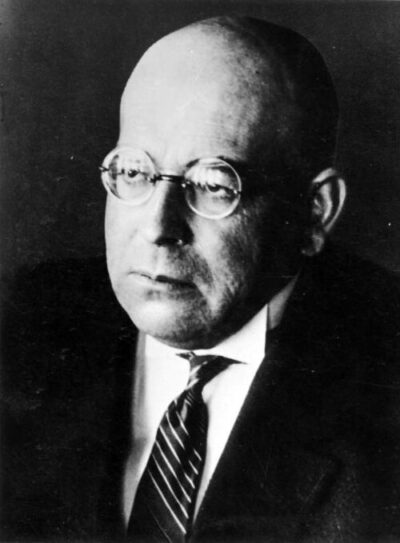
Oswald Spengler
Oswald Spengler was a German historian and philosopher. Born May 29, 1880, in Blankenburg. Died May 8, 1936, in Munich. Known for The Decline of the West. Educated at Martin Luther University Halle-Wittenberg and Humboldt-Universität zu Berlin.
Facts
21 facts · 2 confirmed by two sources · 8 cited · 11 from one source
Where this comes from
Papalocal keeps its own record. It started from these sources; what each one said is kept here as it was copied, so a change on their side never changes this page by itself. Tap one to read its version.
What Wikidata says · copied November 16, 2026 · revision 2569028512
- Described as
- German historian and philosopher (1880-1936)
- Other names
- Oswald Arnold Gottfried Spengler, Oswald Gottfried Spengler
- Born
- May 29, 1880 · 11 references
- Died
- May 8, 1936 · 12 references
- Born in
- Blankenburg · 2 references
- Died in
- Munich · 3 references
- Buried in
- Nordfriedhof
- Cause of death
- heart failure
- Citizen of
- Germany
- Occupation
- historian · 1 reference; philosopher · 2 references; sociologist; mathematician; writer · 1 reference; philologist · 1 reference; opinion journalist · 1 reference; philosopher of culture · 1 reference
- Education
- Martin Luther University Halle-Wittenberg; Humboldt-Universität zu Berlin; LMU Munich
- Known for
- The Decline of the West
- Father
- Bernhard Spengler
- Mother
- Pauline Grantzow
- Wikipedias with a page
- 90
Wikidata item Q57112 (wikidata.org/wiki/Q57112), public domain (CC0). Copied November 16, 2026.
What Wikipedia says · copied November 16, 2026 · revision 1384605967
Oswald Arnold Gottfried Spengler (29 May 1880 – 8 May 1936) was a German polymath whose areas of interest included history, philosophy, mathematics, science, and art, as well as their relation to his organic theory of history. He is best known for his two-volume work The Decline of the West (Der Untergang des Abendlandes), published in 1918 and 1922, covering human history. Spengler's model of history postulates that human cultures and civilizations are akin to biological entities, each with a limited, predictable, and deterministic lifespan. He predicted that Western civilization would enter the period of pre‑death emergency around the year 2000, which would lead to 200 years of Caesarism (extra-constitutional omnipotence of the executive branch of government) before Western civilization's final collapse.
Spengler is regarded as a German nationalist and a critic of republicanism. He was a prominent member of the Weimar-era Conservative Revolution. While the Nazis had viewed his writings as a means to provide a "respectable pedigree" to their ideology, Spengler criticized Nazism for its racialist and antisemitic elements, and he came to be considered a persona non grata by the Nazi regime. He saw Benito Mussolini and entrepreneurial types, such as the mining magnate Cecil Rhodes, as examples of the impending Caesars of Western culture—later expressing disappointment in Mussolini's colonialist adventurism.
- Born, in its opening lines
- May 29, 1880
- Died, in its opening lines
- May 8, 1936
From the Wikipedia article “Oswald Spengler” (en.wikipedia.org/wiki/Oswald_Spengler), by its contributors, under CC BY-SA 4.0 (creativecommons.org/licenses/by-sa/4.0/). Copied November 16, 2026; not changed.
Confirmed Two sources agree. Cited One source, and it names where it got it. One source One source, without a reference of its own. Sources disagree The sources disagree. We show the best-supported value and keep theirs below.
