
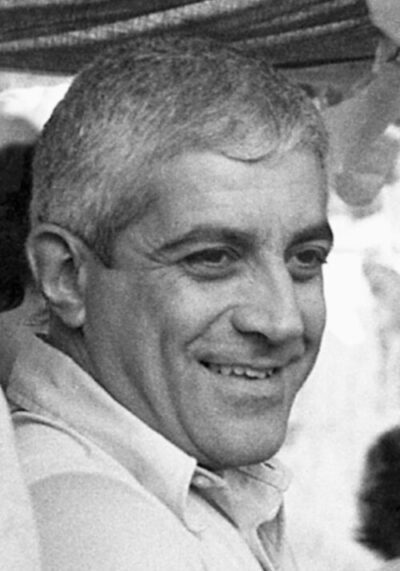
Otelo Saraiva de Carvalho
Otelo Saraiva de Carvalho was a Portuguese military and political. Born August 31, 1936, in Maputo. Died July 25, 2021, in Lisbon. Awards include Medal of Military Merit, Medalha de Comportamento Exemplar and Grand Cross of the Order of Liberty.
Facts
20 facts · 2 confirmed by two sources · 7 cited · 11 from one source
Where this comes from
Papalocal keeps its own record. It started from these sources; what each one said is kept here as it was copied, so a change on their side never changes this page by itself. Tap one to read its version.
What Wikidata says · copied November 18, 2026 · revision 2567370416
- Described as
- Portuguese military and political (1936-2021)
- Other names
- Otelo Nuno Romão Saraiva de Carvalho
- Born
- August 31, 1936 · 1 reference
- Died
- July 25, 2021 · 1 reference
- Born in
- Maputo · 1 reference
- Died in
- Lisbon · 1 reference
- Citizen of
- Portugal
- Occupation
- politician; military personnel; terrorist · 1 reference; revolutionary
- Political party
- Popular Unity Force
- Member of
- Popular Forces 25 April · 1 reference; Associação José Afonso · 1 reference
- Awards
- Medal of Military Merit; Medalha de Comportamento Exemplar; Grand Cross of the Order of Liberty · 1 reference
- Father
- Eduardo Saraiva de Carvalho
- Mother
- Fernanda Aurea Pegão Romão de Carvalho
- Military branch
- Portuguese Army · 1 reference
- Military rank
- Lieutenant Colonel; general · 1 reference
- Wikipedias with a page
- 23
Wikidata item Q1353499 (wikidata.org/wiki/Q1353499), public domain (CC0). Copied November 18, 2026.
What Wikipedia says · copied November 18, 2026 · revision 1380432409
Otelo Nuno Romão Saraiva de Carvalho, GCL (Portuguese pronunciation: [ɔˈtɛlu sɐˈɾajvɐ ðɨ kɐɾˈvaʎu]; 31 August 1936 – 25 July 2021) was a Portuguese military officer and revolutionary. He was the chief strategist of the 1974 Carnation Revolution, he was a key figure during the Ongoing Revolutionary Process (PREC) and later became accused of being a militant leader.
The Movement of Armed Forces (MFA) started with the Portuguese military serving in Portuguese Guinea including Otelo to gather hundreds of officials. The military coup against the 48 year old dictatorship was being prepared in Lisbon, but the coordinator was deployed to Azores by Estado Novo. Otelo stepped in as chief strategist. From the evening of 24 April 1974 to 26 April, he and his colleagues coordinated the military coup, which gathered strong popular support.
After the Revolution, Otelo assumed an influential role as the head of military defense force COPCON, alongside Portuguese Provisional Governments Prime-minister Vasco Gonçalves and President Francisco da Costa Gomes. His military force supported workers' claims against rural landowners, urban landlords, and employers, in contrast to the previous protection of Estado Novo to the latter. After 25 November 1975, he would be dismissed from his role.
In 1976, as a politician Otelo ran in the first Portuguese presidential election, in which he placed second with the base of his support coming from the far-left. The third would be José Pinheiro de Azevedo, Admiral and former provisional prime-minister, and Octávio Pato, candidate for the Communist Party. The winning candidate would be António Ramalho Eanes, also a military, that would win over Otelo again in December, 1980.
By then, Otelo had founded a new political party to work as an electoral front joining various political organisations in 1980: Força de Unidade Popular (FUP). The signature was filmed by the National Portuguese Television. However, FUP would be accused of being a political front for Forças Populares 25 de Abril and Otelo the leader of everything. He was tried and sentenced at lower courts, but the Constitutional Court reverted the sentence due to unconstitutionality.
To solve the impasse, the Portuguese Parliament voted an amnesty for political crimes in 1996 as there was no perspective of juridical solution in "useful time". Besides this reasoning, the amnesty was promoted by President Mário Soares as a gesture of democratic reconciliation as it erased the political crimes by far left and far right. He was further trialled for the assassinations, but was acquitted in 2001 and 2003.
Thousands of persons paid respect at his funeral in 2021, including the president Marcelo Rebelo de Sousa, the prime-minister António Costa and the president of the parliament Eduardo Ferro Rodrigues. At the time, the parliament highlighted his role in April 1974 as a "liberator of Portugal" given his major role in the preparation of the Carnation Revolution.
- Born, in its opening lines
- August 31, 1936
- Died, in its opening lines
- July 25, 2021
From the Wikipedia article “Otelo Saraiva de Carvalho” (en.wikipedia.org/wiki/Otelo_Saraiva_de_Carvalho), by its contributors, under CC BY-SA 4.0 (creativecommons.org/licenses/by-sa/4.0/). Copied November 18, 2026; not changed.
Confirmed Two sources agree. Cited One source, and it names where it got it. One source One source, without a reference of its own. Sources disagree The sources disagree. We show the best-supported value and keep theirs below.
