
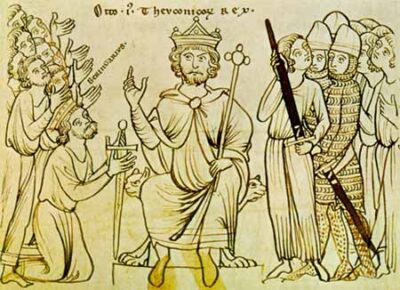
Otto I the Great
Otto I the Great was a Holy Roman Emperor from 962 to 973. Born November 23, 912, in Wallhausen. Died May 7, 973, in Memleben. Positions held include Holy Roman Emperor (962–973), King of East Francia (936–973) and Duke of Saxony (936–).
Facts
27 facts · 2 confirmed by two sources · 9 cited · 16 from one source
Where this comes from
Papalocal keeps its own record. It started from these sources; what each one said is kept here as it was copied, so a change on their side never changes this page by itself. Tap one to read its version.
What Wikidata says · copied November 16, 2026 · revision 2567483835
- Described as
- Holy Roman Emperor from 962 to 973
- Other names
- Otto I, Otto I Magnus, Otto I, Holy Roman Emperor, Otto the Great, Otto I 'the Great', Holy Roman Emperor (962-973), Otto Magnus
- Born
- November 23, 912 · 1 reference
- Died
- May 7, 973 · 1 reference
- Born in
- Wallhausen · 1 reference
- Died in
- Memleben · 1 reference
- Buried in
- Cathedral of Magdeburg
- Citizen of
- Holy Roman Empire
- Occupation
- ruler
- Positions held
- Holy Roman Emperor (962–973); King of East Francia (936–973); Duke of Saxony (936–); Monarch of Italy (951–)
- Spouse
- Eadgyth (929–946) · 2 references; Adelaide of Italy (951–) · 1 reference
- Children
- Liutgarde; Liudolf, Duke of Swabia · 1 reference; Matilda, Abbess of Quedlinburg; Otto II · 1 reference; William, Archbishop of Mainz; Richlind · 1 reference
- Father
- Henry I the Fowler · 1 reference
- Mother
- Matilda of Ringelheim · 1 reference
- Siblings
- Hedwig of Saxony; Gerberga of Saxony; Thankmar; Henry I; Bruno the Great
- Height
- 1.80 m (5 ft 11 in) · 1 reference
- Wikipedias with a page
- 91
Wikidata item Q43915 (wikidata.org/wiki/Q43915), public domain (CC0). Copied November 16, 2026.
What Wikipedia says · copied November 16, 2026 · revision 1383733910
Otto I (23 November 912 – 7 May 973), known as Otto the Great (German: Otto der Große; Italian: Ottone il Grande) or Otto of Saxony (German: Otto von Sachsen; Italian: Ottone di Sassonia), was an East Frankish (German) king from 936 and Holy Roman Emperor from 962 until his death in 973. He was the eldest son of Henry the Fowler and Matilda of Ringelheim.
Otto inherited the Duchy of Saxony and the kingship of the Germans upon his father's death in 936. He continued his father's work of unifying all German tribes into a single kingdom and greatly expanded the king's powers at the expense of the aristocracy. Through strategic marriages and personal appointments, Otto installed members of his family in the kingdom's most important duchies. This reduced the various dukes, who had previously been co-equals with the king, to royal subjects under his authority. Otto transformed the church in Germany to strengthen royal authority and subjected its clergy to his personal control.
After putting down a brief civil war among the rebellious duchies, Otto defeated the Magyars at the Battle of Lechfeld in 955, thus ending the Hungarian invasions of Western Europe. The victory against the pagan Magyars earned Otto a reputation as a savior of Christendom and secured his hold over the kingdom. By 961, Otto had conquered the Kingdom of Italy. Following the example of Charlemagne's coronation as "Emperor of the Romans" in 800, Otto was crowned emperor in 962 by Pope John XII in Rome.
Otto's later years were marked by conflicts with the papacy and struggles to stabilize his rule over Italy. Reigning from Rome, Otto sought to improve relations with the Byzantine Empire, which opposed his claim to emperorship and his realm's further expansion to the south. To resolve this conflict, the Byzantine princess Theophanu married his son Otto II in April 972. Otto finally returned to Germany in August 972 and died at Memleben in May 973. Otto II succeeded him.
Otto has been consistently depicted in historiography through different eras as a successful ruler. He is also reputed to be a great military commander, especially on the strategic level – this also means that the empire this talent recreated was too vast for contemporary administrative structures and could only be governed as a confederacy. Modern historians, while not denying his strong character and his many fruitful initiatives, explore the emperor's capability as a consensus builder – a process that goes in parallel with greater recognition of the nature of consensus politics in medieval Europe (especially Western and Central parts) as well as different roles played by other actors in his time.
Historian David Bachrach notes the role of the bureaucracy and administration apparatus which the Ottonians inherited from the Carolingians and ultimately from the Ancient Romans, and which they developed greatly themselves: "It was the success of the Ottonians in molding the raw materials bequeathed to them into a formidable military machine that made possible the establishment of Germany as the preeminent kingdom in Europe from the tenth through the mid-thirteenth century." Bachrach highlights in particular the achievements of the first two Ottonian rulers, Henry I and Otto the Great in creating this situation. Their rules also marked the start of new, vigorous literary traditions. The patronage of Otto and his immediate successors facilitated a so-called "Ottonian Renaissance" of arts and architecture. As one of the most notable Holy Roman emperors, Otto's footprint in artistic depictions is also considerable.
- Born, in its opening lines
- November 23, 912
- Died, in its opening lines
- May 7, 973
From the Wikipedia article “Otto the Great” (en.wikipedia.org/wiki/Otto_the_Great), by its contributors, under CC BY-SA 4.0 (creativecommons.org/licenses/by-sa/4.0/). Copied November 16, 2026; not changed.
Confirmed Two sources agree. Cited One source, and it names where it got it. One source One source, without a reference of its own. Sources disagree The sources disagree. We show the best-supported value and keep theirs below.
